
Snowflake unveils always-on AI bots—but the headline feature has not launched yet
Snowflake's November 3 announcement puts CoCo, CoWork and a vision of persistent AI coworkers under one banner. Yet the important footnote is easy to miss: the new always-on Bots are marked 'private preview soon'. Existing GA automations and preview integrations are different products with different readiness and governance implications.

Snowflake's November 3 announcement puts CoCo, CoWork and a vision of persistent AI coworkers under one banner. Yet the important footnote is easy to miss: the new always-on Bots are marked 'private preview soon'. Existing GA automations and preview integrations are different products with different readiness and governance implications.
Sources and limitations
- Dated primary source
Original announcement dated November 3, 2026: Snowflake – Read original.
- No independent field test
Vendor claims and editorial inferences are separate. No independent agent run, pricing test, security evaluation or performance benchmark has been performed.
From answering questions to owning long-running goals
At Expedition 2026, Snowflake presented a shift from conversational assistance to ongoing work on governed enterprise data. CoCo supports data and development teams, while CoWork serves knowledge workers. Scheduled jobs can run without a person constantly watching; the announced Bots are designed to pursue higher-level goals across days or weeks and interrupt the user mainly when a decision or approval is needed.
The distinction is central to this story. The company labels its new always-on CoCo and CoWork Bots as “private preview soon”. That means the most ambitious feature is not generally available today. Treating a future private-preview program as a fully shipped autonomous employee would confuse a roadmap with actual product maturity.
What is available, what is preview, and what is still future
Snowflake’s release footnotes give different readiness levels to the individual capabilities. CoCo Automations, the Async Agent API and skill/plugin sharing are identified as generally available. CoWork Profiles and several Slack, spreadsheet and mobile integrations are public preview. The proactive CoCo and CoWork Bots sit a further step back: private preview is planned, not yet in place.
These distinctions create practical boundaries for rollout. A team can evaluate a scheduled CoCo job today and capture its execution history. It cannot reasonably claim to have production-tested the new goal-owning Bots if access has not been delivered. Product notes and feature-specific access terms should be part of every purchasing and architecture review.
Whose authority survives after the user logs off?
Snowflake says Bots are designed to inherit user permissions and role context. Admin-configured CoWork Profiles are intended to control agents, skills and connectors that a role can access; CoCo Cloud Agents operate in managed sandboxes. Proposed Git changes can still pass through existing pull-request review rather than silently entering a production branch. These are meaningful design claims, not independently verified guarantees.
A responsible authorization should specify more than permission to start. It should describe datasets, tool boundaries, write privileges, time limits and accountable owners. Longer-running goals create a second issue: the user’s initial business assumption may change while the automation keeps working. Reauthorization and expiry are therefore essential operating decisions, even when a platform enforces standard data permissions.
A pipeline example separates scheduled work from autonomy
Consider a daily check of an unreliable data pipeline. A CoCo Automation can execute a scheduled diagnosis and prepare a candidate correction that engineers review before production. A proposed goal-driven Bot would instead take on a broader objective such as keeping the pipeline healthy, planning follow-ups and asking for approval at selected decisions.
This is a comparison of architectural patterns, not a reproduced Snowflake deployment. AgentenCode has not run a CoCo job or tested a Bot. A successful real-world evaluation needs an agreed target state, trusted data lineage, defined human sign-off and a measurable stopping condition. Without them, more autonomous steps might simply make a mistaken assumption persist longer.
Our five-case availability and approval matrix
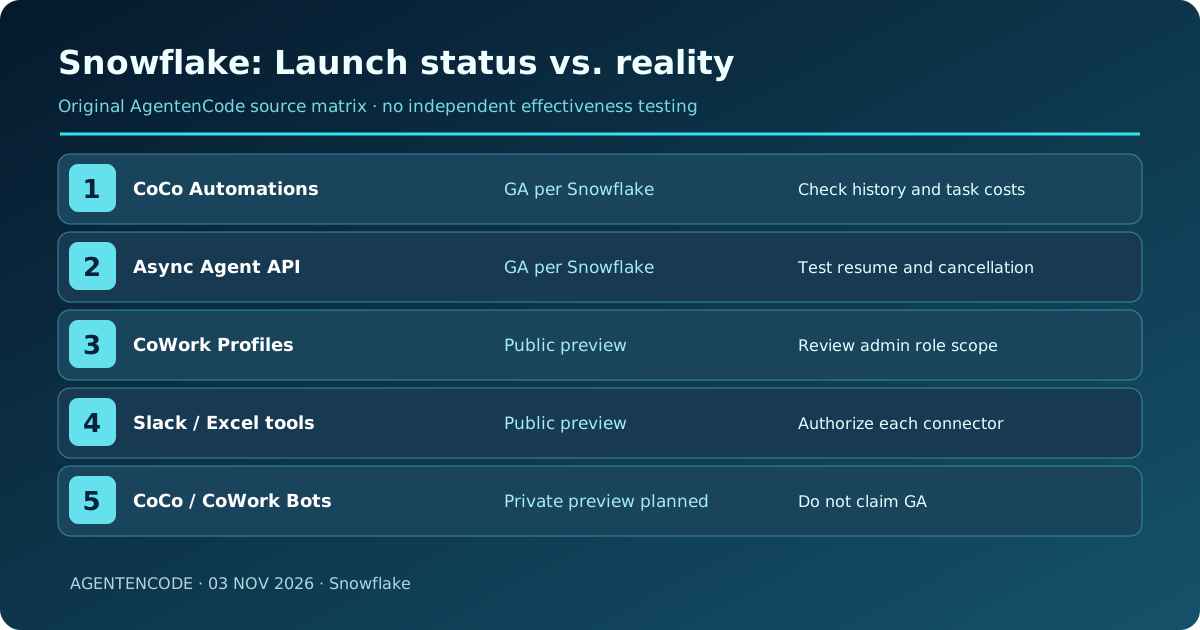
The following matrix is AgentenCode’s original interpretation of Snowflake’s dated footnotes, mapping each capability to its stated status and the minimum operational check before adoption. It is not a vendor-independent benchmark and should not be used to claim that a preview feature has passed a security audit.
The core finding is that “automations are GA” and “always-on Bots are not yet in private preview” are both true. They describe different levels of delegation. Procurement, governance and measurement should target the specific component that an organization can actually use.
| Case | Source status | Acceptance gate |
|---|---|---|
| CoCo Automations | GA per Snowflake | Check history and task costs |
| Async Agent API | GA per Snowflake | Test resume and cancellation |
| CoWork Profiles | Public preview | Review admin role scope |
| Slack / Excel tools | Public preview | Authorize each connector |
| CoCo / CoWork Bots | Private preview planned | Do not claim GA |
Cost control and an evidence-based pilot
A recurring AI workflow can multiply model requests, retries and underlying data-platform task consumption. Snowflake describes model-tiering and routing capabilities, each with feature-specific release status, but no universal savings number should be inferred for a customer. A pilot should track weekly job count, token usage, Snowflake task charges, error retries and human rework per delivered report.
Begin with read-only scheduled pipeline reporting on synthetic or non-sensitive data. Verify run logs, permission boundaries, interruption recovery and a clear owner before introducing tightly scoped write actions. The forthcoming Bots should remain a future evaluation item rather than a fictional completed test.
Verdict: an important direction, not a blanket production promise
Snowflake’s product direction ties together governed data, coding tools, work assistants and permissions in a way that could be operationally valuable. But value comes from bounded workflows whose outputs and actions can be inspected, not from an impressive “always-on” label.
Our conclusion is that available automations warrant controlled experimentation now, while proactive Bots merit attention once the planned private preview actually opens. The honest boundary is between a documented capability available today and an autonomy claim that still requires rollout and empirical proof.
Original sources
Frequently asked questions
Can enterprises use the new always-on Bots today?
Not as a generally available feature. Snowflake marks the proactive Bots “private preview soon” in its November 3 announcement.
Are CoCo Automations and CoCo/CoWork Bots the same?
No. CoCo Automations are a separate GA-listed scheduling capability; the goal-owning Bots are still planned for private preview.
Does governed Snowflake data guarantee safe and cheap autonomous agents?
No. Vendor safeguards need configuration-specific validation of permissions, action scope, token spend and operational outcomes.