
BeyondTrust AI Agent Security GA: Less privilege for autonomous actions
BeyondTrust's new AI Agent Security module is generally available on Pathfinder for Windows and macOS. Its key design choice is to authorize agent actions separately from human privileges.
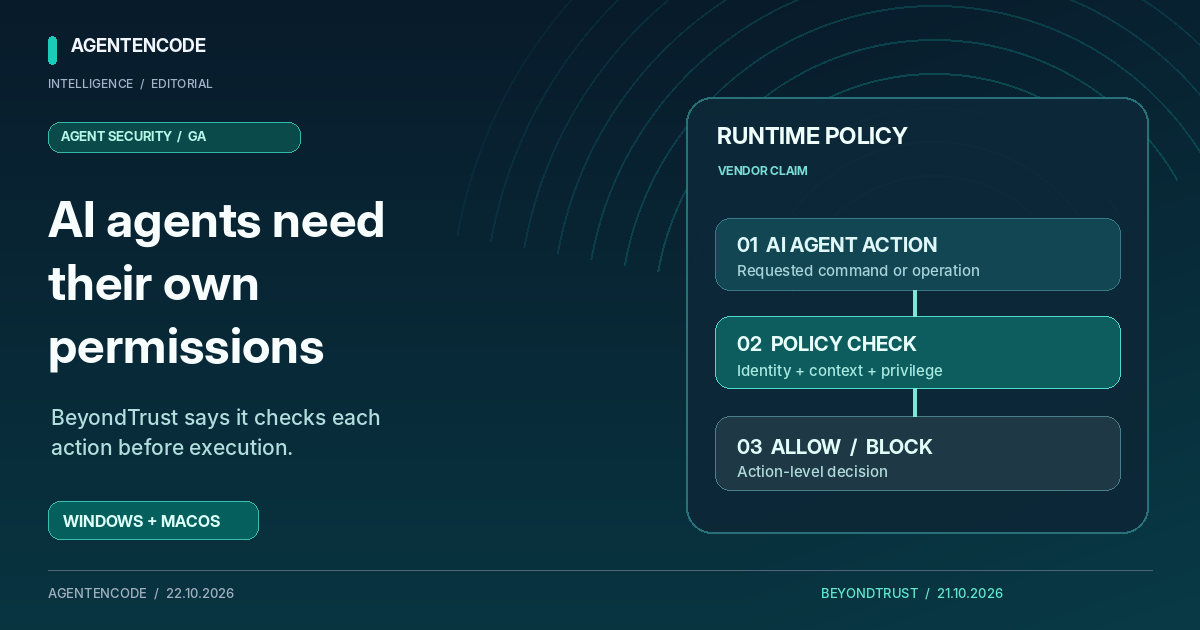
BeyondTrust announced general availability of AI Agent Security on October 21, 2026, for Windows and macOS endpoints on its Pathfinder Platform. Endpoint Privilege Management is a required dependency. The vendor says policies can evaluate individual agent actions before execution.
CLAIM-LEVEL EVIDENCE
What is sourced and what remains open
Separate official records, vendor claims and unresolved questions.
- Primary source
General availability announced
BeyondTrust reports GA for Windows and macOS on Pathfinder on October 21.
Source: BeyondTrust – AI Agent Security general availability ↗
- Vendor claim
Policy enforcement before actions
The vendor's product guide describes action-level runtime control and approval.
Source: BeyondTrust – AI Agent Security product and requirements ↗
- Vendor research
1.28 million requested shell commands
Early customer telemetry counts requests, not proven execution or compromise.
Source: BeyondTrust – AI Agent Security general availability ↗
- Open question
Independent protection and full coverage
No neutral bypass test or universal cloud-agent coverage is established.
Source: BeyondTrust – AI Agent Security product and requirements ↗
First-party source is not an independent effectiveness test. Methodology →
Why an employee's privileges should not become an agent's privileges
A developer may legitimately install tools, modify repositories and access production systems. A coding agent launched under that same identity should not automatically inherit the authority to make every possible decision on the developer's behalf. BeyondTrust announced general availability of AI Agent Security on October 21 to address this distinction. Rather than treating an AI assistant as just another process owned by a trusted person, its system is designed to attribute agent-driven activity and apply separate policy to those actions. This is a shift from general user authentication toward granular authorization at execution time, especially for workflows that chain tools without explicit instructions for every step.
What runtime enforcement is designed to do
The vendor describes agent discovery, activity attribution, process and network controls, credential protection, session audit records and policy simulation. A sensitive command could require approval, while an employee retains the corresponding direct human permission. Pre-execution controls potentially address a different problem from alerts delivered after an unsafe operation completes. Product availability still has boundaries: the October release identifies Windows and macOS endpoints on Pathfinder, and the product page explicitly requires Endpoint Privilege Management. It does not prove complete coverage for remote browser agents, hosted runtimes, mobile devices or all Linux environments. Enterprises should map the actual enforcement point to each agent's execution location.
1.28 million commands: the important methodological caveat
BeyondTrust also released telemetry collected by Phantom Labs from early customer samples. Over four weeks, the vendor counted around 1.28 million shell commands requested by AI coding agents across approximately 132,000 prompts, or nearly ten requests per prompt. This is not the number of successfully executed commands and certainly not a count of hostile actions. The sample is provider-specific, with unknown representativeness across sectors and software. The useful observation is narrower: auditing only a user's prompt will miss the sequence of downstream tool requests that determine the real operational blast radius.
MCP servers and repository skills extend the attack surface
The company reports that 85 percent of observed coding-agent users had at least one configured MCP server, with a mean of 4.35 unique servers per connected user. Those figures concern its observed endpoint population, not all users globally. MCP tools can make agents useful by connecting services, but every connection adds permission scopes and content that may influence the agent. Repository-distributed skills can contain code as well as instructions. An organization needs an inventory of actual server origins, credential scope, permissions and trust boundaries. Security claims should not conflate a large attack surface with observed exploitation or prove a protection product's effectiveness from vendor telemetry.
A practical enterprise acceptance test
A useful pilot includes deliberately forbidden operations. Can the agent reach a production host while the human operator can? Can it open a sensitive key, run an elevated command or connect to an unapproved MCP server? What gets recorded, when is human approval requested and how can permissions be revoked without disrupting legitimate work? Test across the exact Windows and macOS builds, the actual agent runtime and the organization's identity configuration. Then evaluate coverage gaps, overhead, false approvals and rollback. AgentenCode considers action-scoped privilege enforcement a compelling security principle, but the vendor announcement and observational sample are not independent proof of complete protection.
EDITORIAL ASSESSMENT · NO INDEPENDENT TEST
AgentenCode perspective
The practical security boundary is the individual agent action, not just the employee identity. The release reflects a meaningful direction for AI governance, while enterprise buyers still need their own bypass tests and scope-specific evidence.
Original sources
- BeyondTrust – AI Agent Security general availability ↗
- BeyondTrust – AI Agent Security product and requirements ↗
- BeyondTrust – AI Agent Security endpoint documentation ↗
Source publications: October 21, 2026. Article reviewed: October 22, 2026.
Frequently asked questions
Is BeyondTrust AI Agent Security generally available?
The vendor says it is available on Pathfinder for Windows and macOS, subject to product requirements.
Is Endpoint Privilege Management required?
Yes. BeyondTrust lists it as a dependency on the Pathfinder platform.
Were 1.28 million malicious commands detected?
No. The vendor reports agent-requested shell commands from a limited sample, not confirmed malicious executions.