
ThisBash: How browser extensions could command Claude Desktop
A desktop AI agent can read files, run software and work inside enterprise systems. But how does it know that an instruction truly came from the authorized person? ThisBash Escape, research published by Gal Weizman of Forever Security, shows a revealing failure mode: an extension with sufficient access to a logged-in Claude web session could use the former Claude Dispatch workflow to send commands to Claude Desktop. In the researchers' controlled demonstration, the desktop agent executed code, including when the browser and target desktop were on different computers.
What the researchers demonstrated
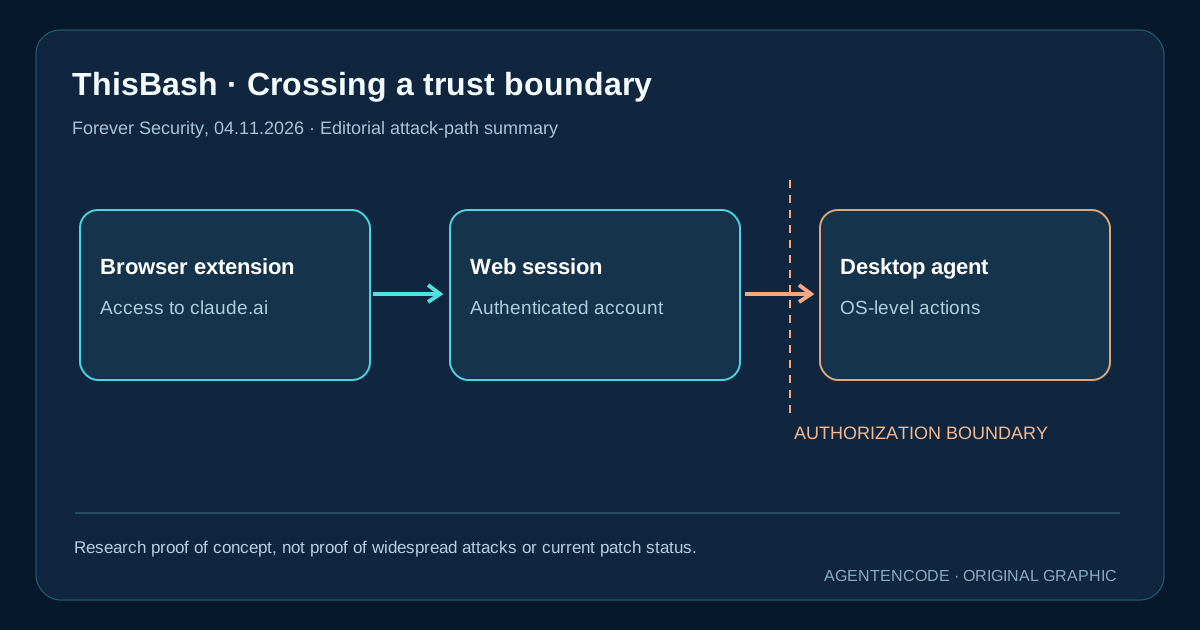
The report was published November 4, 2026. The issue had been submitted to Anthropic on May 14, 2026. The researchers found that Dispatch functionality was reachable from an ordinary authenticated web session, despite appearing to be confined to the desktop application. A browser extension authorized to interact with claude.ai could then cause instructions to reach the desktop agent as though they came from the legitimate user.
In a proof of concept, the researchers controlled a sequence of instructions and approvals. The demonstration ended by causing a benign program to launch Calculator. That shows an execution path; it is not evidence of widespread real-world data theft. We deliberately focus on the authorization failure and defenses rather than reproducing the exploit chain or instructions.
Three layers and a missing independent authorization step
| Layer | Role in the research | Unsafe assumption |
|---|---|---|
| Browser extension | Can act on claude.ai with sufficient site access | Website permission cannot influence the OS |
| Authenticated web session | Presents agent instructions | Logged-in user necessarily approved this action |
| Desktop agent | Executes actions with granted local permissions | Web-sourced command is authorized |
| Cross-device link | Connects browser to another computer | Browser and desktop risks stay isolated |
This is not only a story about a model accepting a suspicious prompt. In the demonstration, the attacker controlled a channel the system treated as a user instruction. A model may sometimes reject an unsafe request, but model hesitation is no substitute for authorization enforced outside the model.
Why this exceeds ordinary browser-extension risk
Extensions already represent a sensitive access surface. But website access should not automatically authorize shell commands or local file operations on a different device. That escalation is what makes ThisBash significant. The researcher describes a particularly concerning situation: a personal browser and corporate desktop signed into the same assistant account, letting a weaker environment potentially steer a higher-privilege agent.
The failure mode is an architectural trust-boundary issue in connected assistants, not evidence that every remote-agent product has exactly the same problem. The relevant question for any system is whether privileged local actions require a fresh authorization signal that cannot be forged from the compromised browser session.
The status question must not be guessed
Forever Security describes an issue acknowledged in May and a planned Dispatch retirement by the end of October. The Register reported on November 5 that an Anthropic help page still listed Dispatch as a limited beta for existing users as of October 30. We have not reproduced the current product status, patch behavior or all connected-session variants on November 8.
We therefore do not claim either that every present Claude setup is still vulnerable or that Anthropic has conclusively eliminated the design risk. The researcher's statements about Claude Code Remote Control and Cowork are attributed as researcher assessments, not independently confirmed exploitation of every currently distributed version.
Original AgentenCode risk matrix
| Configuration | Potential exposure | Practical control | Priority |
|---|---|---|---|
| Personal browser linked to work desktop | Weakened device isolation | Separate accounts and profiles; inspect sessions | High |
| Broad extension permissions | Larger command-input surface | Inventory extensions and restrict site access | High |
| Remotely controlled local code agent | OS-impacting actions | Disable or tightly limit remote execution | High |
| Agent with cloud or repository credentials | Higher consequence of compromise | Short-lived least-privilege tokens | High |
| Read-only assistant without local tools | Narrower potential impact | Document and enforce permission boundary | Medium |
This is an editorial defense matrix, not a vendor severity score or validated product configuration. Operators must verify current permissions, controls and versions in their own environments.
Security controls must sit outside the prompt
A safely operated desktop agent needs more than a system instruction telling it to be careful. Consequential actions should require genuinely independent local approval, not a click or authorization signal reproducible from the same compromised browser environment. Narrow tool permissions, separate device identities, privileged-action logging, authenticated device binding and a quick disconnect path are equally important.
Reasonable immediate steps include reviewing browser extensions with access to AI sites, narrowing unnecessary host permissions, separating personal and corporate sessions, restricting remote-control features on sensitive endpoints until assessed, and inspecting anomalous agent actions and token use. These are broad preventive measures, not substitutes for a verified vendor fix.
What ThisBash teaches about the agent economy
The research should shift attention from prompt injection alone toward action authorization across browser, cloud and OS boundaries. A language model can reject some harmful text while still receiving instructions through an untrustworthy path. The lasting moat for trustworthy assistants is strong identity, sandbox and permission architecture—not simply claiming that an LLM will always spot manipulation.
FAQ
Can any browser extension command Claude Desktop? No. The demonstrated setup required sufficient site permission, a logged-in session and a reachable linked desktop.
Did the proof of concept prove data theft at scale? No. It demonstrated a local code-execution path by opening Calculator; there is no established large-scale attack campaign in the cited sources.
Is ThisBash definitely unpatched on November 8? AgentenCode has not independently confirmed today's retirement or fix state. Operators should verify the current vendor guidance and their actual enabled features.
Can better prompts alone prevent this? Not reliably. Independent authorization and restricted local permissions are the essential controls.
Are other Claude features proven affected? The researcher describes similar trust risks involving Remote Control and Cowork; we did not independently test all current variants.
Conclusion: A web login is not permission to run an OS command
ThisBash illustrates a crucial rule for connected AI agents: Authentication establishes a session identity; it does not prove that a particular privileged local action was independently authorized. Enterprise agent policies need to enforce that distinction beyond model-level safety instructions.
Sources and evidence limits
- Primary research: Forever Security / Gal Weizman, “ThisBash Escape,” November 4, 2026.
- Independent status reporting: The Register, November 5, 2026, including the October 30 limited-beta status.
- Transparency: No independent exploit replication, current patch verification or observed victim-count evidence. The risk matrix and operational analysis are original AgentenCode work. Reviewed November 8, 2026.
Sources and limitations
- Forever Security original research, November 4 2026
- The Register, independent status reporting, November 5 2026
Independent editorial interpretation of cited sources. No independent product/security/cost test or unverified claim about current patch or feature status.