
NVIDIA hits $115.8 billion in quarterly sales as Vera Rubin AI systems begin shipping
NVIDIA reports $115.8 billion in quarterly revenue, up 103% year on year, as Vera Rubin NVL72 ships. What the AI infrastructure boom really means.

A quarterly result reveals the scale of AI infrastructure
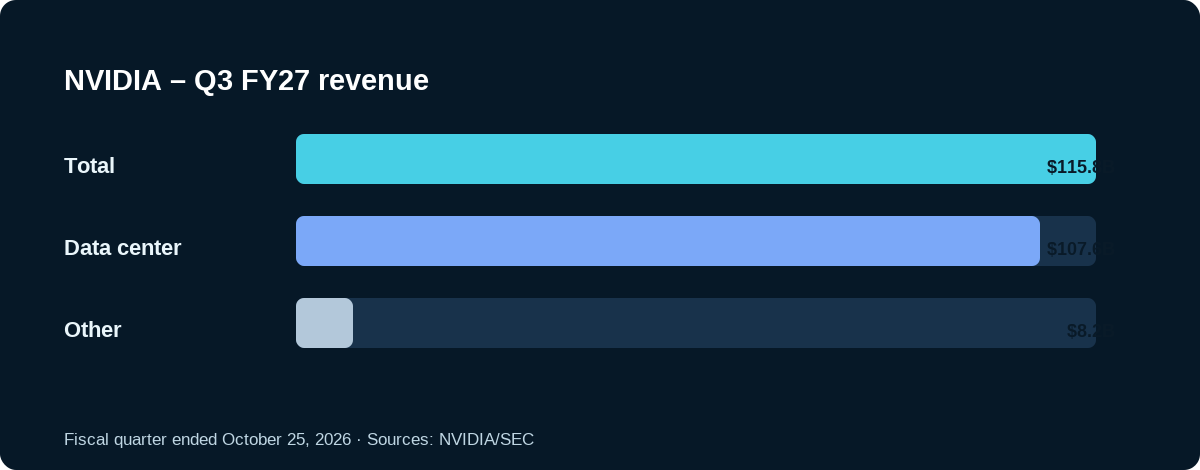
On November 17, 2026, NVIDIA reported $115.8 billion in revenue for the third quarter of fiscal 2027, which ended October 25. Revenue was 103% higher year over year and 20% above the previous quarter, according to the company's official earnings release. The scale is striking because the company largely sells the computing infrastructure behind AI services rather than consumer chatbot subscriptions.
Training models and running digital agents requires processors, networks, storage and optimized software. Those investments show up in NVIDIA's sales long before the end user sees a response on a screen. The results establish strong realized demand for the company's products. They do not demonstrate that every purchaser will earn an attractive return on its AI spending.
Data centers dominate the result
NVIDIA's data-center segment generated $107.6 billion, up 110% over the same period last year and 21% sequentially. That represents roughly 93% of the company's total quarterly revenue. These are reported financial numbers, not extrapolations about how many consumers now use AI assistants.
AI data centers need more than GPUs. Networking and rack-scale system design are vital for linking accelerated computers and delivering acceptable throughput. The economics of AI therefore begin with infrastructure utilization, electricity and capital expenditure. Low prices for a single API call do not fully capture the cost of building or operating the underlying platform.
Vera Rubin NVL72 shipments have started
The company says it has ramped production and started shipping Vera Rubin NVL72. NVIDIA describes this as its fastest product ramp. It lists partners with systems already running, including CoreWeave, Google Cloud, Microsoft Azure, Oracle Cloud Infrastructure and Nebius, while other deployments are expected to follow.
A shipment is not the same thing as broad, immediate access for every developer in every cloud region. Providers still need to install, qualify and allocate the systems. Vendor performance claims should likewise be assessed for each workload: a speed improvement in a defined benchmark cannot be converted into a guaranteed reduction in every model's price.
Why this matters for everyday AI
An assistant that summarizes a paragraph is relatively simple to run. More sophisticated services may review large document collections, execute numerous tool calls or continue work for hours. Each agentic workflow can consume many model requests. Improving the throughput and efficiency of the infrastructure may make such services practical at a larger scale.
Hardware alone does not make a system trustworthy, however. Agents still need strong models, valid data, permission controls and ways to recover from errors. Developers also need to avoid dependence on a single hardware ecosystem where switching costs, supply constraints or pricing changes could disrupt long-running applications.
The next-quarter guidance remains a forecast
NVIDIA guided to $126 billion to $134 billion in revenue for the fourth fiscal quarter, according to its release and contemporaneous Reuters coverage. Reuters reported that the midpoint was above the analyst consensus at the time. That outlook concerns a future period and is not an additional amount NVIDIA has already earned.
Fiscal calendars can be confusing: NVIDIA's third quarter of fiscal 2027 ended in October 2026. Mixing fiscal and calendar years can lead to false comparisons. A sound evaluation distinguishes historical results, expected future sales and speculative projections about the wider AI market.
Capacity, supply and the uncertainty behind the boom
Building more AI infrastructure requires chip production, specialized memory, complex packaging, networking gear and data-center capacity. NVIDIA's filings identify risks around supply, customer commitments, export rules, infrastructure development and expected benefits from new products. High quarterly demand does not eliminate the possibility of future bottlenecks.
Nor does it establish that every AI company will monetize its services successfully. Large capital programs can be rational during rapid growth and still disappoint if customer demand or efficiency evolves differently from forecasts. Financial statements measure products already sold; independent returns on customers' investment require separate evidence.
Leadership and competition add another dimension
The results were released during NVIDIA's leadership transition, with finance chief Colette Kress serving as interim CEO. Reuters highlighted management uncertainty among issues investors were weighing alongside demand forecasts. Customers ultimately need predictable delivery and support regardless of the executive transition.
At the same time, cloud providers and chip competitors continue pursuing alternative accelerators and in-house hardware. Their eventual effect on NVIDIA's position is uncertain. Enterprises planning substantial AI spending should compare total costs, compatibility and availability over several years instead of choosing infrastructure solely from one quarterly result.
AgentenCode assessment: the AI economy has a physical foundation
The central insight is that AI is now an infrastructure business as much as a software business. Agents cannot complete tasks without reliable computation behind them. NVIDIA currently captures a large share of the spending required to supply that computation, and Vera Rubin shipments show the next generation entering deployment.
For consumers and organizations, the meaningful long-term metric is cost per correct completed task, not simply the number of chips shipped. Our AI agent evaluations and benchmarks guide explains what to measure. Whether new hardware produces better access, lower prices and sustainable energy use depends on many factors beyond NVIDIA's sales. The reported results are strong evidence of current demand, not proof of unlimited future growth.
Frequently asked questions
How much revenue did NVIDIA report?
It reported $115.8 billion for its third quarter of fiscal 2027, ended October 25, 2026, up 103% year over year.
How much came from data centers?
The company reported $107.6 billion in data-center revenue, 110% above the year-earlier quarter.
Is Vera Rubin NVL72 already shipping?
Yes, according to NVIDIA. Availability for particular customers and cloud regions depends on the partners' deployment schedules.
Will this automatically make AI subscriptions cheaper?
No. Hardware efficiency matters, but model capabilities, utilization, software, distribution and vendor pricing determine the cost to users.
RESEARCH & CONTEXT
Sources for this article
This analysis relies on the original publications linked below, which readers can inspect directly.
- NVIDIA Investor Relations: NVIDIA Announces Financial Results for Third Quarter Fiscal 2027, 17.11.2026
- U.S. SEC: NVIDIA Form 8-K, financial release for third fiscal quarter 2027, 17.11.2026
- Reuters: Nvidia earnings beat estimates; investors weigh guidance and management, 17.11.2026
- NVIDIA Newsroom: Quarterly results and shipped Vera Rubin NVL72, 17.11.2026
Checked November 18, 2026. NVIDIA financials reflect company/SEC filings. Meta feature and safety claims are vendor descriptions; Reuters findings are attributed.
Related agents, systems and context
Product links identify the subject of a report; ecosystem links provide context, not shared feature claims.
- Background guideWhat is an AI agent?