
Claude Ship: AI agents review, fix and approve code — who controls the merge?
Claude Ship links AI Code Review, PR Steward and policy approvals. We examine GitHub safeguards, costs, availability and risks.
Key takeaway
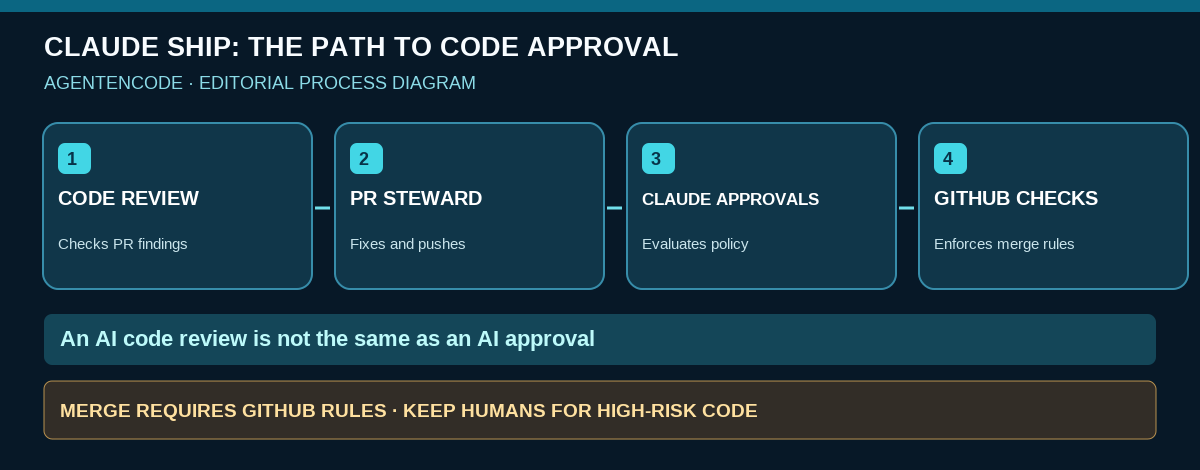
Anthropic launched Claude Ship on November 23: a coordinated set of agents for GitHub pull requests. Code Review inspects diffs for bugs and security issues, PR Steward can push fixes for CI failures, conflicts and reviewer feedback, and Claude Approvals checks a repository's written policy to determine what approvals are still required. Under explicitly permissive rules, Claude can submit an approving review. Actual merges still depend on GitHub's configured branch rules and permissions.
Code Review is generally available; the new PR Steward and Claude Approvals features remain in public beta. Organization-wide Claude Ship currently targets Claude Team and Enterprise organizations with GitHub repositories. The launch does not document an equivalent native GitLab integration. Official product documentation.
The important shift is from AI-generated code to AI-influenced authorization of code changes.
Primary source: Anthropic — Introducing Claude Ship (23 Nov 2026)
The bottleneck moves downstream of code generation
AI coding agents can write patches, run local tests and open pull requests. That creates a new bottleneck: developers still need to read the diff, resolve comments, fix CI problems, handle merge conflicts and secure approvals.
Claude Ship attempts to automate that downstream chain. Anthropic's launch post emphasizes the time between opening a pull request and getting it ready to merge. TechCrunch identifies policy-based AI approval as the most consequential feature. Code review automation is not new; allowing an AI system to provide an approval that GitHub may count toward the merge decision is materially different.
AgentenCode assessment: Creating code and authorizing its acceptance are separate powers. Combining them can shorten routine work, but it raises the standard of independent evidence, traceable decisions and non-bypassable safeguards.
The three agents do different jobs
| Agent | Responsibility | What it does not guarantee |
|---|---|---|
| Code Review | Multiple agents inspect changes in context, verify candidate findings and post severity-ranked inline comments. | No findings do not mean the code is bug-free. Code Review alone neither approves nor blocks a merge. |
| PR Steward (beta) | Handles failing checks, certain review comments and merge conflicts; pushes new commits and reports what changed. | It is designed not to approve or merge. Some failures cannot safely be fixed automatically. |
| Claude Approvals (beta) | Reads .claude/approvals.yml to determine people required and whether Claude may submit an approving review. | Its status does not stop a merge unless GitHub requires the check. It is not an alternative to testing. |
Anthropic says Code Review uses a find, verify, rank and post sequence, with configurable Quick, Standard and Deep levels. The default emphasis is production-relevant correctness, not cosmetic style. Code Review docs.
PR Steward is an active writer. It may commit fixes in a cloud session while developers work elsewhere. Anthropic recommends starting in a manual @claude steward mode; a watched pull request can be stopped with @claude stop. Organizational PR Steward is not the same service as the developer's locally running /steward command. PR Steward docs.
Background reading: AI knowledge
Approval policies become release authority
A team expresses its decision rules in .claude/approvals.yml. Policies can match changed paths, require a defined number of reviewers and allow Claude approvals in scoped situations. More advanced conditions can use pull request facts and model-powered classifiers. Where multiple enforced rules apply, the stricter applicable verdict governs. Approvals policy reference.
A sensible editorial example — not a copy of any vendor-recommended configuration — is:
| Change type | Possible rule |
|---|---|
| Low-risk documentation | Automated review first; consider AI approval only after measured pilots |
| Minor internal interface bug | Required CI and a human check, or a narrowly justified pilot exception |
| Authentication, permissions, payments and secrets | Independent human specialist review plus mandatory security tests |
| CI workflows and the approval policy itself | Strong maintainer approval, no self-relaxing policy changes |
The novelty goes beyond path-only CODEOWNERS rules: a model classifier can influence the amount and type of approval required. Because such classifiers can be wrong, teams should not make them the only line of defense for sensitive code.
Four approval traps teams must test
A check does not enforce itself. Claude Approvals blocks merges only where the repository configures it as a required GitHub check; observe mode normally does not enforce decisions.
A seat does not always mean another human. Policies can count the pull request author toward a required seat. With one seat, a change may need no separate reviewer. With zero seats, a bot-authored pull request under auto-merge can proceed without human inspection. GitHub can also count a Claude approving review toward its own approval requirement.
An AI approval does not necessarily entail a code review. A policy that simply permits claude: approves does not automatically run Code Review. Conversely, adding an Approvals policy can unintentionally stop previously automatic Code Reviews unless applicable rules preserve claude/code_review, even in observe mode.
The policy itself is an attack surface. Someone able to merge a policy file into the default branch may be able to activate or weaken the mechanism, unless organization-level controls prevent it. Protect .claude/ and CI configuration as rigorously as production code. Anthropic: approvals and unaudited merges, GitHub safeguards.
AgentenCode assessment: Approval automation is trustworthy only if critical conditions are enforced outside the agent's discretion. Independent CI, strict branch protection, protected policy edits and genuinely independent human review for high-risk code remain necessary.
Local /ship is a separate workflow
The new /ship command in Claude Code can commit and push the developer's code, create a GitHub pull request, run /code-review and keep watching the PR for new comments, CI failures and conflicts. The watch runs in the developer's own local Claude Code session with their GitHub credentials. The developer ultimately merges the ready pull request.
According to Anthropic's command documentation, the prerequisites currently include Claude Code v2.1.330+, GitHub CLI 2.63+ and git 2.38+ for certain merge operations. The command can initiate commits or pushes without a second confirmation. Anthropic also warns that trusted branch writers may influence code run locally during a watch, with the developer's privileges.
By contrast, organization-wide PR Steward acts through the Claude GitHub App and bills the organization's usage credits. The distinction matters for identity, secrets, audit trails and emergency response.
Cost and access: a usage-based service
Claude Ship's organization-wide agents are available for Team and Enterprise organizations using GitHub. Code Review is GA; PR Steward and Approvals remain beta. The announcement provides no native GitLab equivalent, although other coding-agent tools can be used separately in GitLab workflows.
These agents are charged for token usage, outside included plan usage. There is no flat charge per code review. Cost varies with pull request size, depth, repeated reviews and Steward workload. Anthropic encourages repository pilots with monthly spend caps. An important operational detail: PR Steward has no spend cap of its own until an Owner configures one.
Claude Approvals has no base fee, but model classifiers and policy-triggered Code Reviews consume billable tokens, including in observe mode. Billing docs, Code Review costs.
The service is unavailable in organizations using Zero Data Retention, the specified HIPAA configuration, or customer-managed encryption keys. Approvals has additional configuration exclusions. Regulated teams should verify compatibility before considering deployment.
A controlled rollout is more valuable than immediate full automation
A reasonable, measurable introduction proceeds as follows:
- Pilot one repository: Enable Code Review with existing human approval, tests and branch protection still required. Record useful findings and false positives.
- Test manual PR Steward: Use
@claude steward, inspect pushed commits, confirm rollback procedures and set a separate spend cap. - Observe approval rules: Run the policy in observe mode, compare with human verdicts and make sure existing automatic reviews do not silently disappear.
- Harden GitHub enforcement: Require the approvals check if it should block, protect policy changes and retain human specialists for sensitive paths.
- Automate narrowly: Only allow routine categories to receive AI approval once evidence supports that choice, and keep a clear escalation route.
Success metrics should include time to merge, post-merge reverts, incidents, unresolved security findings, cost per completed PR, changes requiring human escalation and skipped or overridden checks. Counting only merged PRs would reward speed without testing quality.
What Anthropic's performance figures mean
Anthropic reports that, inside its Claude Code engineering team, merged pull requests more than doubled from June to September while the share of reverted changes fell by over 40%. The company says Code Review was one layer of a broader process. Original announcement.
Those are useful internal observations, not independent causal evidence that Claude Ship alone produced the changes. The announcement does not provide a controlled comparison that cleanly isolates each agent and its effect across representative software teams. Companies should establish their own before-and-after operational baseline rather than reuse the vendor numbers as a promised return on investment.
AgentenCode verdict: software authorization becomes an agentic control plane
Claude Ship extends AI coding from proposing and inspecting edits to influencing which edits a team is willing to accept. That is a more consequential form of automation than another AI linting tool.
The upside is less waiting for routine feedback, faster recovery from failing checks and improved allocation of specialist reviewer time. The risks are equally concrete: a model may miss an issue, an automated fix may introduce another, a classifier may underestimate risk, and an overly permissive policy may remove the independent review that teams assumed was still present.
Our assessment: Claude Ship is a meaningful workflow development, but it does not eliminate human accountability for production software. Its quality depends on how narrowly authority is delegated, how technical controls prevent bypass, and how decisions are measured and audited.
Frequently asked questions
Can Claude Ship merge without a human reviewer?
Under certain policy and GitHub auto-merge configurations, a Claude-approved change can be merged **without separate human review**. PR Steward itself is not designed to merge. Actual outcomes depend on GitHub's required checks, approvals and branch rules.
Does Claude Ship support GitLab?
The announced organization integration targets GitHub repositories. Equivalent native Claude Ship support for GitLab is not documented in the official sources reviewed. Other Claude Code workflows are separate.
How much does it cost?
There is no universal price per PR. Token costs can arise from Code Review, PR Steward and classifiers, including certain observe-only policy runs.
Does Code Review guarantee secure code?
No. Anthropic explicitly warns that the system can miss security issues and bugs. Independent testing and risk-appropriate human sign-off remain necessary.
Is /ship the same as organizational PR Steward?
No. `/ship` works through the developer's local session and permissions; organizational PR Steward runs as an app-controlled cloud agent for the configured repository.
RESEARCH & CONTEXT
Sources for this article
This analysis relies on the original publications linked below, which readers can inspect directly.
- Anthropic — Introducing Claude Ship (23 Nov 2026)
- Anthropic — Claude Ship documentation
- Anthropic — Code Review
- Anthropic — PR Steward
- Anthropic — Claude Approvals
- Anthropic — Approval Policy
- Anthropic — GitHub approval safeguards
- Anthropic — Local /ship command
- TechCrunch — Claude Ship launch report (23 Nov 2026)
Reviewed November 24, 2026. Vendor features and internal metrics are attributed; no independent Claude Ship deployment or approval benchmark was performed.
Related agents, systems and context
Product links identify the subject of a report; ecosystem links provide context, not shared feature claims.
- Ecosystem contextAnthropic · Claude
- Background guideIdentity and permissions
- Background guideAgent tool use