
Copilot Studio meets Codex and Claude Code via MCP: who can publish the agents?
Microsoft is putting agent development and management tools inside popular coding assistants. The important difference is between a draft and a released agent with real access.
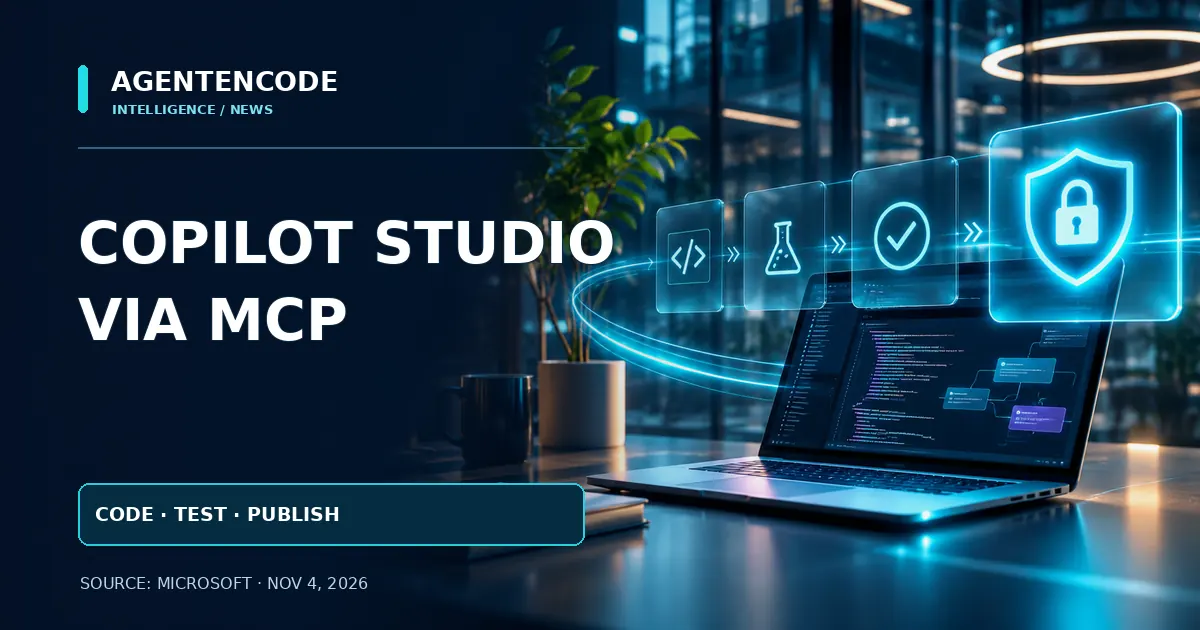
Microsoft's November 4 update introduces a Copilot Studio MCP server for compatible interfaces such as GitHub Copilot, Claude Code and Codex. These clients may discover agents, author and test drafts and manage published versions, subject to the connected identity, environment, policies and advertised service actions.
Sources and limitations
- Primary source
- Primary source
- Editorial analysis, not a product test
Information is grounded in Microsoft's official announcement and product docs. We have not connected a customer tenant, tested availability in any region, executed tool actions or verified independent pricing and security outcomes.
1. The important direction: Copilot Studio becomes an MCP tool
Microsoft's November 4, 2026 update highlights a Copilot Studio MCP server that allows compatible development assistants—including GitHub Copilot, Claude Code and OpenAI Codex—to work with Copilot Studio without leaving the coding interface. This is not the same as adding an external MCP tool inside an already published Copilot Studio agent.
The new direction is developer assistant → agent-building platform. The client can discover existing resources, prepare agents and workflows, run evaluations and request supported lifecycle operations. Permissions remain tied to the signed-in identity, chosen environment and organizational policy. Microsoft's original update provides that scope.
2. Drafting, testing and publishing are different operations
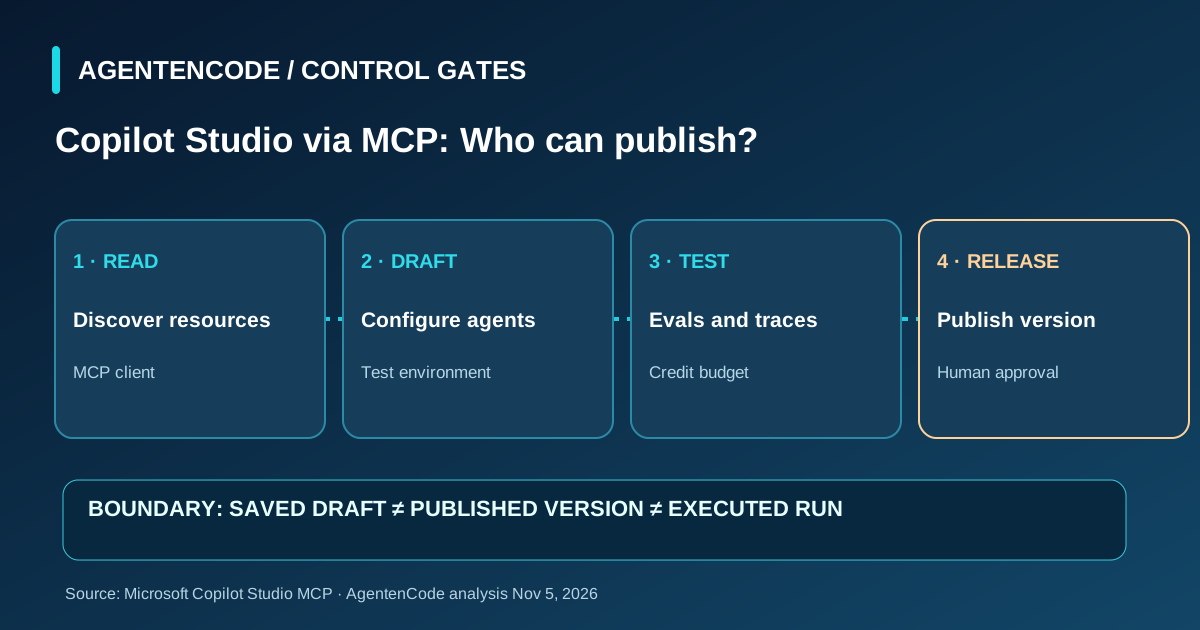
Microsoft's technical guide distinguishes discovery, creation, testing, publishing, troubleshooting and maintenance. Reading an agent's settings is not equivalent to changing its instructions, and saving a draft is not equivalent to deploying it to users.
The current documented tools include discover_resources, manage_agents, manage_workflows, get_consumption and get_copilot_studio_skills. Each tool offers operations through published schemas. A client should discover those schemas rather than assume a guessed operation exists or claim a release succeeded when no service result confirms it.
3. How the connection works: npx, sign-in and environment
Microsoft documents the published @microsoft/copilot-studio-mcp npm package, launched through npx from an MCP-compatible client. Users sign in and select a Copilot Studio environment; the server runs over standard input/output (stdio) and handles the service connection. Teams should use Microsoft-supported client configuration rather than inventing an endpoint or copying undocumented authentication tokens.
Access to the client does not grant universal environment access. Tool catalogs and side effects can vary with permissions, service rollout and client policies. The least risky pilot should begin with a dedicated non-production environment and explicitly scoped roles.
4. Why agent publishing needs a stronger approval boundary
AgentenCode analysis: Once one coding agent can configure another agent, the creation and release of authority becomes automatable. That makes the release boundary a first-class governance concern. Separate discovery, draft editing, testing and publication permissions rather than treating them as one trust level.
Microsoft recommends confirming the target environment, keeping the client's approval controls enabled and distinguishing proposed work, saved change, published version and actual execution. If the client times out, first inspect the resulting artifact; retrying blindly can duplicate a change or overwrite a newer version. A sound workflow is inspect → explain → approve → change → verify.
5. Preview, private preview and GA must not be merged
The November update contains several distinct statuses. Persistent proactive agents with approved credentials and process memory are described as a private Frontier preview. Microsoft's customer-conversation harness is in preview. Work IQ in Copilot Studio and several workflow nodes are explicitly described as generally available. The MCP server announcement does not establish a single across-the-board GA entitlement for every organization.
That is why “every Copilot Studio account can now deploy from Codex” would overstate the evidence. The actual environment, rollout status, credentials and advertised operations determine what a given user can do.
6. Credit controls still matter when a coding client initiates work
The same Microsoft update describes better visibility into Copilot Credits, including maker usage during development and testing, workflow node-level reporting and centralized administrative controls. The central Copilot Credit cost-management experience is explicitly marked preview. Pay-as-you-go, pre-purchase and capacity options do not imply one universal per-agent price.
Calling a Copilot Studio tool via MCP does not make underlying evaluations or workflow execution free. Teams should distinguish the coding assistant's cost boundary from the Copilot Studio environment's consumption and budget policy. They also need to validate the regional and contractual scope of connected services.
7. Original AgentenCode decision matrix: action, risk and evidence
This is an editorial authorization framework derived from Microsoft's published tool lifecycle, not a benchmark of an actual tenant:
| Activity | Risk | Approval gate | Evidence |
|---|---|---|---|
| Discover and inspect | Metadata exposure | Read-only identity and confirmed environment | Object ID and scope |
| Create or modify draft | Instructions or tools change | Isolated workspace, reviewable diff | Saved draft/version |
| Run evaluation | Credits, possible tool side effects | Test-data and budget controls | Run ID and evaluator result |
| Publish or deploy | Real users receive new behavior | Explicit human production approval | Released version and audit entry |
| Modify connections | Broader data access | Separate consent and secret-management gate | Verified connection state |
AgentenCode interpretation: The MCP server's promise is not fewer clicks alone. It is the possibility of faster development without diluting who is accountable for deployment. That requires enforceable permissions and evidence, not a chat transcript stating “published”.
8. A low-risk pilot: from inspection to separately approved release
A team first links the MCP client to a non-production environment. It asks the assistant to inspect an onboarding agent, drafts a limited change and saves it without publishing. It then runs an evaluation against synthetic scenarios. Only a designated human approver should authorize a separate production publishing step after inspecting the result and required permissions.
Before extending the workflow, check the actual tool catalog, environment boundaries, version history, connector consent, credit visibility, audit entries and rollback. This is an illustrative operating design, not an independent AgentenCode product test. Further context: Model Context Protocol, agent security and agent evaluations.
FAQ
Can Codex create Copilot Studio agents now?
Microsoft documents a Copilot Studio MCP server whose available lifecycle tools may be used from compatible clients such as Codex. Actual operations depend on identity, environment, rollout and tool permissions.
Is Copilot Studio MCP the same as an MCP data tool inside an agent?
No. This server exposes Copilot Studio management/lifecycle functions to external clients; adding MCP data sources to an existing agent is a different direction.
Can the client publish agents automatically?
The documented lifecycle includes publish/deploy capabilities when exposed and authorized. Microsoft recommends client approval gates and independent verification of release results.
Are all the November Copilot Studio features generally available?
No. Microsoft's update explicitly distinguishes private preview, preview and generally available components.
Did AgentenCode test a Microsoft tenant?
No. This is a source-backed analysis. Account entitlements, data regions and price outcomes were not independently tested.
Methodology, original sources and transparency
Based on Microsoft's November 4, 2026 Copilot Studio update and its MCP technical documentation. Vendor claims and rollout qualifications are separated from AgentenCode's original decision matrix. We did not sign into a tenant, create an agent, run an evaluation or publish to Copilot Studio.
Original sources: Microsoft Copilot Studio monthly update, Nov 4 · Microsoft Learn: Copilot Studio MCP lifecycle tools