
GitHub HydraFusion Max adds deeper multi-model code review workflows
GitHub expands HydraFusion with Max, stage-specific reasoning and tool-driven critics. What Cascade and Critique change, and why it remains a research preview.
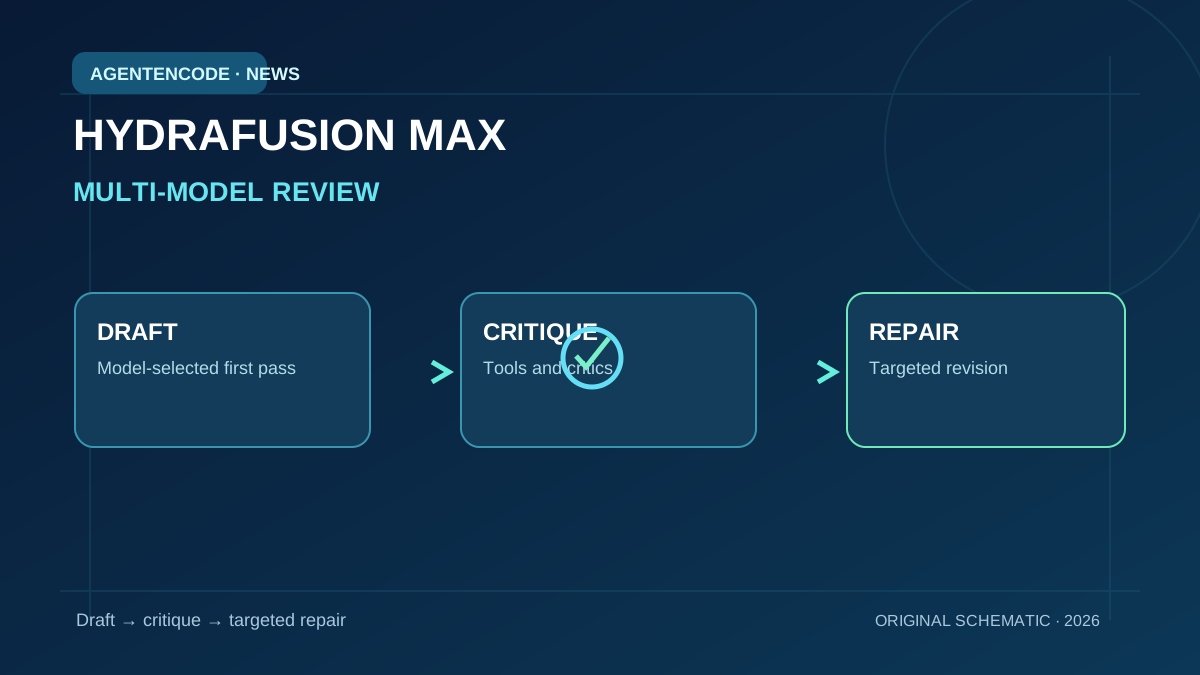
On October 14, GitHub introduced HydraFusion Max alongside updates to its multi-model orchestration. HydraFusion routes work among different AI models, varies reasoning effort by stage and changes its checking workflows. Both the regular and Max options remain research previews, not proven across-the-board improvements for every coding task.
HydraFusion already combined models but largely used their default reasoning effort. Critique relied more on text summaries, while Cascade escalated to a stronger model when necessary.
Cascade may now judge a draft and request targeted repair. Critique uses more direct workspace tools and parallel critics. Max emphasizes deeper reasoning on demanding tasks.
An orchestration layer rather than a single new model
GitHub describes HydraFusion as a system that coordinates several models to produce one answer. Its refreshed model pool includes Claude Opus 5.5, GPT-6 Astra, GPT-6.1 Sol and GPT-6 Luna. The exact models used vary with the workflow; naming the pool does not mean that every task calls all four. This distinction matters for teams trying to understand latency, cost, data handling and the evidence behind an answer.
With the update, HydraFusion can set different reasoning effort levels for separate stages. A draft may use medium effort while review uses high effort. The goal is to direct computation toward checking the parts most likely to benefit from scrutiny. That is a plausible design rationale, not an independently demonstrated outcome. The short announcement does not provide reproducible results showing that every repository or bug class improves by a specified percentage.
Cascade and Critique gain more explicit evidence checks
Cascade starts with a draft and escalates only when needed. The revised design may insert a judging step that inspects the initial solution and requests a repair when justified. In principle, this avoids always running the most expensive option while still providing a quality gate. Actual efficiency depends on model selection, task complexity, false positives in the judging step and the number of repairs ultimately required.
Critique is also changing. GitHub says it now makes greater use of tools to examine the workspace directly, instead of reviewing only written summaries. It can enlist parallel critic models. That is relevant for coding agents because directly inspecting files, diffs or execution results can be more informative than accepting another agent's self-report. But a tool-enabled critic is only as reliable as the information it can access and the independence of its checks. Human code review remains necessary.
What Max offers and who can try it
HydraFusion Max shares the underlying architecture with the balanced option but aims for frontier-level capability on more demanding tasks. The standard option places more emphasis on balancing useful performance with moderate token savings. GitHub lists support for both in VS Code, the Copilot desktop app and Copilot CLI. Both are still research previews, and their availability depends on the relevant experimental or preview settings.
Access is described for Copilot Pro, Pro+, Business and Enterprise customers, subject to organizational model policies. A sensible comparison should test the same repository tasks using both modes, collecting patch quality, test coverage, follow-up corrections, latency, token use and reviewer time. The meaningful question is not simply whether additional models participated. It is whether independent checks produce better, more traceable decisions without unacceptable cost or complexity.
AgentenCode assessment
HydraFusion Max shows where agentic coding tools are heading: draft with one execution path, inspect with another, and repair when the evidence supports it. This could be useful, especially when critics inspect the actual workspace. But the research-preview label and the absence of independent comparative measurements should prevent claims of guaranteed improvement or hands-off software delivery.
Sources and verification
Reviewed against GitHub's October 14, 2026 Changelog. Feature availability, model pool and workflows are vendor-described; no independent benchmark was performed.