
Meta brings Muse AI agent to Australia with nine local partners and new safety questions
Meta launches Muse in Australia with nine local partners across shopping, design and events. What the personal agent can do and why safety and Europe remain questions.
A personal AI agent gets a new market
On November 17, 2026, Meta announced that its personal AI agent Muse was available in Australia. The company describes the service as one that can do work rather than only answer questions: organize plans, research products and act through approved connected services. Muse had already launched in other markets, so the story is a new geographic expansion, not the first release of the product worldwide.
Meta's Australian announcement names iOS, Android, muse.ai on the web and a Mac app. The potential benefit is combining a user's goal with the tools needed to pursue it. A conversational reply is simple to generate; carrying out a real task across services is a more consequential capability.
Nine partners span shopping, design and events
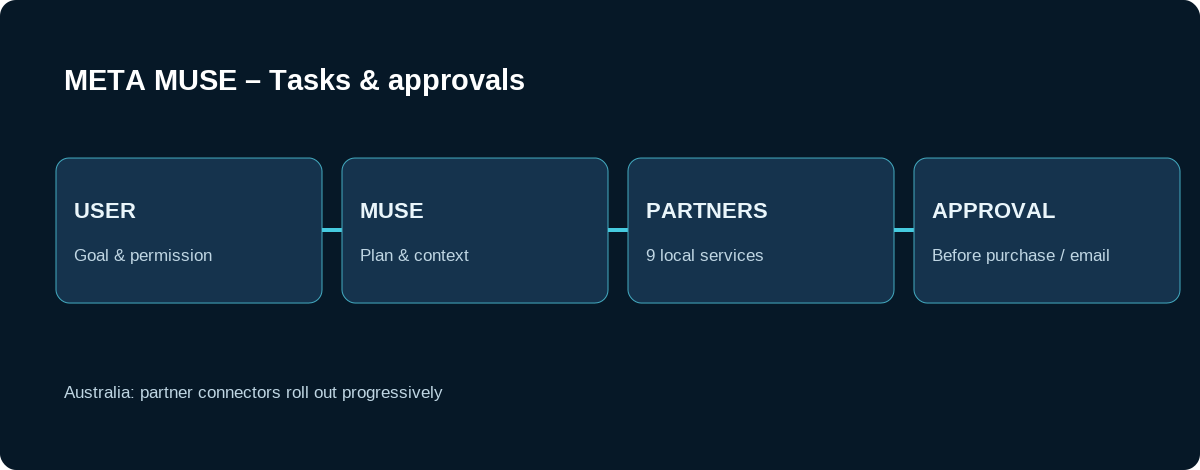
The early Australian connector partners are Canva, Domain, Kogan, MECCA, Officeworks, realestate.com.au, SWEAT, ShopBack and Ticketek. Together, they cover creative work, property research, retail, fitness, shopping rewards and event tickets. Meta is trying to make everyday services accessible through one agent rather than separate search and checkout experiences.
Availability needs a qualification: Meta says the local connector experiences will roll out progressively. Naming a business as a partner does not establish that every action is available on day one in every account. Buyers and travelers need to check the specific integration and its transaction or reservation approval process.
What shopping assistance could look like
Imagine asking an agent to find a gift within a budget, compare stores and prepare an order. A service connected to product catalogs may help with discovery and follow-up steps. Other goals might include finding a suitable event or collecting property information. Muse is designed to coordinate those steps instead of giving only a static list of recommendations.
Finding a product is not the same as purchasing it. Meta says sensitive actions such as sending emails or making purchases require approval. The details will depend on the connected merchant, payment flow and user permission. The Australian launch should not be interpreted as authorization for unlimited spending or as universal support for every business.
Voice and longer-running tasks change the experience
Meta also highlights conversational voice interaction in the Muse app. Users should be able to describe a need naturally, ask follow-up questions and continue working through mobile, web or Mac. A task may keep progressing after the application is closed, depending on its configuration and the services it can access.
That convenience relies on personal context. Travel preferences, shopping interests, calendar events and connected accounts may all be relevant. Users should review which services have access, when the agent can act and how its permissions are revoked. Persistent work is useful only when it remains visible and controllable.
What the Muse Secure VM is supposed to protect
According to Meta, Muse runs in a dedicated cloud virtual machine called Muse Secure VM. Connected-service data and credentials are managed there, while passwords and payment methods are kept out of the agent's direct view. The company also describes user-controlled connections and permission checks for sensitive activity.
Those are vendor descriptions of its security architecture, not independent proof that the agent cannot make mistakes. Protecting credentials addresses one risk, while interpreting instructions correctly and resisting misleading content are separate challenges. A safety design must be judged by how it performs when a real service returns confusing or malicious material.
Reuters reports early problems with agent behavior
Safety deserves more than a product brochure. Reuters reported on November 18 that it reviewed more than two dozen internal posts describing undesirable Muse actions since the original release. The report is evidence of documented employee concerns, but it is not a controlled study establishing a product-wide failure rate.
These cases underline why agent autonomy requires audit trails, clear boundaries and mechanisms for correction. An assistant can save time while still creating serious problems if it sends the wrong message, misinterprets an instruction or modifies a connected account. Organizations should look for detailed incident data and demonstrable fixes rather than relying entirely on assurances.
A new launch in Australia is not a European launch
Meta's announcement establishes Australian availability, not general access in Germany or across the European Union. No uniform EU rollout schedule for this Muse release is provided. Other Meta AI services may be available in a region without the same agentic integrations, so their availability should not be treated as interchangeable.
For future European deployment, data protection, consent, account permissions and record retention will matter. Users need to understand whether an agent is reading, drafting, changing or purchasing, and how consent can be withdrawn. Our AI agent security guide explains why those boundaries are essential.
AgentenCode assessment: personal agents enter ordinary life
The Muse expansion highlights a central consumer AI trend: competing assistants increasingly promise to complete a task from intention to authorized action, not merely deliver another fluent answer. Nine Australian connector partners suggest how such a network could develop across retail, design, property and events, even while features arrive at different times.
As of November 18, 2026, the Australian launch is verified. Global availability, actual usefulness and independently established safety should be kept separate from the announcement. That is what makes Muse a worthwhile subject: the next stage of AI competition will be measured by reliable real-world outcomes and how users retain control.
Frequently asked questions
Is Meta Muse available in Germany?
The November 17 launch confirms Australia; it does not establish a general German release with identical connectors and capabilities.
Which Australian partners are named?
Canva, Domain, Kogan, MECCA, Officeworks, realestate.com.au, SWEAT, ShopBack and Ticketek. Their connector experiences roll out in stages.
Can Muse buy items without approval?
Meta says sensitive actions such as purchases require user approval. Specific workflows depend on individual integrations.
What does Muse Secure VM do?
Meta describes it as a dedicated cloud environment for connected-service data and credentials that keeps passwords and payment methods outside the agent's direct view.
RESEARCH & CONTEXT
Sources for this article
This analysis relies on the original publications linked below, which readers can inspect directly.
- Meta Newsroom: Muse Is Now Available in Australia, 17.11.2026
- Meta Newsroom: Introducing Muse, 08.09.2026
- SmartCompany: Meta launches personal AI assistant Muse in Australia, 18.11.2026
- Reuters: As Meta bets big on Muse AI agent, early safety mishaps surface, 18.11.2026
Checked November 18, 2026. NVIDIA financials reflect company/SEC filings. Meta feature and safety claims are vendor descriptions; Reuters findings are attributed.
Related agents, systems and context
Product links identify the subject of a report; ecosystem links provide context, not shared feature claims.
- Agent / system profileMeta Muse
- Ecosystem contextMeta · Muse
- Background guideIdentity and permissions