
AlphaGenome 2: Google's AI looks for genetic disease clues in individual cell types
AlphaGenome 2 predicts DNA variant effects across cell types. What 107 million cell profiles and a 30% vs 16% benchmark actually show.

The critical question: Why does the same DNA act differently?
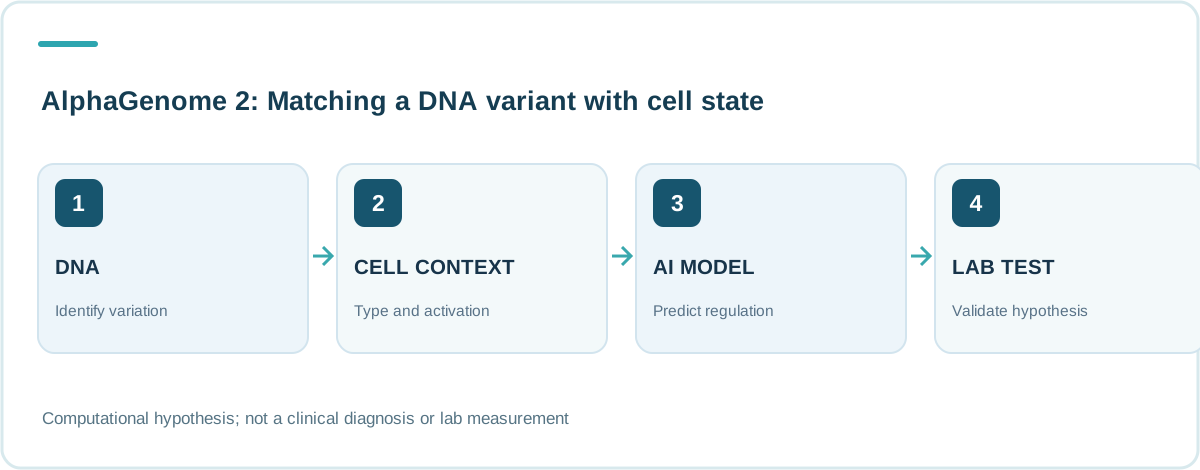
Most cells in a human body carry essentially the same DNA blueprint, yet an immune cell behaves very differently from a cardiac muscle cell or a neuron. What changes is which genes are active in a given biological context. On November 11, Google DeepMind unveiled AlphaGenome 2, a research model that predicts how DNA sequences and genetic variations influence gene activity in specific cell types.
This is not a system that can diagnose an individual patient's disease. Its research goal is to link DNA changes associated with a condition to the cell and mechanism in which the change might matter. That transition from statistical association to a biological hypothesis can make experiments more targeted, but a model's predictions still need to be confirmed in the laboratory.
From tissue-wide averages to cellular context
The first AlphaGenome predicted molecular activity from long DNA sequences across numerous bulk tissue types. Its successor is a conditional model: it also takes a biological context such as cell type, tissue or activation state. This allows it to model distinctions between related cell populations that may be obscured by averages across a whole tissue sample.
DeepMind describes using DNA sequences up to one million letters long and predicting gene expression, chromatin accessibility, histone marks and DNA methylation. A researcher could ask how a variant might act in activated immune cells rather than receiving one aggregated estimate for a mixed tissue. Such a prediction is a computational hypothesis, not an observed molecular measurement.
More than 107 million individual cell profiles
Google says the model was trained with over 107 million single-cell profiles across 68 tissues, combining human and mouse data with broader tissue measurements. That scale may help the model represent a wide range of biological states. Crucially, 107 million cell profiles does not mean 107 million people: a cell profile is a measurement involving an individual cell, not a separate patient.
Connecting sequence information with single-cell measurements can also support cross-modality imputation. A researcher might provide one kind of observed activity and ask the system to estimate an unmeasured molecular property. That could prioritize follow-up experiments, although imputed results remain uncertain estimates and should not be presented as direct measurements.
Thirty versus sixteen percent: Reading the reported results correctly
The central evaluation highlighted by DeepMind's research announcement concerns the TenK10K dataset containing 28 primary immune cell types. In that setting, the team says AlphaGenome 2 identified 30% of the tested causal variants, compared with 16% for a single-cell-adapted predecessor. For predicting effect direction the reported comparison was 43% versus 23%. These results represent a substantial improvement within the specified benchmark.
They must not be misreported as 30% diagnostic accuracy or an overall success rate for all genetic diseases. Interpretation depends on how reference variants were chosen, the available cell measurements and the evaluation protocol. The figures come from the original research team's assessment; AgentenCode has not reproduced them independently.
An example involving inflammatory bowel disease
Prior research identified a distant regulatory element connected to ETS2, a gene involved in inflammatory bowel disease biology. DeepMind reports that AlphaGenome 2 reproduced the expected effect computationally in macrophages, a type of immune cell found in the gut. It predicted that the relevant variant boosts ETS2 expression in this particular context while having smaller effects in other cell populations.
The value is a more specific mechanistic hypothesis for researchers to investigate. It does not independently establish causation in a particular patient or represent a new treatment. Experimental validation, replication and eventually appropriately designed clinical studies would be needed to establish any practical health application.
New cell states without retraining the entire model
DeepMind says AlphaGenome 2 can adapt to newly measured single-cell states not represented in exactly the same way during training. A few dozen measured cells can supply information used to condition the sequence model on a new biological situation. The model can then predict additional properties or variant effects for that state, potentially supporting research into activated or disease-related cells.
One example examines immune T cells activated after an mRNA vaccination. In the research evaluation, the model predicted a stronger impact of a particular DNA variant on gene regulation in activated rather than resting cells. That is a cell-state modeling result, not evidence that a vaccine is safe or unsafe for an individual. Any such broader conclusion requires separate biological and clinical evidence.
Who can access AlphaGenome 2 now?
The official release announcement says non-commercial researchers can use AlphaGenome 2 through its API. Commercial research access is in private preview. DeepMind also plans AlphaGenome 2 Skills for Google Antigravity, potentially combining specialized sequence predictions with agentic scientific tools. That planned integration is not yet equivalent to general availability.
Responsible use involves scientific expertise, lawful handling of sensitive genetic information, reproducible experiments and careful communication of uncertainty. The vendor explicitly states that AlphaGenome 2 is intended for research only and has not been validated or approved for clinical or diagnostic use. It cannot substitute for laboratory confirmation or clinical decisions.
AgentenCode assessment: AI is making hypotheses more precise
AlphaGenome 2 is a notable general-AI scientific development because it tries to model biological variation at the level of cells instead of relying solely on broad averages. Long DNA sequences conditioned on cellular state may help researchers connect disease-associated variants with the specific context where those variants matter. Such specificity could make laboratory hypotheses better targeted and experimentally testable.
Yet stronger benchmarks are not independent validation for clinical application. Scientific reproducibility, error analysis and transparent comparison remain essential. Future connections to AI-enabled scientific workflows will raise familiar questions about evidence, privacy and human control. Our guide to AI agent evaluations explains why a useful metric must reflect the actual task rather than merely the model's marketing headline.
Frequently asked questions
What is AlphaGenome 2?
It is a research AI model introduced by Google DeepMind on November 11, 2026 that predicts how DNA variants affect gene activity in specific cell types and states.
How accurate is AlphaGenome 2?
For one TenK10K immune-cell benchmark, DeepMind reports identifying 30% of tested causal variants versus 16% for an adapted predecessor. This is not a general clinical accuracy figure.
Can AlphaGenome 2 diagnose disease?
No. Google explicitly states it has not been validated or approved for clinical or diagnostic use; it is designed for research.
Is AlphaGenome 2 publicly available?
DeepMind provides an API for non-commercial research, while commercial research access remains in private preview.
RESEARCH & CONTEXT
Sources for this article
This analysis relies on the original publications linked below, which readers can inspect directly.
- Google DeepMind – AlphaGenome 2 research announcement, 11 November 2026
- Google DeepMind – AlphaGenome 2 original research manuscript
- AlphaGenome – official scientific API documentation
Checked November 15, 2026. Vendor statements, pilot scope and preview benchmarks have not been independently reproduced or certified.