
GitHub Dependabot updates agent skills—but security updates remain missing
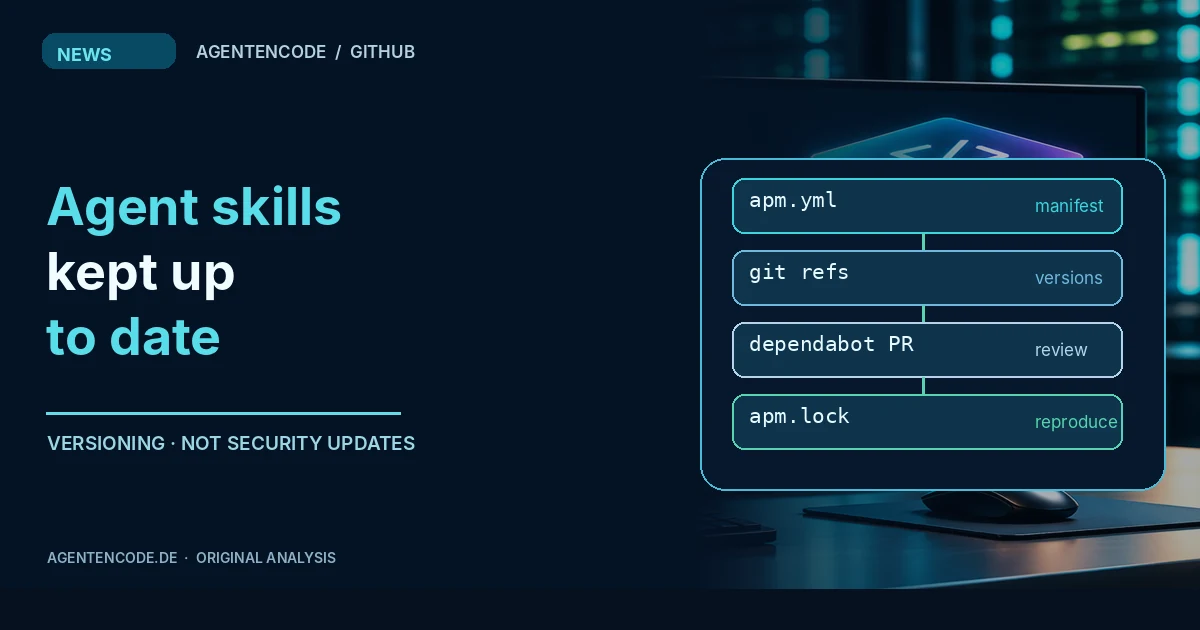
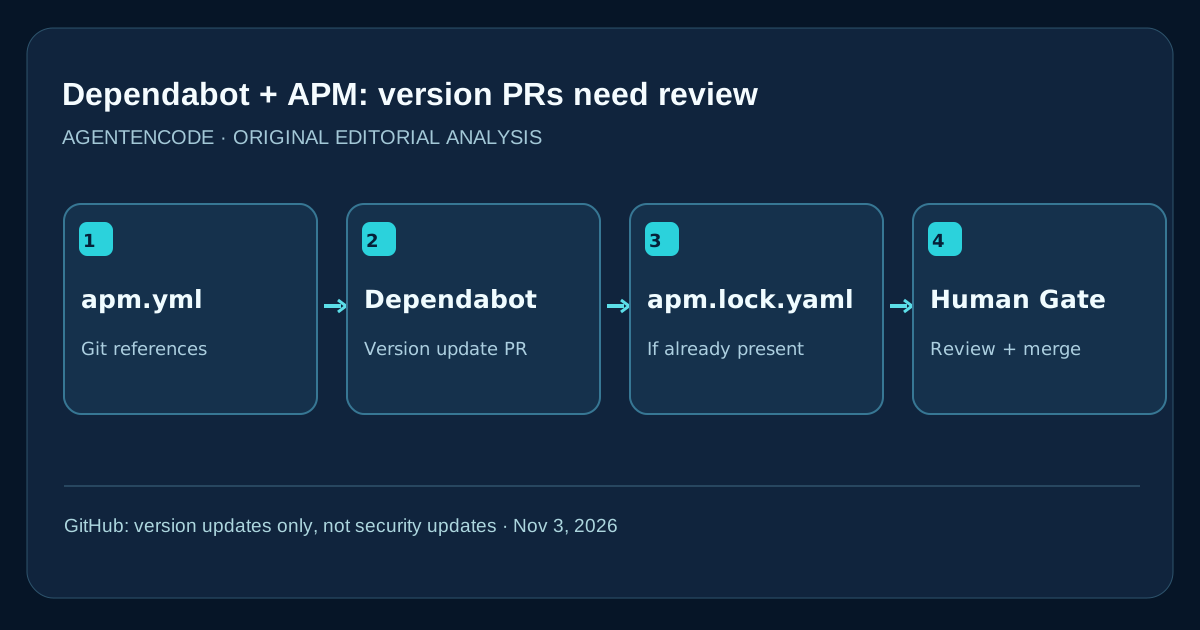
GitHub has added Dependabot version updates for Agent Package Manager (APM). Supported Git dependencies for agent skills, prompts and instructions listed in apm.yml can now receive automated version-update pull requests. When an apm.lock.yaml file already exists, Dependabot regenerates it for supported changes. This improves maintenance and traceability, but the APM integration does not support security updates.
Why agent instructions are a software dependency
A modern coding agent is more than a base model. Teams install reusable skills, prompt templates, instruction packs and sometimes MCP integrations from external repositories. These components can change planning behavior, permitted tools, file operations and prioritization. Even when no conventional executable library is involved, the content is operationally influential.
Dependabot's new support treats a subset of these components as manageable versioned dependencies: detect updates, propose a pull request, refresh an existing lockfile and route the change through the repository's normal approval workflow. This is not a complete security scanner, but it establishes an important maintenance primitive for agent-driven development.
What GitHub actually released on November 3
GitHub's announcement says Dependabot version updates now support Agent Package Manager. Dependabot opens pull requests for supported git-based references in apm.yml and updates an existing apm.lock.yaml. The feature is generally available for all GitHub plans on github.com, with GitHub Enterprise Server 3.24 listed for future support. This is not an announcement of a GitLab-native Dependabot feature.
A basic configuration in .github/dependabot.yml looks like this:
version: 2
updates:
  - package-ecosystem: "apm"
    directory: "/"
    schedule:
      interval: "weekly"
The example assumes a matching APM manifest at the specified directory. It is not evidence that AgentenCode uses APM or has changed its own deployment process.
Exactly which references can change?
GitHub's technical docs distinguish reference types. A SemVer tag can move to the latest SemVer release. A complete commit-SHA pin can be replaced by the commit tied to the latest annotated, non-prerelease release tag. A branch such as #main prompts an update to an already existing lockfile only. Dependabot will not create an apm.lock.yaml if the repository does not contain one.
| APM reference | Documented behavior | Operational risk |
|---|---|---|
| SemVer-tagged git dependency | Update the version tag | New tag may change behavior |
| Complete commit SHA | Update to release's commit SHA | Source changes require review |
Moving branch, e.g. #main | Refresh existing lockfile | Manifest may look unchanged |
| Object-form, local path or MCP entry | Not supported in this update path | Separate governance needed |
| Missing ref or abbreviated SHA | Not updated | Dependency may silently age |
Enabling APM updates therefore does not put every installed agent component under automated maintenance. Teams need to inventory the references the updater does not understand.
The vital boundary: versions are not vulnerabilities
GitHub explicitly states that APM integration covers version updates, not security updates. A higher version does not establish that a malicious instruction, prompt-injection vector or overly privileged workflow has been detected or fixed. Standard Dependabot security support for other ecosystems must not be inferred here.
A lockfile helps reproduce content; it does not prove the content is safe or appropriate. Repeatability and behavioral safety are distinct controls. A skill can be pinned to exact bytes and still instruct an agent to perform unwanted actions.
Original AgentenCode go/no-go matrix
| Change | Automation | Human gate | Editorial decision |
|---|---|---|---|
| Patch tag for a trusted skill | Create Dependabot PR | Review diff, provenance and tests | Suitable pilot |
| Major tag adds new tools | Propose only | Reauthorize tool scopes | No automatic merge |
| Moving branch for team prompts | Track lockfile change | Check actual commit diff | Controlled update |
| Skill requests extra file/network rights | Treat as higher risk | Security review and least privilege | Manual sign-off |
| Unsupported MCP dependency | No automatic coverage | Separate inventory and updater | Additional gate needed |
This is original AgentenCode analysis, not a GitHub-certified security policy. Its purpose is to treat changes to agent behavior with the seriousness of changes to production code.
A small, measurable pilot
Start with a repository containing a handful of known skills, named owners and an existing lockfile. Pin one dependency to a SemVer tag, schedule weekly version updates, and examine the first PR. The review should inspect not only the version number but also changes to tool instructions, network access expectations and file-operation boundaries.
After merging, rerun the same representative agent task against the new skill and compare output and actions. Include negative tests—situations where the agent must refuse to act or stop at an authorization gate. If your team distributes the same APM content into several agent harnesses, verify each actual deployed version rather than trusting the root manifest alone.
Why the supply-chain model for agents is different
Software engineering already tracks code libraries with manifests, locks and update bots. AI agents introduce a further category: packages that influence decision-making and tool behavior even though they may look like simple documentation. Dependabot helps make this category maintainable inside a familiar PR process. The unresolved question is how to demonstrate what each skill does under the rights it receives.
AgentenCode verdict: APM support is a useful upgrade for teams on GitHub. Its benefit only becomes meaningful when version PRs also record provenance, permissions, tests and accountable approval. Do not confuse automatic updates with automatic security approval.
FAQ
Which files does Dependabot use for APM? References are declared in apm.yml. If apm.lock.yaml already exists, the updater can regenerate it. It does not create a missing lockfile.
Does the updater cover MCP server entries? No. GitHub explicitly lists mcp: entries among unsupported APM update forms.
Are these security updates? No. GitHub's release covers version updates only.
Can I enable it on GitLab? The announcement concerns GitHub Dependabot, not a native GitLab feature.
Should teams auto-merge the PRs? AgentenCode recommends explicit review for any change that affects agent behavior or tool permissions.
Sources and editorial method
- Primary source: GitHub Changelog, “Dependabot version updates support Agent Package Manager,” November 3, 2026.
- Technical reference: GitHub Docs, “Dependabot supported ecosystems and repositories,” APM section.
- APM project documentation: microsoft/apm, “Installing packages”.
- Technical support limitations come from GitHub; the risk matrix and pilot are original AgentenCode interpretation. No independently executed Dependabot job, APM security audit or repository certification.
Sources and limitations
- GitHub Changelog – Dependabot APM
- GitHub Docs – Dependabot supported ecosystems
- microsoft/apm – Install packages
Vendor claims and original editorial conclusions are distinct. No independent product test or security certification.