
Codex designs hardware—but manufacturing reveals the real limits of AI agents
OpenAI says Astra helped design a Codex-connected device in under a week, spanning CAD, a PCB and firmware. Manufacturing still required human correction. Here is the engineering boundary that matters.

In a November 3, 2026 post, OpenAI describes using ChatGPT, Codex and GPT-6 Astra for mechanical and electrical engineering. Two staff members used the models to design a device for talking to Codex as a side project in under a week. A contract manufacturer produced a small run of prototypes in less than a month, according to OpenAI.
Sources and limitations
- Primary source
https://openai.com/index/accelerating-engineering-for-the-physical-world/
- Editorial context, not a product test
First-party sources dated November 3, 2026. Decision framework is AgentenCode editorial analysis; no independent hardware, agent-runtime or security test.
Key takeaway: a CAD deliverable is not a manufacturing approval
In a November 3, 2026 post, OpenAI describes using ChatGPT, Codex and GPT-6 Astra for mechanical and electrical engineering. Two staff members used the models to design a device for talking to Codex as a side project in under a week. A contract manufacturer produced a small run of prototypes in less than a month, according to OpenAI.
But OpenAI also reports a limitation that matters more than the speed headline: Astra did not consistently handle production constraints, tolerances and assembly requirements. Several human review and revision cycles were required. This is an engineering research example, not a generally available autonomous hardware-manufacturing product.
What the agent crossed: four engineering disciplines
OpenAI describes an end-to-end path covering functional requirements and industrial styling, mechanical enclosure and internal structures, component selection and PCB layout, plus UI, firmware and software integration with Codex.
The novelty is the attempt to coordinate disciplines whose files, verification procedures and tooling are normally separate. A language-driven agent may reduce handoffs, but the announcement does not provide an independent controlled comparison of total engineering time or error rates.
Two partnerships, two different validation boundaries
OpenAI says its own hardware teams use Codex and ChatGPT to revise CAD models, prepare manufacturing drawings, set up simulations and review designs. Model usage, measured in tokens, has increased 23-fold since February. That is a usage metric—not proof of a 23-fold productivity gain.
With Chip Ganassi Racing, OpenAI is testing the transformation of 3D scans of existing parts into editable CAD and 2D manufacturing drawings. Racing engineers check whether the outputs are accurate and manufacturable. With Mazda, researchers are exploring airflow and structural simulations for vehicle design while accounting for styling and costs. Neither project is presented as a fully autonomous production release.
BenchCAD 2.0: encouraging scores with a narrow scope
OpenAI reports an average 0.875 for a newer internal model on BenchCAD 2.0, compared with 0.594 for GPT-6 Astra at its highest reasoning setting. BenchCAD examines tasks including reconstruction of 3D parts and PCB connectivity.
The superior model is described as internal, not a commercial release. Nor does this score establish manufacturing yield, mechanical safety, regulatory approval or legal responsibility. The separate BenchCAD methodology documents recurring assembly-placement failures in frontier models. Benchmarks should therefore be read as tests of specific artifacts, not of the entire product lifecycle.
AgentenCode decision matrix: five gates from design to factory
| Stage | Evidence to request | What was demonstrated | Who authorizes progress? |
|---|---|---|---|
| Design artifacts | Versioned CAD, PCB, firmware | One prototype project reported | Engineering team |
| Geometric and functional review | Tolerances, connections, simulation | Narrow tests and benchmark context | Domain experts |
| Manufacturability | Assembly limits and vendor constraints | OpenAI reports remaining failures | Production engineers |
| Real-world validation | Prototype tests and defect records | Small run reported, no general yield | Quality assurance |
| Release | Safety, change control and acceptance | Not claimed as autonomous | Accountable organization |
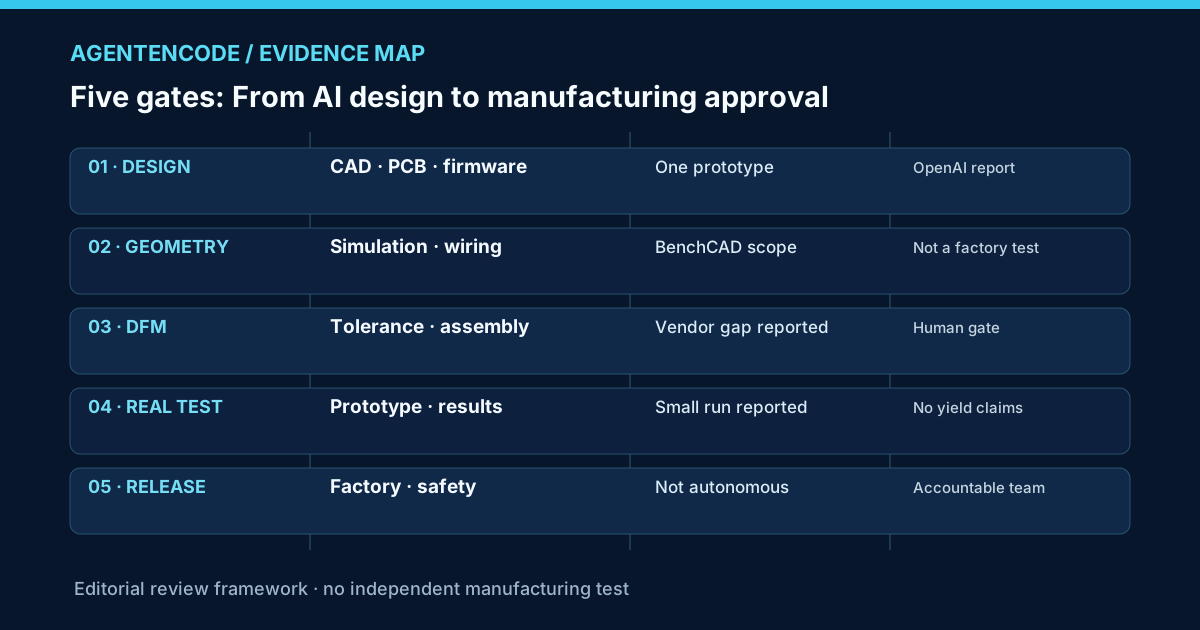
This is an AgentenCode editorial decision framework, not a vendor-certified process or independently run experiment.
How an organization should pilot this class of agent
Start with low-risk, reversible design tasks: producing CAD variants, translating a scan into a parametric model, documenting a bill of materials or organizing simulation inputs. Track every generated artifact, tool access, assumptions and reviewer action. Separate read-only research, draft generation, simulation and final manufacturing permissions.
The durable technical value is not a striking CAD screenshot; it is a traceable chain of artifacts and decisions that survives specialist review and a real supplier's constraints. An agent that cannot expose its assumptions or roll back a mistaken design is harder to trust in physical engineering than in ordinary drafting.
Verdict: autonomy ends where accountability begins
OpenAI's examples point toward useful engineering workflows, including cross-disciplinary coordination. The openly acknowledged manufacturing gaps make the story more valuable: design assistance is becoming practical, but manufacturing authority is a different capability.
Frequently asked questions
Did Astra manufacture the device without humans? No. The model reportedly generated the design without direct human edits; a manufacturer produced prototypes and humans conducted subsequent reviews.
Can customers access the higher-scoring internal model? OpenAI does not announce its general availability in this article.
Has Mazda deployed an AI-designed production car? No. The announcement describes an engineering research collaboration and simulations.
Sources and editorial method
- OpenAI: Accelerating engineering for the physical world, November 3, 2026 — dated first-party report.
- BenchCAD: Introducing BenchCAD 2.0, October 12, 2026 — independent benchmark methodology context, not our own rerun.
Method: Source-first reading with a separate decision framework. No independent hardware build, model benchmark or safety audit. Editorial cover artwork is illustrative, not an authentic OpenAI or Mazda photograph. More guidance: Choose an AI agent, AgentenCheck, Compare agents.