
The best choice begins with an actual task, not a top-ten list. Research, coding and site reliability operations call for different tools and limits. Verify the accepted result and allowed actions before comparing marketing promises.
Define the task and the access scope. Verify availability and sources. Compare two or three eligible candidates on the same tests. Never enable high-impact write operations without documented approval and safe rollback.
Which AI agent should I choose? The direct answer
The right AI agent is the one that can complete a defined job with verifiable outcomes and controlled permissions. For multi-step, citation-heavy investigations, examine research agents. For changing a software repository, consider coding agents. For incident response, evaluate specialist SRE agents. If you only need a drafted explanation, a tool-using autonomous agent may be unnecessary.
Start with your desired result, available data and boundaries. Shortlist two or three suitable products, then test them under comparable conditions. AgentenFit maps requirements to documented properties, AgentenCheck structures risk and evidence questions, and Agent Comparison shows differences. None guarantees suitability or verified product safety.
1. Begin with the job, not the agent's brand
“Use AI in sales” is not a testable requirement. A better version is: “Draft a proposal using approved CRM fields, but never change prices or send the proposal without human sign-off.” This establishes the trigger, input scope, accepted result and forbidden actions. A specific task makes later comparisons possible.
Record frequency, the time people currently spend, exceptions and consequences of mistakes. A rare ambiguous question may call for assisted research; a routine deterministic export may not require an AI agent at all. Microsoft's AI agent adoption guidance separates planning, governance, implementation and management rather than reducing adoption to a product choice.
2. When is a chatbot or ordinary automation enough?
A chatbot can answer questions and prepare drafts. A fixed automation follows predefined rules. A configured agent may plan multiple steps, use tools and adapt to intermediate results. Real products often blend these patterns. Their names do not establish which external operations they can actually execute.
Use the least complex system that achieves the desired state. A one-page summary may need only an assistant. A nightly export with exact rules often belongs in a conventional workflow. Changing research material or incident diagnosis can warrant tool-using agents. Every added access permission creates responsibility, not intrinsic value. See AI agent versus chatbot.
3. Match the agent type to the task
Research agents need source controls and traceable citations. Coding agents need repository context, test execution and review gates. SRE agents rely on incidents, observability data and runbooks. Enterprise workflow agents depend on approved CRM or ERP data, identity boundaries and communication approval.
Two products running similar language models can differ radically in tools, integration, context and authorization. Compare actual operating workflows before comparing marketing capability claims. Our agent types guide and business adoption reference offer further context.
4. Six real agent profiles grouped by task
The table below is an editorial map of documented product roles, not a leaderboard or an independent performance benchmark. The primary sources linked in the profiles and the vendor's current terms take precedence over this snapshot, reviewed November 4, 2026.
For one defined job, it is usually more useful to examine two promising options in depth than twenty superficially. A coding agent and an incident agent may both use tool calls, but their access, testing and rollback demands are very different. Treat the table as a starting point for verification.
| Task category | Agent profile | Check before use |
|---|---|---|
| Cited web research | ChatGPT Deep Research | Verify sources and plan limits |
| Repository coding | OpenAI Codex | Constrain file and command rights |
| Open-source coding | OpenCode | Check model access and infrastructure |
| Incident triage and runbooks | PagerDuty Paige | GA; verify feature-level access |
| Trace-based release checks | Honeycomb AI SRE Agents | Personal/Team: Early Access |
| Cloud and infra diagnosis | AWS DevOps Agent | Verify region and integrations |
5. Four authority levels: read, propose, approve, act
Separate reading context, proposing a change, execution with approval and narrowly bounded autonomous action. Drafting an incident note is a different risk from restarting a service or sending customer records. The last autonomy level is not a required destination.
Review every tool and execution identity: what can the agent read, modify, delete or transmit? Are approvals enforced, can activity be audited, and is a safe stop or rollback available? The OWASP Top 10 for Agentic Applications 2026 covers tool abuse, goal hijacking and excessive authority. It does not certify a vendor's implementation. See human-in-the-loop controls.
6. Verify feature availability, privacy and integrations separately
An agent may be generally available, in beta, offered by invitation or restricted by region and contract. Product-wide GA does not automatically apply to every integration or future feature. PagerDuty Paige was announced generally available on November 3, 2026, with some capabilities requiring narrower status checks. Honeycomb Personal and Team Agents remained in Early Access as of our review.
Before involving real data, confirm provider, account plan, connected services, personal information handling, processing region, retention and the effective execution identity. If there is no product-specific documentation or contract evidence, record the field as unknown. NIST's Generative AI Risk Management Profile provides voluntary risk management guidance, not a substitute for a product assessment.
7. Measure cost per accepted outcome, not per answer
A low-priced subscription may still be expensive if people routinely correct outputs or agents retry work. Estimate licensing, model and tool usage, integrations, privacy reviews, approvals, monitoring and failures. Usage-based AI Actions or API fees may change the economics of an otherwise similar product.
AgentenCode recommends comparing full cost per correctly verified task rather than tokens or subscription fees alone. Only your own evaluations establish realistic rework and failure costs. The cost and ROI guide provides a transparent method without pretending that illustrative figures are actual customer savings.
8. Run a fair comparison using the same tasks
Give every candidate comparable task descriptions, allowed sources, tool budgets and acceptance criteria. Assess final outputs, source accuracy, tool actions, unauthorized access attempts, retries, consistency and human corrections. One successful demo run is not evidence of repeatable operation.
Anthropic's agent evaluation guidance and OpenAI's agent evals documentation discuss realistic tasks and graders. An early learning pilot may benefit from 20–50 carefully specified cases, but this does not prove that rare high-impact errors are unlikely. Our evaluation reference goes deeper.
9. A decision matrix without artificial precision
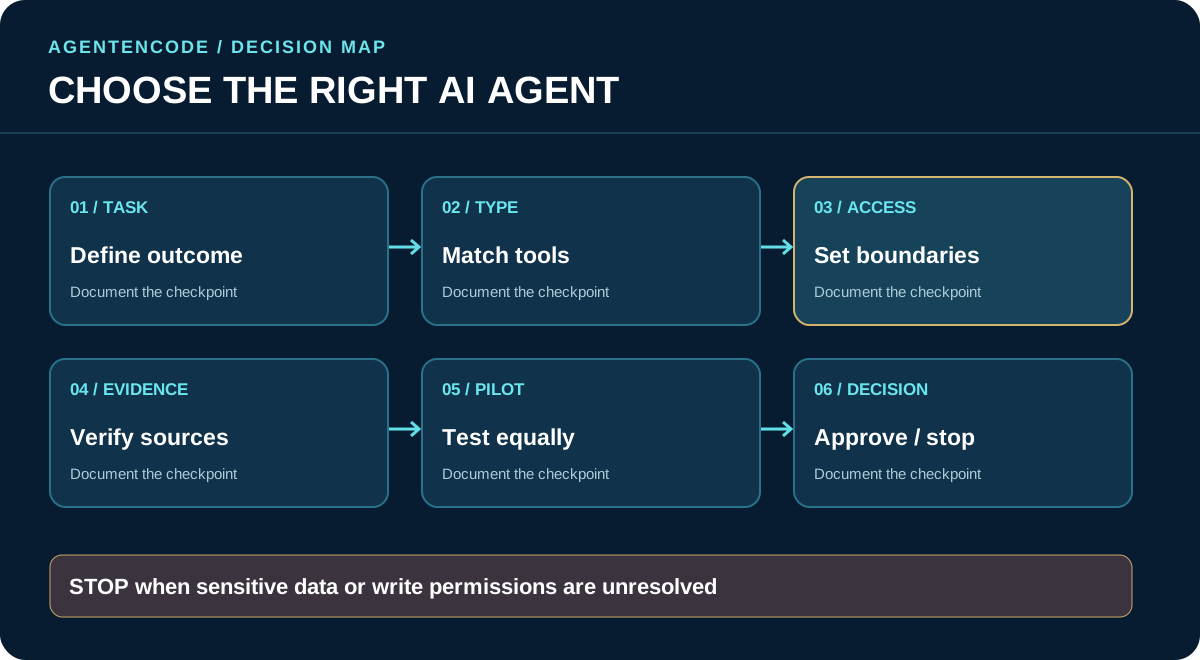
Apply hard stop conditions first: wrong task, unavailable account access, prohibited data processing, uncontrolled write permissions or no safe test mode. A flattering benchmark result cannot compensate for a major authority violation. If critical facts are unknown, demand evidence before enabling the risky operation.
Then compare remaining candidates qualitatively across task fit, source evidence, integration, operating effort and total cost. Mark unsupported fields as unknown rather than assigning a zero or an invented probability. Our original decision diagram illustrates six gates; it is a practical editorial method, not a measured ranking of products.
10. Example: weekly competitive research
Imagine a small team produces a Friday report from public competitor announcements. An agent may inspect pre-approved public sources and write a draft with checkable citations. It must not access private CRM records or send the report independently. Two research products could tackle the same questions while reviewers log inaccuracies and missing citations.
ChatGPT Deep Research and Gemini Deep Research are plausible candidates to investigate, depending on current entitlements. This is a hypothetical test design, not a benchmark executed by AgentenCode. Source citations and accepted end states matter more than which system writes faster.
11. Example: incident response versus trace monitoring
An on-call team might evaluate PagerDuty Paige for incident context and governed runbook actions. A team with strong distributed tracing may evaluate Honeycomb AI SRE Agents for recurring release and service-quality investigations, noting their Early Access status. For AWS and infrastructure diagnosis, AWS DevOps Agent provides another relevant source-backed profile.
These examples represent different entry points, not a performance winner. Incident execution needs clear approvals and rollback, while trace-driven investigations depend on telemetry coverage and interpretable findings. Both demand an auditable escalation path and customer-specific testing.
12. A bounded 14-day selection workflow
Days 1–2: define the task, expected state and hard restrictions. Days 3–4: check two or three candidate products, access terms and documentation. Days 5–9: execute comparable low-risk tests. Days 10–12: review quality, authorization and full cost. Days 13–14: explicitly stop, revise or approve a restricted follow-on pilot.
The 14-day structure is our editorial suggestion, not an industry standard. Healthcare, financial or production-critical tasks may require significantly longer technical, legal and operational reviews. Measure time to a verified accepted outcome, including review and rework, not only latency to first output.
13. Combine AgentenFit, AgentenCheck and Agent Comparison
Start with AgentenFit to match the task to documented properties, and read the shortlisted profiles and current vendor sources. Agent Comparison helps examine two candidates side by side. Before granting sensitive access or production actions, use AgentenCheck to structure unresolved evidence and security questions.
AgentenCode is a source-based independent reference rather than a regulator, certification body or live benchmarking service. A described Trust feature is not equivalent to a successful independently executed safety test. Our tools support a decision; they cannot guarantee product suitability.
Conclusion: choose the smallest agent that safely achieves the task
Do not automatically reward the longest feature list or strongest autonomy promise. The best-fit agent delivers a defined, verifiable result at defensible full cost and within limited permissions. When a normal assistant or fixed automation can do the job, added complexity may be counterproductive.
Begin with two suitable candidates and a narrow test case. Explore the agent directory or start directly with AgentenFit.
Frequently asked questions
Which AI agent is best in 2026?
There is no universal best AI agent. Task fit, data access, actual permissions, availability and your own comparable test outcomes matter.
What should a beginner choose?
Start with an assistant that has limited permissions. Add autonomous tool use only when the job needs it and the risks are controlled.
Do I need programming skills?
Not always. Many agents have ready-made interfaces, though business integrations still require careful access and data protection reviews.
Is Early Access worse than general availability?
Not necessarily. It chiefly describes an access and maturity status, not independently measured quality.
Does AgentenFit guarantee the best agent?
No. It matches documented requirements and properties; it does not replace product trials, contractual checks or security evaluations.
How many agents should I compare?
Two or three plausible candidates can make a useful initial shortlist. Higher-risk deployments need broader testing and expert review.
Primary sources, method and limitations
This guide applies an independent editorial selection framework to public methods and source-backed AgentenCode profiles. It is not a controlled product benchmark, privacy assessment or certification. Verify changing product terms and availability with current vendor sources.
- Microsoft: AI agent adoption
- Microsoft: Agentic AI adoption maturity
- NIST: AI RMF Generative AI Profile
- OWASP: Top 10 for Agentic Applications 2026
- Anthropic: Agent Evals
- OpenAI: Agent Evals
Reviewed 2026-11-04. Our methodology · Evaluate agents · Costs & ROI.