
AI agents are more useful to classify by task, autonomy and execution environment than by marketing names. Common categories include research, coding, workflow, service, sales, data and enterprise agents.
AGENTENCODE · ORIGINAL DATA / EDITORIAL ANALYSIS
What AgentenCode's own data adds
An expert reading of our source-linked registry — not an invented lab benchmark.
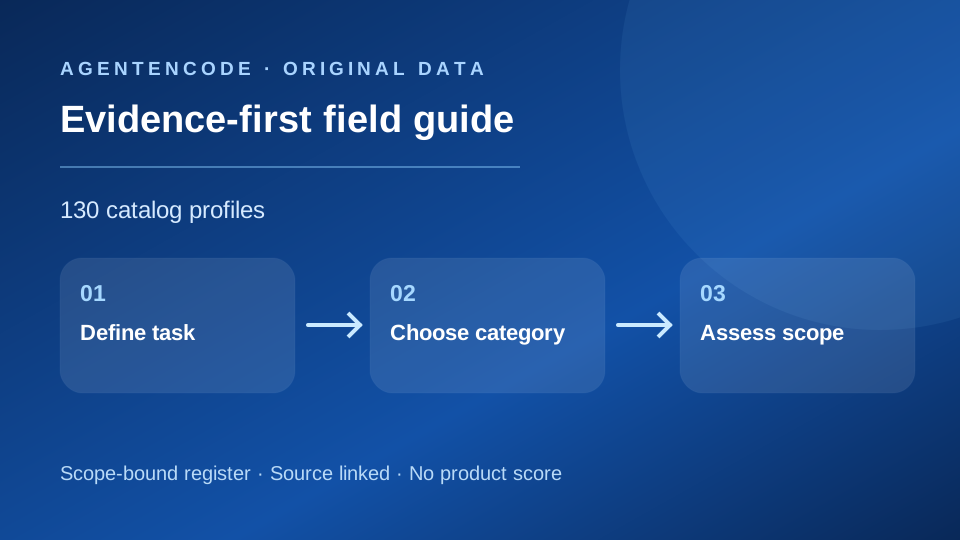
Our 2026-10-08 catalog contains 130 profiles. For example, it tags 25 as coding, 10 as research and 29 as automation. These categories describe a curated sample, not market share.
Three documented agent examples
These deliberately different profiles illustrate how application scope changes what the concept means:
ChatGPT Deep Research OpenAI
AgentenCode records ChatGPT Deep Research (OpenAI) in the Research segment. Use the individual profile to check the exact product, plan and deployment limits rather than projecting another agent's abilities onto it.
Claude Code Anthropic
AgentenCode records Claude Code (Anthropic) in the Coding segment. Use the individual profile to check the exact product, plan and deployment limits rather than projecting another agent's abilities onto it.
Salesforce Agentforce Salesforce
AgentenCode records Salesforce Agentforce (Salesforce) in the Enterprise segment. Use the individual profile to check the exact product, plan and deployment limits rather than projecting another agent's abilities onto it.
Method: the named profiles come from the AgentenCode catalog (snapshot 2026-10-08). Protocol relations, where shown, come from the explicit AgentenGraph relation set (snapshot 2026-10-05). This is editorial interpretation of primary-source-backed records, not independent hands-on testing, formal certification, proof of production deployment or an exhaustive market census. Unknown does not mean false. Read methodology →.
Research agents
Research agents search for information, inspect documents, compare sources and synthesize findings. Strong products expose citations or source links and make it possible to distinguish retrieved evidence from generated interpretation.
Important comparison points include source quality, browsing capability, file support, depth of research, traceability and whether the agent can continue from earlier work.
Coding agents
Coding agents inspect repositories, edit files, run tests and sometimes work asynchronously in local or cloud environments. Their value depends not only on model quality but also on repository context, terminal access, sandboxing and review workflows.
Organizations should compare permission boundaries, network access, branch or pull-request behavior, execution isolation and model-selection policies.
Workflow and automation agents
These agents connect tools and business systems to carry work across multiple steps. Some are built inside automation platforms; others are persistent agents that can respond to schedules or events.
Key questions include connector permissions, credentials, trigger conditions, human approval and whether an action can be rolled back.
Service, sales and data agents
Customer-service agents handle conversations and business actions such as ticket updates. Sales agents can research accounts or support outreach. Data agents query governed data sources, analyze changes and may trigger follow-up actions.
The risk profile varies with the systems involved. A read-only research agent is very different from an agent that can modify CRM records or send external messages.
Enterprise agent platforms
Enterprise platforms provide agent builders, orchestration, identity, governance and connectors rather than only one preconfigured agent. They are often evaluated on SSO, RBAC, SCIM, audit logs, deployment controls, data handling and administration.
Platform features should not automatically be assumed to apply to every individual agent or plan. Scope remains part of the evidence.
Classifying by autonomy
Agents can also be grouped by how they act: read-only analysis, recommendation, action with approval, or autonomous action inside a bounded scope. This classification is often more useful for governance than the product category alone.
Single-agent and multi-agent systems
A single agent can use many tools. A multi-agent system uses multiple specialized agents or roles. Multi-agent designs can improve specialization but add coordination, handoff and observability challenges.
Choose the simplest architecture that reliably solves the task. More agents do not automatically mean better results.
Frequently asked questions
What is the most common type of AI agent?
There is no single dominant category across all markets; research, coding, automation and enterprise agents solve different problems.
Can one product belong to several categories?
Yes. Categories are editorial navigation aids, while the underlying capabilities are stored separately.
Which type is safest?
Risk depends more on permissions, data, actions and controls than on the category label.