

Agent profile · Coding
OpenCode
Provider: OpenCode
OpenCode is classified by AgentenCode as an open-source coding agent from OpenCode. It belongs to the Coding category. This English profile does not maintain a separate factual record: it renders the same underlying evidence, trust and history data as the German profile.
Documented references: 2Trust documentation: 1 of 36 controls documented (not a score)
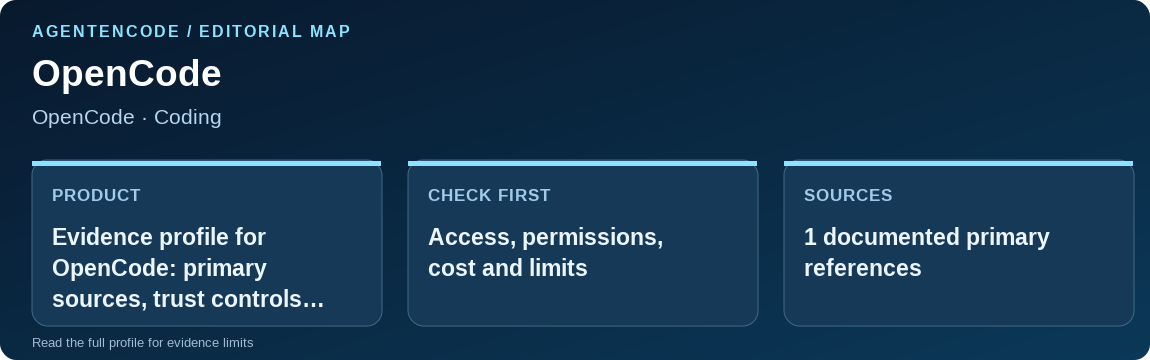
Source-backed decision graphic
OpenCode — decision overview
Product context, adoption checks and primary references at a glance. The article below explains the evidence and limitations.
Overview & direct answer
Codingeditorial classification
OpenCodeprovider
3 primary sourcessource status
September 30, 2026last verification
AgentenTrust 2.0 · EU & governance evidence
What is OpenCode?
OpenCode is classified by AgentenCode as an open-source coding agent from OpenCode. It belongs to the Coding category. This English profile does not maintain a separate factual record: it renders the same underlying evidence, trust and history data as the German profile.
Capabilities & how it works
Capabilities, strengths and deployment checks for OpenCode
OpenCode is classified as Open-Source Coding-Agent from OpenCode. The profile’s editorial layer is derived from the stored use cases, strengths and checks below; claims about security, privacy or governance remain separate and require field-level evidence.
Codebasis analysieren
This use case is part of the stored profile for OpenCode. The related strength is “Open Source”. In a production evaluation, the practical boundary to verify is: Modellprovider und Datenflüsse dokumentieren.
Dateien ändern
This use case is part of the stored profile for OpenCode. The related strength is “Flexible Modellwahl”. In a production evaluation, the practical boundary to verify is: Shell- und Dateirechte minimieren.
Terminalbefehle ausführen
This use case is part of the stored profile for OpenCode. The related strength is “Terminal-Workflow”. In a production evaluation, the practical boundary to verify is: Änderungen mit Tests und Review absichern.
Modell- und Tool-Experimente
This use case is part of the stored profile for OpenCode. The related strength is “Erweiterbar und lokal integrierbar”. In a production evaluation, the practical boundary to verify is: Modellprovider und Datenflüsse dokumentieren.
Use cases & workflows
No further product-specific evidence is documented in this section.
Access, pricing & limits
No further product-specific evidence is documented in this section.
Privacy, security & trust
Trust, privacy and control evidence for OpenCode
Direct answer: AgentenCode currently documents 1 of 36 normalized trust controls for this profile. Missing fields remain Unknown and are never automatically interpreted as “no”.
EU AI ActEvidence context only. AgentenCode does not infer legal applicability or compliance from individual product controls.
GDPRPrivacy and security signals are documented field by field. Data residency alone is not a compliance or transfer assessment.
Important: these numbers show evidence coverage, not a product rating. 0 of 10 means that no field-level public evidence is stored for those ten controls in the current dataset. It does not mean the product lacks those capabilities.
One documented tool permission control (1/36).
OpenCode v2 documentation describes configurable allow/ask/deny rules for actions and tools. This is evidence of available configuration, not safe defaults, mandatory human approval or independently validated enforcement. All remaining 35 fields are unknown.
Official OpenCode v2 permissions documentation · source reviewed October 31, 2026.
Field-level evidence
Documented controls and values from primary sources.
Documented yesDocumented valueUnknown remains unknown
High confidence
API · Rest
Yes — documentedOpenCode exposes a documented HTTP/OpenAPI server API.
Scope: opencode_local_server · verified 2026-10-01 ·
Primary source ↗ High confidenceHosting · Self Hosted
Yes — documentedOpenCode supports a local user-managed agent runtime.
Scope: opencode_local_agent · verified 2026-10-01 ·
Primary source ↗ High confidenceProtocols · Mcp · Client
Yes — documentedOpenCode acts as an MCP client.
Scope: opencode_agent · verified 2026-10-01 ·
Primary source ↗Evidence-backed overview
Alternatives & decision
Decision context
Provider and category
OpenCode is documented under Coding and is associated with OpenCode. Category labels help navigation but do not replace product-specific evidence.
Verification status
The public profile is marked editorially reviewed and was last checked on September 30, 2026.
Trust coverage
1 of 36 normalized trust controls currently have field-level public evidence. The remaining controls are not treated as negative findings.
Source-first use
For procurement, security or legal decisions, use the linked primary sources and verify the plan, region and configuration that apply to your organization.
In-depth analysis
Product-specific evidence for OpenCode
This profile links 4 unique primary sources across the product profile, field-level evidence, trust controls and documented relations. The points below describe this product’s stored evidence rather than generic characteristics of Coding.
protocols · mcp · client
Yes · Scope: opencode_agent · verified 2026-10-01.
Primary source ↗hosting · self_hosted
Yes · Scope: opencode_local_agent · verified 2026-10-01.
Primary source ↗api · rest
Yes · Scope: opencode_local_server · verified 2026-10-01.
Primary source ↗AgentenCode treats this page as a reference profile rather than a ranking. Product facts are separated from editorial classification, and the profile is tied to a specific verification date. If a capability is not backed by sufficiently precise public evidence, it remains unknown instead of being inferred from marketing language or from similar products.
1primary source
3field-level evidence claims
0documented trust controls
1history events
How to read the evidence
The field-level evidence layer records a value, a scope, a confidence level, a verification date and one or more primary sources. Scope matters: an enterprise-only security feature must not be generalized to every plan or deployment surface. The same rule applies to hosting, privacy, audit and protocol claims.
AgentenCode also keeps Unknown distinct from false. A missing claim means the public dataset does not currently contain sufficiently precise evidence for that field. A negative value is used only when a reliable primary source explicitly documents a restriction or non-availability.
What to verify before adoption
- Modellprovider und Datenflüsse dokumentieren. Treat undocumented controls as Unknown and verify the exact plan, region and deployment scope.
- Shell- und Dateirechte minimieren. Treat undocumented controls as Unknown and verify the exact plan, region and deployment scope.
- Änderungen mit Tests und Review absichern. Treat undocumented controls as Unknown and verify the exact plan, region and deployment scope.
Editorial boundary: The use-case and strength descriptions are product-specific editorial context based on the stored profile. Trust, privacy and governance statements are only presented as facts when field-level primary-source evidence exists.
OpenCode 2: explicit major upgrade and discontinued session links
OpenCode's October 2026 changelog clearly separates the 1.x release line from OpenCode 2. Version 1 installations should not receive version 2 as a normal update: the documented transition is an explicit /update choice or opencode upgrade --major. The availability of a major upgrade is not proof that all existing plugins and configurations are compatible without changes.
A consequential privacy and collaboration change appears in v1.19.1 on October 15: session sharing through links was discontinued, including the related commands and importing sessions from share URLs. The October 16 release further clarifies the 1.x upgrade path. The OpenCode 2 changelog describes improved error handling for free usage limits and an option to hide free models from the catalog.
Editorial assessment: the installed major version matters to feature and security claims. Before migrating, verify account credentials, extensions, session retention and provider configuration. Release notes describe vendor-maintained changes, not independently reproduced compatibility results.
Evidence status: Maintainer/vendor release notes only. Historic full review and Trust evidence remain unchanged.
- OpenCode changelog: versions 1 and 2 ↗ 2026-10-21
Frequently asked questions
Frequently asked questions
What is OpenCode?
OpenCode is listed by AgentenCode as a coding agent or agentic product from OpenCode.
How much trust evidence is documented for OpenCode?
The current trust layer documents 1 of 36 normalized controls. Missing controls remain unknown rather than being treated as false.
When was this profile last checked?
The current profile verification date is September 30, 2026. The linked primary sources remain authoritative if the product changes between checks.
Method note: AgentenCode does not certify GDPR or EU AI Act compliance. It documents evidence that can support a separate legal, security or procurement assessment.
Content updated October 21, 2026 · Source-scoped
Source-scoped default-permissions caveat · 1 November 2026: Official OpenCode v2 docs show a broad initial allow policy, with ask for certain .env reads. Without configured external_directory rules, access outside the working tree may proceed without prompting according to its v2 documentation. Teams must configure ask/deny and organization policies deliberately. Official v2 permission rules. Do not conflate v1 configuration or documented controls with runtime security validation. Full-profile date remains 30 September 2026.
Sources & updates
Verified history
The public history layer records only confirmed profile changes and verification events. Monitoring signals are not published as product facts until they have been reviewed.
- September 30, 2026 · New profile
Official sources
This profile links 3 unique primary sources across the product profile, field-level evidence, trust layer and documented relations. Provider documentation remains authoritative when the product changes between verification cycles.
EXPLORE
Knowledge for this use case
General references for this use case, not claims about this product.
Related news and analyses
Editorial coverage of this product or ecosystem. News does not automatically update verified profile facts.