
Gemini Decision 1: Google speeds up multimodal AI classification
Google's Gemini Decisions API evaluates up to 1,000 questions against one multimodal input. An analysis of probabilities, latency, price and limitations.
A model that scores choices instead of writing essays
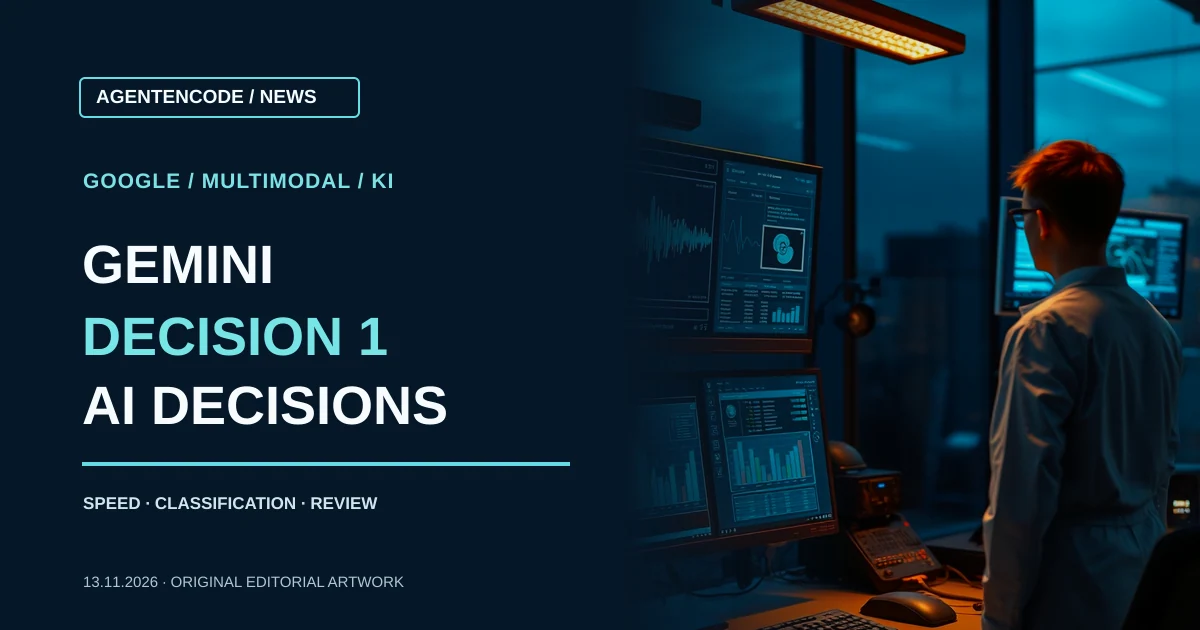
Most large language models generate words one token at a time. That is valuable for open-ended conversations, but often unnecessary when an application needs to classify a document, flag a risk or choose which team should review a case. Google's Gemini Decisions API, announced on November 11, takes a more constrained approach.
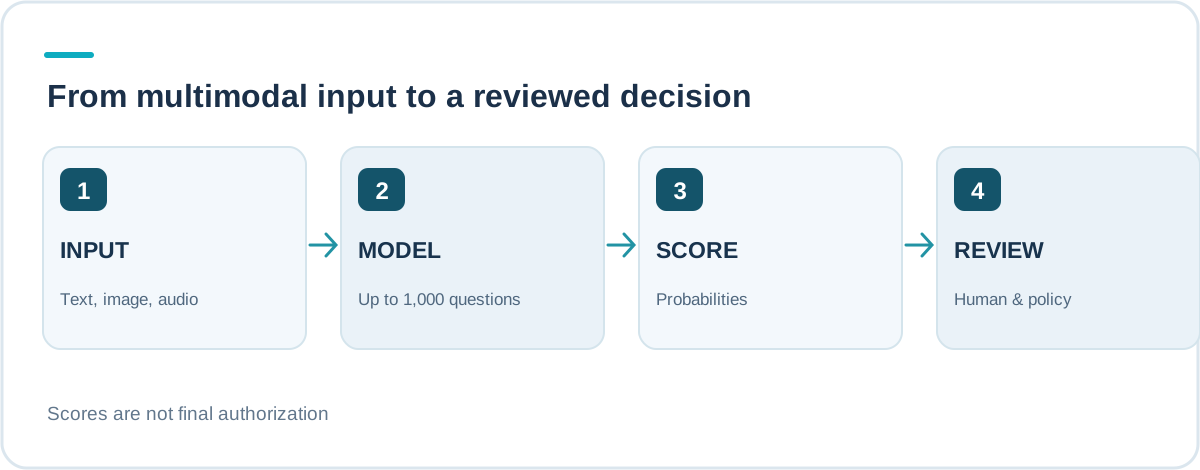
Its `gemini-decision-1` model evaluates yes/no checks, multiple-choice options and ordered rubric scores. Applications receive probabilities and confidence scores rather than lengthy answers. Google positions it as a building block for software workflows, not a replacement for a conversational assistant.
One multimodal input, up to 1,000 questions
Google says developers can send up to 1,000 independent questions about one shared input, with text, images, audio, video and PDFs supported in contexts of up to 256,000 tokens. The same incoming file can be checked against several defined categories without issuing a new generation prompt for every question.
For example, a claims application might evaluate a submitted form and damage photo against eligibility, severity and manual-review rules. That is an illustrative workflow, not an independent AgentenCode test of an insurer's deployment.
How to interpret the speed and price claims
Google quotes 150–250 milliseconds end-to-end and a listed price of $0.10 per million input tokens, with no output-token charge. The specific low compute-latency claims in the launch post concern shorter benchmark contexts and should not be extrapolated to maximum-size video or document inputs.
Google also reports nearly fivefold lower costs than Gemini 3.5 Flash-Lite in a shared benchmark suite. Real deployments still incur data processing, retrieval, integration, monitoring and human-review costs. Independent validation in the target workload is necessary before adopting the comparison as an ROI estimate.
Why this matters beyond chatbots
Decision endpoints could become common infrastructure in products that need many small, repeatable classifications. Google points to model routing, policy checks, tool selection and context evaluation. A system could therefore ask an inexpensive classifier to route a request before calling a larger reasoning model.
For AI agents, this offers a potential intermediate layer between receiving a task and executing an action. It does not grant tool permission or replace a host application's authorization logic. Our agent directory and agent security explainer cover those separate controls.
Probabilities are not ground truth
A confidence score looks numerical and precise, but it can be miscalibrated for unfamiliar customers, rare events or changed categories. False positives and false negatives have different costs, especially in regulated workflows such as lending, employment or healthcare.
Teams should test representative cases, measure calibration, and preserve a human review path for ambiguous results. A low-latency endpoint is only useful when mistakes can be detected and corrected.
AgentenCode assessment: start with a bounded pilot
Our assessment is that specialized scoring APIs could make multimodal AI deployment more economical. A sensible pilot would compare error rates, latency and total cost against existing rules and generative alternatives. The final decision should rest on operational evidence, not a vendor leaderboard alone.
The deeper architectural shift is from asking a general model to write everything toward assigning bounded tasks to specialized services. For a related development, see Google's A2UI interactive interface protocol.
Frequently asked questions
Can Gemini Decision 1 approve a business transaction?
It returns classifications and scores; access control, policy enforcement and final authorization remain the application's responsibility.
Does Google guarantee 1,000 questions in 150 milliseconds?
No. Maximum question count and the quoted latency figures have different context and benchmark conditions.
Are the weights freely available?
The launch describes a hosted Gemini API and AI Studio service, not a release of open model weights.
RESEARCH & CONTEXT
Sources for this article
This analysis relies on the original publications linked below, which readers can inspect directly.
- Google DeepMind – Gemini Decisions API (11 November 2026)
- Google AI for Developers – Gemini API pricing and availability
Checked November 13, 2026. Vendor claims are identified and political discussion topics are not treated as adopted measures.