
Google A2UI 1.0: AI agents get interactive screens, not just answers
Google ships A2UI 1.0 for agent-generated interfaces. We examine MCP Apps, native renderers, approvals and uneven platform version support.
From conversational answer to usable interface
An AI agent can compare three offers in a long answer. Choosing one, confirming a reservation or examining trade-offs is harder when the result is only prose. On November 11, 2026, Google released A2UI 1.0, the first stable version of an open protocol for agents to describe interactive interfaces.
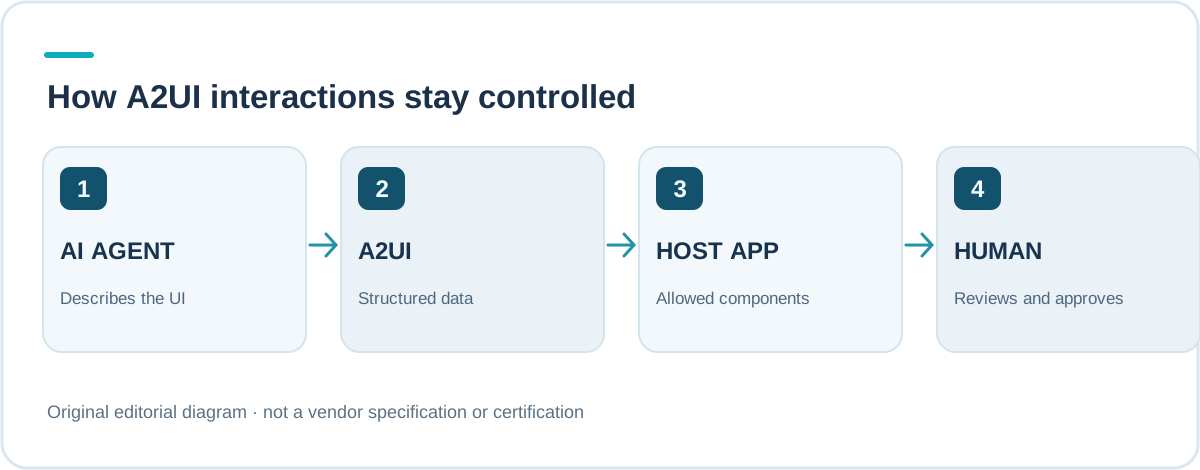
The host application renders those instructions with components it already controls. The model does not receive a blank check to run arbitrary frontend code. The distinction between an agent describing an interface and an application deciding what it may render is central to the design.
What actually ships in 1.0
Google says the stable protocol adds bidirectional function calls, accessibility support and metadata extensions. A picker can check a live option or update a dependent field while a person remains in the same workflow, instead of turning every step into another chat message. The official A2UI project documentation covers the protocol, components and renderers.
The project provides open-source renderers for React, Angular and Lit, along with Flutter and SwiftUI, plus agent-side SDKs for Python, TypeScript and Dart. Platform support is uneven: Jetpack Compose remains at 0.9.1, with 1.0 planned. Some Gemini deployments also currently support 0.9.1 rather than the full new version.
How it fits with MCP Apps
A2UI complements MCP Apps; it does not replace the Model Context Protocol. MCP-based integrations connect assistants to tools and applications, while A2UI specifies the interactive output an agent can ask a host app to draw. Google says the web and Flutter renderers can run inside MCP Apps.
This could make agent results easier to review across first-party products and external assistants. It does not remove the need for a secure host renderer, correctly scoped data bindings and tool-specific permission checks.
A visible approval is not an authorization system
A neatly designed confirmation card does not itself authorize a payment, CRM change or data export. The app still needs a verified actor, an allowed operation and, where needed, an explicit human approval. An agent should not be able to smuggle additional writes into the same visual flow.
Teams should test untrusted agent messages against their component catalog and interaction handlers. An attacker may not need to run arbitrary code if a misleading interface convinces a user to approve the wrong action.
Evidence and maturity
The Google release confirms a stable protocol and working SDKs, not universal adoption or independent security certification of every implementation. Google highlights early deployments and integrations by Atlassian, Alation and ByteDance, but those case studies are not substitute performance benchmarks for another organization.
Production readiness is therefore a question about the exact renderer version, supported interaction types, host access rules, mobile accessibility and failure behavior. A prototype rendering one successful card is a useful start, not an end-to-end reliability test.
AgentenCode assessment: pilot a bounded task
A good first test is a read-only comparison workflow or a low-risk approval flow. Measure whether people make fewer mistakes, whether tool calls stay within the approved scope and whether screen-reader and mobile use remain clear.
Our assessment is that agent-generated UI can become an important interoperability layer. The real quality advantage will belong to teams that connect it to reliable data and permission checks rather than merely making more attractive cards. For context see our earlier A2UI and CopilotKit article and agent security guidance.
Frequently asked questions
Does A2UI authorize agent actions?
No. It describes interactive output. The host application remains responsible for access control and confirmation.
Is A2UI 1.0 on every supported platform?
Not yet. The stable protocol is available, but some renderers and Gemini integrations still use version 0.9.1.
Is A2UI the same as MCP?
No. A2UI can render inside MCP Apps, while MCP provides the tool and application connectivity.
RESEARCH & CONTEXT
Sources for this article
This analysis relies on the original publications linked below, which readers can inspect directly.
- Google Developers Blog – A2UI 1.0 (11.11.2026)
- A2UI – offizielle Projektdokumentation
- A2UI + CopilotKit – Google Entwicklerbericht (29.10.2026)
Checked November 13, 2026. Vendor statements are identified as such; we conducted no independent product benchmark or security certification.