
Personal AI agent on a Pentagon network? The disputed report and its security lessons
A WIRED investigation alleges a privately linked AI coding agent on a sensitive defense system. Accenture denies the allegations. The bigger issue is accountable access and enforceable tool boundaries.
WIRED reported on October 29 that, according to anonymous sources, an Accenture employee allegedly linked a personal Claude Code agent to a US Defense Department system for roughly two months. The account suggests credentials and network details may have reached a risky third party. Accenture told WIRED it investigated and found the allegations without merit. The incident has not been independently established.
What is documented—and what remains open
Reported facts, original calculations and unverified allegations are separated.
- Original publication
WIRED – original investigation, Oct 29 2026
- Evidence limit
No independent case verification
No invented measurements, nor any cross-vendor security certification.
A serious allegation is not a forensic finding
WIRED's October 29, 2026 investigation describes the alleged use of a personally managed Claude Code agent inside a US Defense Department environment. Relying on sources who spoke anonymously, the publication reports that an Accenture employee connected the agent to a production system to write and deploy code. The arrangement reportedly persisted for about two months before it was identified and addressed.
If substantiated, the account would illustrate a significant class of security risk. Unlike a conversational assistant, a coding agent may invoke real tools and use existing identities to alter software and infrastructure. But the underlying incident is disputed, and AgentenCode has not seen publicly available forensic records that independently verify the specific access, transfers or timeline.
The two positions that must both appear in this story
According to WIRED's sources, a personal Claude account was connected to a secured environment with credentials that enabled code changes and certain administrative actions. Their account suggests that passwords and network information were sent toward a third-party site described as high-risk. WIRED did not publish the site's identity. These claims should be read as the allegations reported by the publication, not as findings established by our own technical inspection.
Accenture told WIRED that the allegations were thoroughly and independently investigated and found to be without merit, and that the firm fulfilled its legal and contractual duties. A Department of Defense spokesperson declined to comment on the status of the department's systems. Without further primary records, one cannot responsibly turn the disputed account into an independently verified security breach.
Sensitive does not always mean classified
The report locates the alleged environment in NIPRNet, a US military network used for unclassified information, and discusses Controlled Unclassified Information. Such data may include records and infrastructure details that are not classified but remain subject to disclosure restrictions. The absence of a classification label does not authorize the transfer of internal credentials or business data to an unrelated internet service.
The principle extends far beyond defense. Contracts, customer records, identity tokens, network maps and configuration files may all be highly consequential without appearing in a national-security secret store. An agent can create exposure without any intent to attack if it is configured with access and data destinations broader than the legitimate task requires.
A technical chain of trust boundaries
The pattern described by WIRED crosses several boundaries in sequence: an individually owned account, an internal identity, privileged credentials, executable tools, outside network connections and potentially a third-party application. When an agent is able to perform each step with little independent enforcement, untrusted instructions may become real actions in systems beyond the chat interface.
This is an editorial threat model derived from the allegations, not a reconstruction based on packet captures or incident logs. We have not verified which credentials, services or destinations were actually used. That distinction matters because controls can be discussed and improved without implying that every hypothetical consequence occurred in this particular disputed case.
| Boundary | Test |
|---|---|
| 1 · Owner | Approval documented? |
| 2 · Identity | Revoked token denied? |
| 3 · Tools | Forbidden write blocked? |
| 4 · Network | Unapproved egress blocked? |
| 5 · Audit | Decision traceable? |
Why personal accounts and production systems require separation
A personal coding assistant may be entirely appropriate for drafting, local experimentation and reviewing code. Production access imposes additional obligations: an accountable organizational owner, limited credentials, explicit tool privileges, approved data handling, expiration and revocation. A personal subscription is not, by itself, evidence that those obligations have been met.
Approval should distinguish accepting a generated suggestion from allowing an agent to modify a live repository or deploy new code. The moment a tool can write, privileged identity becomes a safety-critical resource. The product brand alone tells very little about whether a particular deployment was managed responsibly; permissions and actual execution paths determine the exposure.
Prompt injection is an authority problem
WIRED says the alleged third-party website was considered risky and describes a potential path for malicious instructions to influence an AI coding agent. It withheld the site's name. AgentenCode has not independently confirmed the alleged website vulnerability or an actual injection in this incident. Naming a specific attack as proven would exceed the available evidence.
More generally, an agent can read webpages, repository notes, search results and tool responses containing text written by people other than the authorized operator. If the agent treats that text as a privileged command, it may try to read secrets or send them elsewhere. The defense needs to operate outside the model, at tool authorization, credential scope and network egress.
Our original five-boundary control matrix
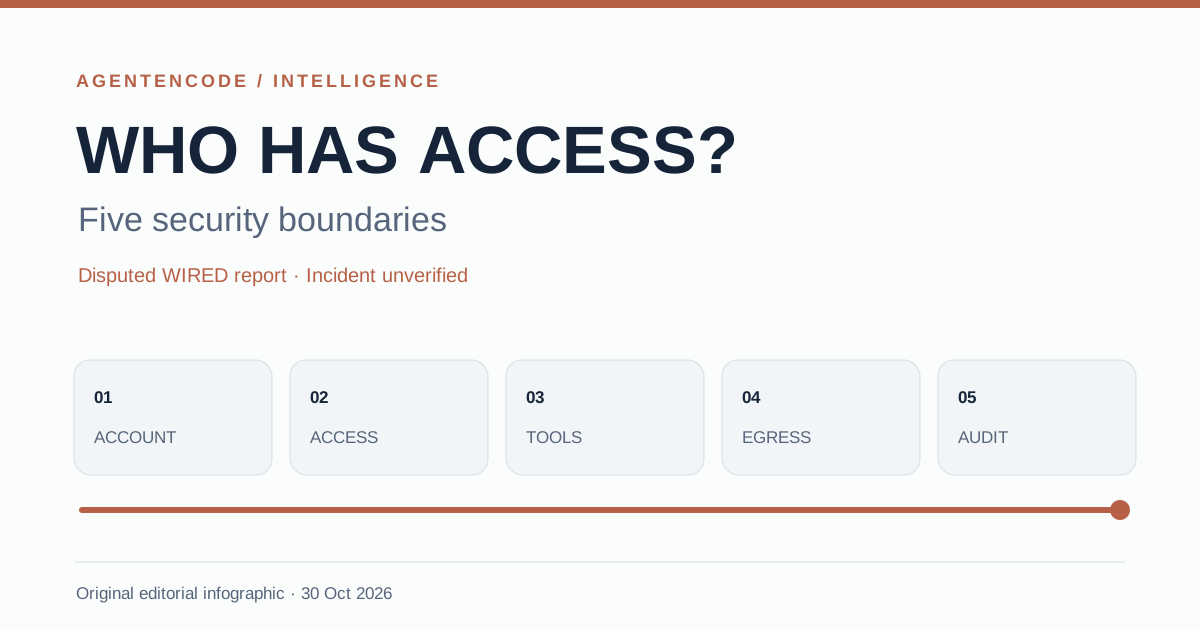
We propose five checkpoints for any agent allowed near sensitive systems. First, account and human ownership must be recorded. Second, credentials must have explicit scope and expiration. Third, dangerous tool calls must require enforceable approval. Fourth, outbound network destinations must be constrained. Fifth, audit trails must demonstrate alerts, denials and actual revocation. Each checkpoint should have a negative test rather than a vendor checkbox.
This is AgentenCode's own practical evaluation structure, not a new Pentagon dataset or certification of Accenture, Anthropic or any other supplier. A well-designed negative test asks the system to attempt a forbidden real-world action and checks that the call fails for the documented reason. An agent saying that it cannot comply is not sufficient evidence.
The significance of the reported two-month delay
WIRED's anonymous sources say the alleged agent connection continued for around two months before being identified. If the timeline is accurate, the issue is not merely whether the initial access was appropriately approved. It would also raise questions about continued discovery of active agents and the time needed to detect unexpected credentials or outbound connections.
The duration itself is a disputed reported claim, not an independently timed observation. Nevertheless, every organization can measure how long it takes from an unauthorized test connection to discovery, alarm and actual access revocation. Event collection alone offers little protection without a clear response process tied to those observations.
Incident reporting is different from containment
WIRED discusses notification obligations for certain US defense-contractor incidents and says its sources alleged the issue was not promptly reported. Whether this particular case met the legal definition and time requirements of a reportable incident cannot be resolved by a news story alone. A legal conclusion would require facts not publicly established here.
Enterprises should prepare documented roles for preserving evidence, disabling credentials and evaluating disclosure responsibilities before an incident occurs. Technical containment may be urgent but does not eliminate the need for an accountable decision on notification. A robust process also records when the possible issue was detected and which systems were actually affected.
No evidence here of a classified network compromise
The original article does not establish that classified Pentagon systems were breached. Security experts quoted by WIRED describe hypothetical ways in which malicious code introduced into one environment could later move into more sensitive development pipelines. Such possibilities are risk scenarios; they are not findings that a classified system was accessed in this case.
The public reporting does not establish that adversaries used the allegedly exposed credentials, either. Possible exposure, verified data transfer, confirmed malicious use and demonstrated damage are four very different evidentiary states. An independent analysis has to preserve those distinctions rather than turning worst-case speculation into a finished incident narrative.
Four reproducible tests for ordinary companies
Begin with an inventory of agents that can reach live repositories, cloud infrastructure, employee accounts or sensitive documents. Record their owners, legitimate purpose, expiration and narrowest necessary tool rights. Next, test four situations: malicious instructions hidden in an external document, an expired credential, an unapproved external destination and a production deployment attempted without permission.
The evaluation passes only when the real tool or network operation is blocked and an actionable audit trail identifies the reason. Repeat after adding a connector, upgrading a model or changing the owning employee. A refusal message from the model is useful context but is not proof that the underlying credential or network authorization has been withdrawn.
Why this is more than a Pentagon story
Most companies have no military systems, yet many are beginning to connect AI assistants to operational records, customer databases and development environments. The transition from advice to execution is what makes the reported scenario relevant to hospitals, banks, law firms and small organizations alike. Action authority brings responsibilities that cannot be outsourced to a conversational system prompt.
There is no reason to infer from the disputed story that Claude Code, or any coding-agent brand, is categorically unsafe. The meaningful generalization concerns unmanaged identities, overbroad permissions and unreviewed network paths. Those are deployment characteristics that should be tested regardless of the model's marketing claims.
Conclusion: verify the boundary, not just the explanation
WIRED published serious allegations and Accenture rejected their substance. AgentenCode cannot independently establish the reported Pentagon incident and does not describe it as a confirmed data breach. But the reporting provides a useful case through which to examine what happens when powerful agent tools inherit privileges in sensitive environments.
The lasting question is whether a real unauthorized tool call will be prevented, detected, explained and reversed. Reliable agent systems need clear ownership, least privilege, approved destinations, effective enforcement and auditable revocation. Security should be measured at those boundaries, not inferred from how convincingly a model describes its intentions.
Frequently asked questions
Has the alleged Pentagon incident been confirmed?
No. The central claims rely on WIRED's anonymous sources, and Accenture disputes the allegations.
Were classified US defense systems compromised?
The reporting does not establish that classified networks were accessed.
Does this prove Claude Code is unsafe?
No. A disputed account of one deployment cannot establish a product-wide security verdict.
What should teams test?
Identity ownership, narrow access, network egress, denied tool calls, auditable approvals and actual revocation.