
OpenAI acquires Orchestra Bio: What AI can prove in drug development
OpenAI combines Orchestra Bio with Rosalind. We separate documented drug-development workflows from unproven claims about faster treatments.
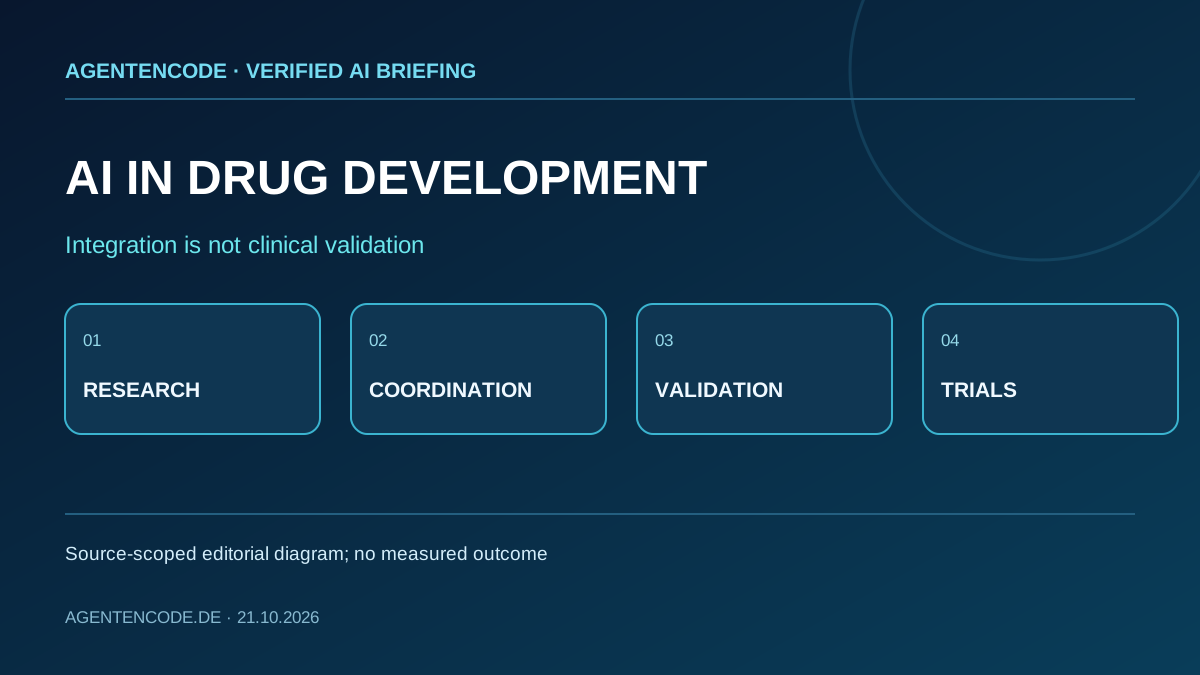
OpenAI acquired Orchestra Bio and plans to combine its workflow platform with GPT-Rosalind. The move may improve how research teams coordinate drug programs. Faster approved therapies have not been demonstrated.
Research teams coordinate laboratory results, trial planning, manufacturing and external partners across disconnected systems. Connecting experimental results to program-level decisions often requires manual work.
OpenAI intends to integrate Orchestra Bio with Rosalind so agents can map dependencies, studies, decisions and next steps. Measured effects on development timelines remain unknown.
What did OpenAI actually announce?
On October 20, OpenAI said it acquired Orchestra Bio, a platform for teams to coordinate drug-development programs with human and AI agents. Orchestra's software and team are to join Rosalind, OpenAI's collection of models and tools for life-sciences research. GPT-Rosalind helps researchers reason through biological and chemical questions, while Rosalind Workbench connects models to specialized tools and scientific data. That is a documented strategic and software integration, not evidence that a new drug has passed clinical trials or received regulatory approval.
Why coordination is part of the scientific challenge
A laboratory result is only one stage of developing a medicine. OpenAI describes an example in which a failed manufacturing batch delays a clinical trial and affects multiple dependent tasks. Orchestra aims to map those dependencies, collect relevant information and compare possible responses. Scientists and program leaders still need to judge the evidence and authorize decisions. OpenAI's announcement does not provide a controlled study quantifying time saved, improved trial outcomes or fewer development failures. Claims of speed should therefore be kept separate from demonstrated medical results.
What access and evidence can we verify?
The dated acquisition release supports the fact that OpenAI announced the transaction and its planned integration. A separate October 15 announcement provides concrete boundaries for Rosalind's academic access: eligible US university labs can apply for up to 30 seats for as long as twelve months, with vetting required and API access excluded from that plan. That is not universal availability. Independent clinical endpoints, laboratory validation, cost savings, error rates and comparative studies of the integrated platform have not yet been disclosed in these sources.
What this means for the broader AI industry
The development is part of a wider shift from general-purpose chat models toward specialized software embedded in consequential professional workflows. Life sciences are especially demanding: a plausible hypothesis is not an experimentally validated finding, and neither is an approved treatment. Regulatory review, reproducibility, scientific oversight and sensitive-data controls remain separate obligations. Integrating multiple AI tools can make a process easier to navigate, but it cannot on its own establish that the underlying biology is correct.
AgentenCode assessment
The acquisition supports a clear strategic conclusion: foundation-model providers are expanding into coordinated scientific workflows. It does not yet demonstrate faster, safer or more successful medicines. Meaningful proof will require external evaluation, validated outcomes and audit-ready research trails.
Sources and fact-checking
Reporting and source claims are evaluated separately. Vendor descriptions are not independent proof of effectiveness. Source dates and editorial review dates are distinct.