
OpenAI Daybreak: AI agents test web apps and prepare security fixes for review
Daybreak Red Team and Defense Factory use AI agents to investigate web vulnerabilities and prepare fixes for human review. Access, guardrails and limitations explained.
From a finding to a tested fix
Security teams frequently struggle more with validating and fixing a long backlog than with producing another scanner alert. Reproducing bugs, tracing affected code and confirming a safe change require substantial engineering work.
OpenAI Daybreak Red Team and Defense Factory aim to join these phases through specialized agents and existing security tools. The products do not remove the need for authorized tests or human accountability for production code.
Daybreak Red Team beyond basic scanning
According to its product page, Daybreak Red Team coordinates agents that inspect web applications using source code and application context, verify reported vulnerabilities and examine whether proposed fixes stop a reproduced issue.
OpenAI describes isolated testing environments and Guardian controls that restrict authorized targets. Access is presented as early access, not as an unrestricted public testing service for third-party infrastructure.
Defense Factory connects issues to patches
Defense Factory consumes findings from existing tools or Daybreak Red Team, traces them through code and prepares a concrete patch for review. Engineers can inspect evidence, edit with Codex and test the resulting change before merging.
OpenAI also describes recurring checks as repositories change. The distinction matters: a model-generated patch is an engineering proposal, not an approved deployment or proof of full security.
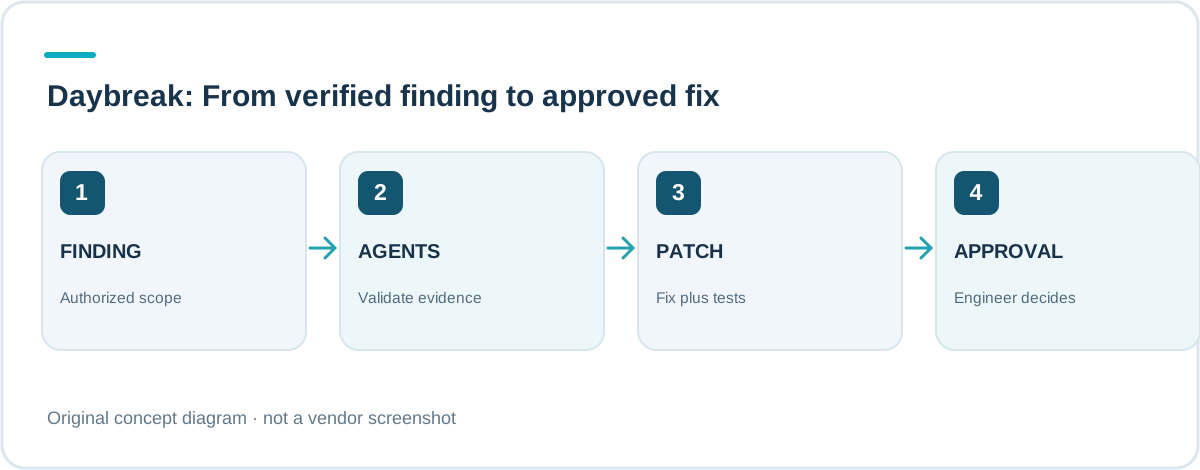
What a safe workflow looks like
A bounded workflow starts with an explicitly authorized application. A scanner supplies a possible issue. An agent reviews code and attempts to reproduce it in a disposable environment while retaining evidence, followed by an agent proposing a narrowly scoped fix and repeatable regression tests.
Human engineers then evaluate side effects and whether unit, integration and security suites still pass. Critical deployments also need change management and rollback plans. Autonomous tools should not bypass these controls.
Why AI output cannot certify security
Agents can misunderstand dependencies, prioritize false positives or react to malicious content in source files. A single successful negative test does not rule out other exploit variants or affected endpoints.
The Defense Factory overview emphasizes isolated environments and reproducible workflows. Vendor descriptions should not be confused with independently measured false-positive rates or audited protection guarantees.
Eligibility and responsibility
Daybreak Red Team focuses on authorized testing and currently advertises restricted early access. Teams must establish scope, protect secrets, log activity and review the blast radius of every tool permission.
The AI agent security guide and AgentenTrust provide broader evaluation criteria for control, accountability and evidence outside any one vendor's marketing.
How to pilot responsibly
Begin in a small test environment where security engineers already understand the expected faults. Compare confirmed issues, missed problems, false alarms, reliable patches, repeatability and human review time.
Do not compare unbounded vendor demos with professional penetration testing under different constraints. Production validation requires documented permissions, boundaries and independent assessment.
AgentenCode verdict: The evidence chain is the advance
The significant change is connecting discovery, reproduction, remediation and retesting in a traceable workflow instead of producing another unreviewed AI report.
Whether the service delivers broad value depends on measured reliability, access terms and the quality of patches under real deployment constraints. Its launch is notable, but not proof that autonomous agents can replace a security team.
Frequently asked questions
Can anyone use Daybreak Red Team against arbitrary websites?
No. Access is restricted and intended for authorized, scoped security work.
Does Defense Factory deploy fixes automatically?
OpenAI describes preparing patches and tests for engineer review before merge, not unreviewed production changes.
Does it replace penetration testers?
No. Human authorization, scope definition, independent testing and security review remain necessary.
What do security agents add?
They can help inspect code, validate findings and prepare reproducible tests and patches while operating within explicit boundaries.
RESEARCH & CONTEXT
Sources for this article
This analysis relies on the original publications linked below, which readers can inspect directly.
- OpenAI Daybreak – Red Team: authorized AI-assisted security testing
- OpenAI Daybreak – Defense Factory: investigate findings and propose tested patches
- OpenAI – The Defense Factory: continuous defensive security workflows
Checked November 14, 2026. Vendor statements, pilot scope and preview benchmarks have not been independently reproduced or certified.