
AgentenCode News · October 18, 2026 · Coding agents · model lifecycle
GitHub Copilot will retire three models on November 16
GitHub plans to retire Claude Opus 4.8, Opus 5 and GPT-5.6 Terra across Copilot experiences, including agent mode, on November 16, 2026.
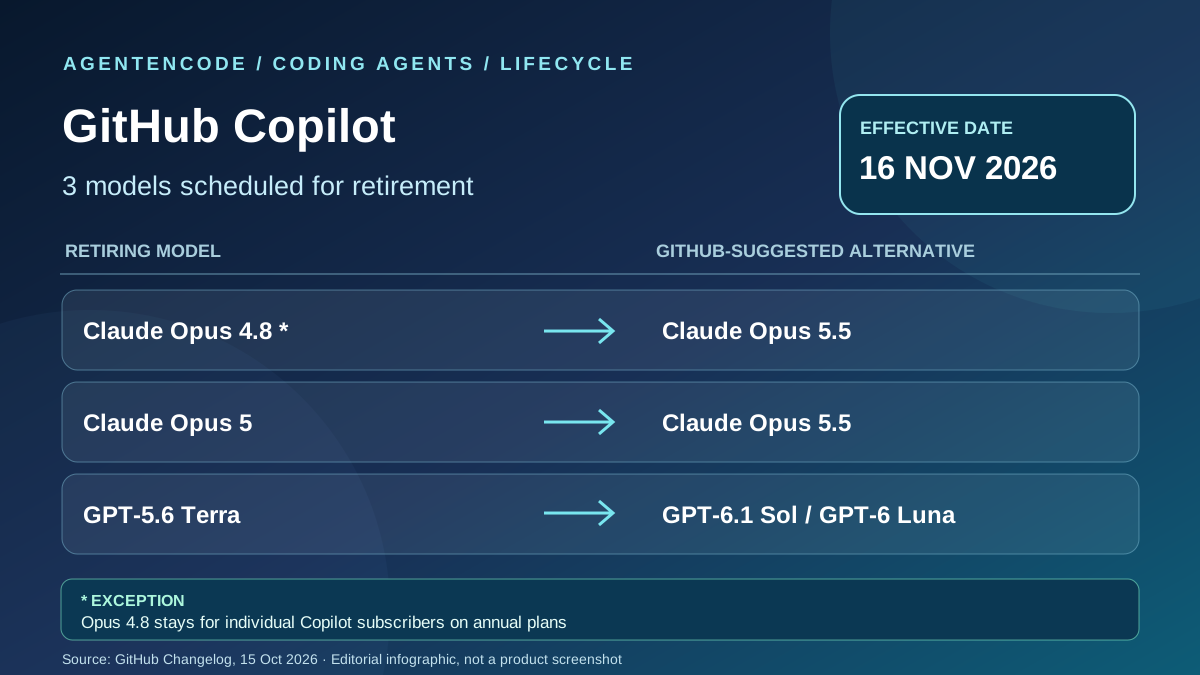
In brief
GitHub will retire three Copilot models on November 16, 2026, including in agent mode. The announcement includes a specific annual-plan exception for Claude Opus 4.8.
What GitHub actually announced
On October 15, 2026, GitHub announced an upcoming change to its GitHub Copilot model lineup. Claude Opus 4.8, Claude Opus 5 and GPT-5.6 Terra are scheduled for deprecation on November 16, 2026. The official changelog explicitly covers Copilot Chat, inline edits, ask and agent modes, and code completions. This makes the announcement relevant to teams relying on selected models in agent-assisted development. It does not say that the GitHub Copilot Coding Agent product is being discontinued: the change concerns particular model choices inside Copilot.
Which models and replacements does GitHub name?
GitHub suggests Claude Opus 5.5 as an alternative to both Claude Opus 4.8 and Claude Opus 5. For GPT-5.6 Terra, it lists GPT-6.1 Sol or GPT-6 Luna. These are the vendor's suggested replacements, not independently verified recommendations from AgentenCode. The announcement provides no evidence that existing prompts, coding tasks and tool-use decisions will produce identical outcomes after a model change. Teams should test important workflows instead of assuming functional or cost equivalence.
The subscription exception and enterprise policies
An explicit exception matters. GitHub says Claude Opus 4.8 will remain available to individual GitHub Copilot subscribers on annual plans, who are therefore not affected by that model's November retirement. This exception must not be generalized to Copilot Business or Enterprise, nor to Opus 5 or GPT-5.6 Terra. Subscription terms and model policies determine the actual options for each customer. An accurate internal migration note needs to preserve that distinction.
GitHub also explains the enterprise policy behavior. Under default model enablement, the suggested alternatives are automatically enabled for Copilot Business and Copilot Enterprise unless an administrator has disabled the global default or explicitly blocked a model. When the global default is off, administrators can enable alternatives through the model policies in Copilot settings. This concerns model availability. It should not be interpreted as a promise that every scripted agent workflow will migrate without operational changes.
What should teams do before November 16?
Before November 16, a practical first step is to identify teams, prompts and agent procedures that explicitly select one of the retiring models. Organizations can then assess the suggested alternatives with their own representative development tasks and human code review. Reviews should focus on traceable differences in outputs, tool calls, errors and operational controls, as well as any cost changes that can actually be observed. GitHub's source documents the retirement schedule and policy behavior; AgentenCode has not conducted independent comparison benchmarks.
My take: model lifecycle is a governance issue
My editorial view is that model retirement announcements deserve as much operational attention as new agent features. A team with an explicit model inventory, approval boundaries and repeatable test cases can prepare before a planned change. A team with undocumented model dependencies may only discover the impact when a workflow stops behaving as expected. That is a reasoned operational assessment, not a claim about measured performance of the listed alternatives.
GitHub Copilot: impact on agent mode
- Inventory explicit model choices in existing workflows
- Treat the annual individual-plan exception separately
- Review Copilot Business / Enterprise model policies
- Evaluate replacements with your own tasks and human review
A model change in Copilot does not automatically establish a capability change for every standalone coding agent. Consult the linked product profile and original vendor source for feature scope.
Frequently asked questions
Is GitHub discontinuing the Copilot Coding Agent on November 16?
No. GitHub documents the planned retirement of three models across Copilot experiences, including agent mode, not discontinuation of the Copilot Coding Agent product.
Are all Copilot subscribers affected in exactly the same way?
No. Claude Opus 4.8 is specifically exempt for individual Copilot subscribers on annual plans. Business and Enterprise model policies also determine which suggested alternatives are available.
Official primary source
Original announcement dated October 15, 2026; reviewed for this publication on October 18. The announced deprecation is scheduled for November, not an already completed removal.
GitHub Changelog – Upcoming deprecation of selected GitHub Copilot models in mid-November ↗
Agent profile / context
GitHub Copilot Coding Agent – related product context, model eligibility separately scoped →
Explore the coding-agent category →
Check your requirements with Agent Fit →
Author and transparency
Editorial assessment by Kai Schiller. His interpretation is marked as editorial opinion; product claims follow GitHub’s original announcement. No independent comparative testing was performed.