
AgentenCode News · October 18, 2026 · European businesses · agentic AI
OpenAI report: Agentic AI use rises in EU businesses
OpenAI reports an 8.1-fold increase since May in weekly active Codex and ChatGPT Work users among sampled EU SMB customers. What it means.
In brief
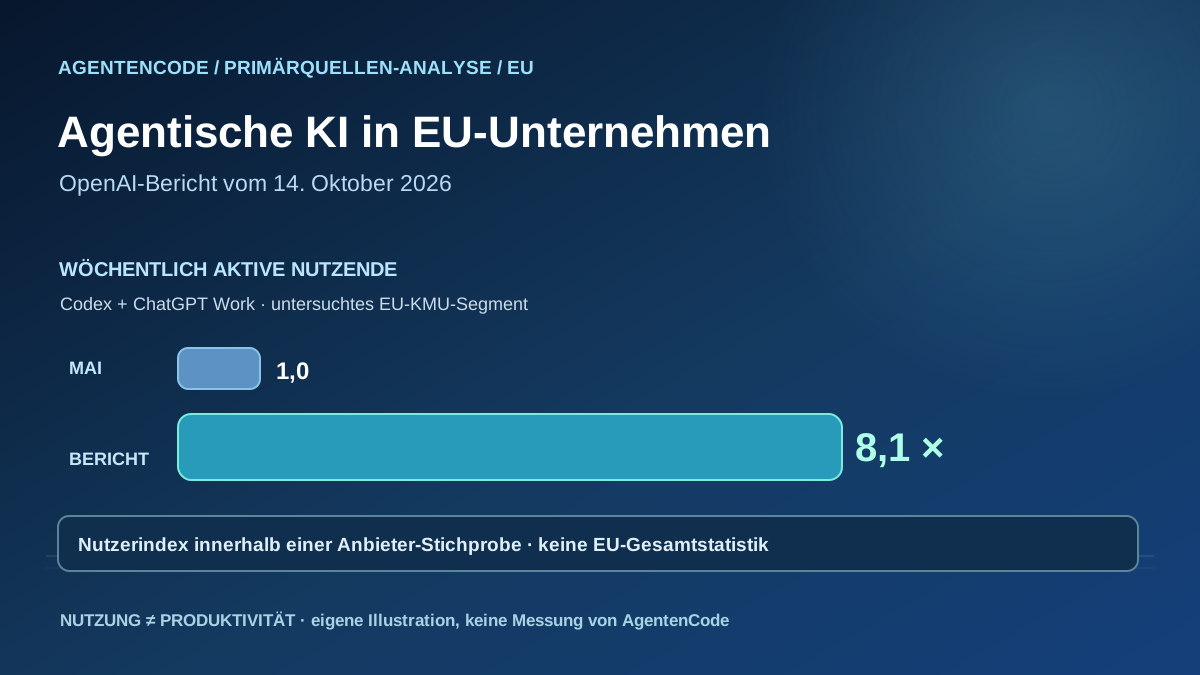
An October 14, 2026 OpenAI report says weekly active users of Codex and ChatGPT Work among sampled EU SMB customers reached 8.1 times their May level. That measures a single provider's customers, not all EU businesses or independently confirmed productivity.
What the new EU research actually covers
The report The EU’s next chapter in AI is agentic draws on OpenAI's own Business and Enterprise customer activity across Europe. Researchers examine how intensely organizations use agentic tools and what types of work they bring to ChatGPT. They define an SMB as an organization with at most 200 associated users for this study. That operational definition need not match legal EU small-business classifications.
Since May 2026, weekly active users of Codex and ChatGPT Work in the sampled EU SMB segment grew to 8.1 times the earlier level. Growth appeared in every member state. This does not establish eight times as many companies using agents across the wider EU economy. The population consists of users of selected products among OpenAI customers.
More than half of output tokens: important limitations
Within the sampled ChatGPT Enterprise accounts, Codex and ChatGPT Work now account for more than half of output tokens, OpenAI reports. Tokens measure generated output, not successful tasks, saved staff hours or profit. A tool that produces longer responses or more code can increase token volume regardless of whether its work is eventually accepted.
The reported share of agentic output tokens ranges from 22% in Slovenia to 85% in Lithuania among sampled Enterprise accounts. Those percentages are not a definitive ranking of national AI maturity. Customer mix, business functions and product access may differ across countries.
Top users and typical firms diverge
OpenAI defines frontier firms as the top tenth by output tokens per active user. In September these EU firms generated more than four times as many tokens per person as typical customers in the sample. Frontier companies outside the EU generated more than twice the per-person output of the EU frontier group. These are activity comparisons, not independently validated business-success indicators.
Executives should resist targeting token output as if it were return on investment. High output may come with extra review, waste or a different kind of task. Actual process reliability, correction rates, cost and accountability are more useful in purchasing decisions.
Codex and ChatGPT Work serve different purposes
Codex focuses on agentic software development; ChatGPT Work supports a broader set of delegated work tasks. Combined growth does not make their permissions, subscriptions or capabilities interchangeable. Availability and feature scope have to be established for each product and plan.
AgentenCode publishes separate profiles for OpenAI Codex and ChatGPT Work. Agent Fit can help identify and inspect documented requirements. These are product references; the research is not an independent benchmark.
A practical starting point for organizations
Start with one observable workflow such as approved research, sales-preparation or a scoped coding ticket. Define the human owner, permitted data, quality requirements and approval gates before expanding action rights. Compare error rates, rework, costs and time to final acceptance rather than relying on token consumption alone.
Our article Agentic Organizations explores organizational design. The business agent category offers further selection criteria, while AgentenFreigabe discusses controlled actions. These are our editorial recommendations, not findings measured in the OpenAI customer report.
AgentenCode · editorial perspective
My assessment: What the study means for businesses
My assessment: The 8.1-fold usage growth is a relevant adoption signal, not proof that businesses became 8.1 times more productive. For smaller companies, one well-governed workflow with measured quality improvements is worth more than dozens of activated tools. I would assess real outcomes, human approvals and full operating costs before investing broadly. This is an editorial interpretation, not an independent economic evaluation.
Personal editorial interpretation by Kai Schiller, not independent field research.
Four practical checks
- The 8.1 figure covers sampled OpenAI EU SMB customers
- Output tokens do not measure economic value
- Check product plans, tools and permissions separately
- Measure completed work, errors, corrections and costs
Vendor usage metrics do not establish features or plan availability of a specific agent profile. Capabilities and operating rights need their own evidence.
Frequently asked questions
Does the report mean eight times more EU firms now use agents?
No. It tracks weekly active users of selected OpenAI tools in the sampled SMB customer base since May.
Do output tokens prove higher productivity?
No. They quantify model output, not independently measured business outcomes.
Which agentic products are discussed?
Codex and ChatGPT Work, whose capabilities and access requirements must be checked separately.
Original sources and methodology limits
The report was checked against the provider's original research. This is internal research or usage evidence, not an independent product benchmark or a guarantee for the linked AgentenCode profile.
Agent profile / related context
ChatGPT Work – related product profile; check source and plan scope separately →
OpenAI Codex – eigenständiges Coding-Agentenprofil →
Agentic Organizations – organizational context →
Agent Fit: review requirements →
Author and transparency
Editorial assessment by Kai Schiller. Personal interpretation is separate from the first-party research. AgentenCode did not conduct independent product benchmarks.