
GitHub Copilot's six-model retirement date is today: What teams should check
GitHub scheduled six Copilot models for retirement on October 19. The recommended replacements and the implications for coding-agent workflows.
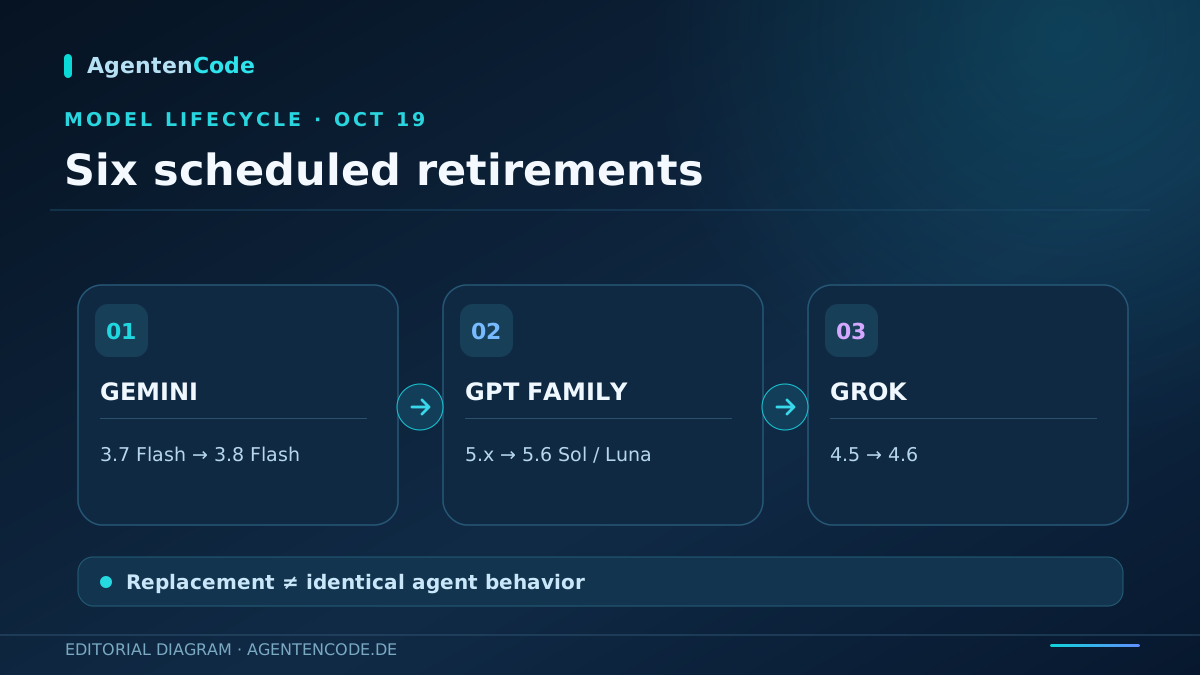
GitHub scheduled six Copilot models for deprecation on October 19, 2026: Gemini 3.7 Flash, GPT-5.5, GPT-5.4, GPT-5.4 mini, GPT-5 mini, and Grok 4.5. Its notice covers chat, inline edits, ask and agent modes, and completions. The announcement does not independently prove that every account has already switched today.
Before the stated deadline, organizations could select those older models in supported Copilot experiences, subject to their existing model settings.
October 19 is the scheduled retirement date. GitHub lists named replacement models, making policy checks and workflow regression tests timely today.
Six retirements and the proposed replacements
GitHub's migration table is explicit. Gemini 3.7 Flash maps to Gemini 3.8 Flash. GPT-5.5 and GPT-5.4 map to GPT-5.6 Sol, while GPT-5.4 mini and GPT-5 mini map to GPT-5.6 Luna. Grok 4.5 maps to Grok 4.6. These are vendor recommendations, not claims that answers, tool behavior, latency, or cost will remain identical.
The notice covers Copilot experiences broadly, including agent mode. A team that names a model in internal instructions, coding conventions, runbooks, or training material should check both the availability of that identifier and what the selected replacement actually does. Publication of a retirement date does not substitute for inspecting a live organizational environment.
Model policies matter as much as names
GitHub says suggested alternatives are enabled by default for Business and Enterprise customers when default model enablement is in force. However, administrators may have disabled that global setting or explicitly disabled individual models. In those cases, teams may need to enable replacements through Copilot's model policies rather than assume they will appear automatically.
GitHub says no manual action is required to remove retired models. That is a statement about their removal from Copilot, not a guarantee that existing workflows remain correct, secure, or equally useful. Central organizational model policies and user-facing selectors can also differ; an apparent choice in one Copilot interface should not be treated as proof of availability in every interface.
A practical regression check for coding agents
We recommend testing three real tasks: a multi-file code change, a debugging session requiring tools, and a pull-request review. Record the model shown, Copilot surface, elapsed time, corrections, and any approvals that changed. This checklist is AgentenCode's recommendation; GitHub has not promised a fully automatic quality-preserving migration.
GitHub published its notice on September 18. The news value today is the scheduled effective date, not a newly announced launch. Without inspecting individual accounts and execution logs, we cannot establish that the retirement has completed for everyone. Teams should therefore verify their configuration while clearly distinguishing the announced timetable from independently observed rollout status.
AgentenCode assessment
AgentenCode assessment: A disappeared model label is visible; subtle changes in agent output, approval behavior, and code review quality are harder to spot. A small representative regression suite is more useful than assuming a suggested substitute will behave identically. Treat the migration table as guidance, not performance evidence.
Sources and verification
Source check: October 19, 2026. This story relies on GitHub's original September 18 changelog with an October 19 effective date. We did not inspect production account settings or verify a completed rollout across all organizations.