

Agent profile · AI agents & automation
OpenBot 1.0
Provider: CopilotKit
OpenBot 1.0 brings AI coworkers into a modular workspace with browser tasks, files, routines and human approvals. Its application is open source, while CopilotKit Intelligence has a separate license.
Original evidence-based decision map
OpenBot 1.0 — Decision and approval boundaries
Product scope, supervision, and open questions before live agent actions.
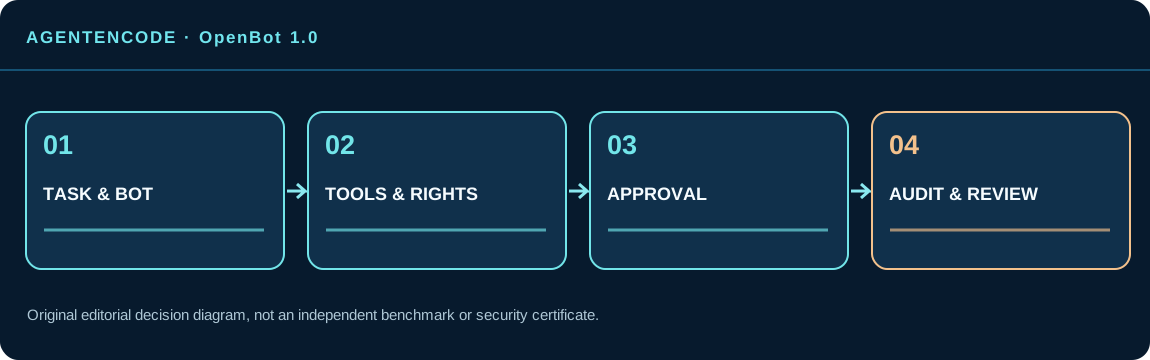
Overview & direct answer
What is OpenBot 1.0 — Overview & direct answer
OpenBot 1.0 is CopilotKit's modular workspace for collaborating AI coworkers. Different Bots have their own instructions, tools and conversation history, while people can observe progress and approve important actions. The product is closer to an agent workspace than a standalone chatbot. CopilotKit announced version 1.0 on November 10, 2026; AgentenCode reviewed first-party documentation on November 14. Product claims should not be confused with independent hands-on testing.
Bots combine research, files, browser activity and connected applications. Existing AG-UI-compatible agents can join the same workspace without being rewritten as one bundled assistant. Compatibility still depends on actual protocols and tool permissions. The claim that a Bot can perform a task is distinct from proof that it handles exceptions correctly, protects secrets or reaches an expected success rate. This profile deliberately separates documented capabilities from unknown operational outcomes.
Capabilities & workflow
OpenBot 1.0 — Capabilities & workflow
OpenBot ships desktop installers for macOS and Windows with a personal local runtime. A Bot may use a browser, files and a shell, show its computer activity and hand control to a person during login or another sensitive step. Teams may connect their existing agents using AG-UI, including compatible implementations from Google ADK or LangChain. MCP connections provide access to external tools, subject to the deployment's authorization rules.
CopilotKit's 1.0 notes describe up to five parallel subagents, recurring routines, check-ins and demonstrations that can become proposed reusable browser skills once approved. Bots also support structured user interfaces through A2UI components. Personal Bots usually share a computer, while the commercial offering advertises separate isolated computer environments for selected Bots. Not every feature is available on every plan or platform, and the real integration needs testing.
Practical use cases
OpenBot 1.0 — Practical use cases
A practical starting point is controlled research or document review. One Bot finds the relevant policy, reads an approved document and drafts an assessment, while a person confirms the cited evidence before responding. A recurring check can collect routine changes without giving the Bot permission to publish or modify a record. The task must have clear acceptance criteria so a polished but incorrect answer is not counted as success.
Business applications may include support triage, sales preparation, internal search or operations reporting. Access should be limited per Bot, application and account; an agent that can read a policy does not automatically need to edit it. Teams should begin with sandbox data, observe failures and require approval for outgoing messages, changes and financial actions. Several agents collaborating do not guarantee that the final result is correct or safer.
Availability, pricing & limits
OpenBot 1.0 — Availability, pricing & limits
The official pricing page describes the personal desktop workspace as free for individual projects and experiments. The application template is released under the MIT license, while CopilotKit Intelligence is separately licensed. A free local Intelligence license is offered for personal use, but the app's open-source license must not be mistaken for unrestricted commercial rights to the complete service. Cloud model providers may also bill directly for their inference calls.
OpenBot for Business is marketed through early access and commercial terms. The published pay-as-you-go price is up to US$29 per monthly active user, excluding separately billed models and infrastructure. The pricing page also describes a five percent charge on monthly model spend exceeding US$5,000. Mobile apps, Slack and Teams are in early access, with the browser workspace still marked as coming soon. Pricing, contract scope and the actual user deployment should be checked before purchase.
Privacy, security & trust
OpenBot 1.0 — Privacy, security & trust
OpenBot documents server-side action policies and approval requests for potentially sensitive behavior. The vendor says Bots normally ask before deleting, sending, sharing or posting, with administrators able to customize rules. OpenBot for Business additionally describes identity management, company-level policies and auditable attempted or completed actions. Those are first-party product descriptions, not a security assessment conducted by AgentenCode; implementation and configuration could affect real protection.
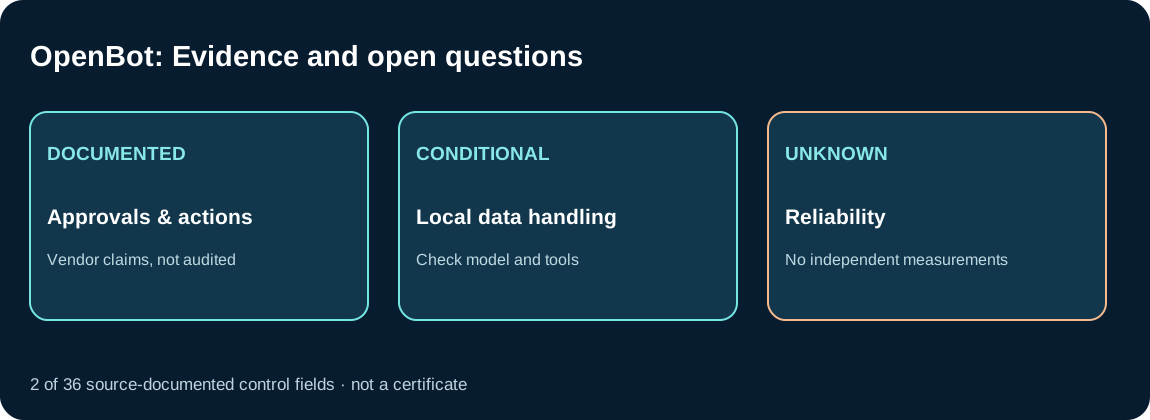
Self-hosting does not automatically keep all information local. Cloud model providers and linked SaaS tools can receive necessary prompts, files or task context when authorized. Fully local deployment requires a compatible local model as well as local Intelligence and controlled network flows. A real evaluation should test secret handling, identity separation, logs, failed approvals and data retention. The two source-scoped Trust signals here are not a comprehensive 36-control audit.
Comparison & decision
OpenBot 1.0 — Comparison & decision
OpenBot is well suited to organizations evaluating a common work surface for multiple externally built or built-in agents. OpenClaw emphasizes a different set of personal integrations and automation patterns; Claude Cowork is more closely tied to Anthropic's work environment. These architectural distinctions are not controlled benchmark comparisons. OpenBot's support for AG-UI can help preserve existing agent investments, but integration quality must still be verified.
Decision criteria include whether agents already exist, which tools they need, whether a shared computer is acceptable and how approvals are enforced. A local model may change the data-protection picture but also changes deployment demands. For developer-driven orchestration, teams should compare products such as Mistral Studio Managed Agents. License, administration, monitoring and inference costs belong in the same evaluation, rather than judging by the number of advertised Bots.
Editorial deep dive
OpenBot 1.0 — Editorial deep dive
The noteworthy development is OpenBot's attempt to put agent execution, observation and authorization in one interface. Visible browser takeover and approval cards help humans see the distinction between a draft recommendation and an action affecting outside systems. Bringing an existing AG-UI agent into the workspace can reduce the need to rebuild it from scratch. A polished shared interface still does not make the underlying model more accurate.
AgentenCode recommends a small production-like pilot with predefined expected results and clear stop conditions. Measure completed tasks, errors, unapproved actions blocked, human interventions, unexpected network egress and total cost per successful task. Separately test shared versus isolated computers and the behavior when credentials expire. These metrics are recommended evaluation criteria; no independent benchmarks, product certification or complete security audit were performed in preparing this profile.
Frequently asked questions
Frequently asked questions — OpenBot 1.0
What is OpenBot 1.0?
A modular CopilotKit workspace for multiple AI agents, tools, visible execution and human approval.
Is it free?
Personal experimentation is free and the app is MIT-licensed, but Intelligence is separately licensed and model or business costs can apply.
Does all data stay local?
Only with a fully local configuration. External models and apps can receive data required for their work.
Can I connect my own agent?
Yes, through compatible AG-UI endpoints and carefully scoped tool permissions.
Are the governance controls independently audited?
No. Two source-scoped provider-documented signals are recorded, not a complete independent security audit.
Original sources & method
Original vendor sources and evidence scope
Product claims are limited to the linked first-party sources and their stated scope. No independent hands-on test, audit, or compliance certification was performed. Unverified controls remain unknown, not negative findings.
- CopilotKit – Introducing OpenBot 1.0 (10 Nov 2026) — https://www.copilotkit.ai/blog/introducing-openbot-1-0
- CopilotKit – What's new in OpenBot 1.0 — https://www.copilotkit.ai/blog/openbot-whats-new
- OpenBot – Official overview — https://open.bot/
- OpenBot – Open source repository and license — https://github.com/CopilotKit/OpenBot
- OpenBot – Official pricing and separate Intelligence license — https://open.bot/pricing
- OpenBot – Runtime and action-policy architecture — https://github.com/CopilotKit/OpenBot/blob/main/docs/architecture.md