
Agent reference · Enterprise agents & ERP
Oracle Fusion Agentic Applications
Provider: Oracle
Oracle is moving from AI suggestions toward governed business-process execution. It says 25 new Fusion Claw applications are available. We separate product scope from real-world deployment evidence.
Source-backed decision graphic
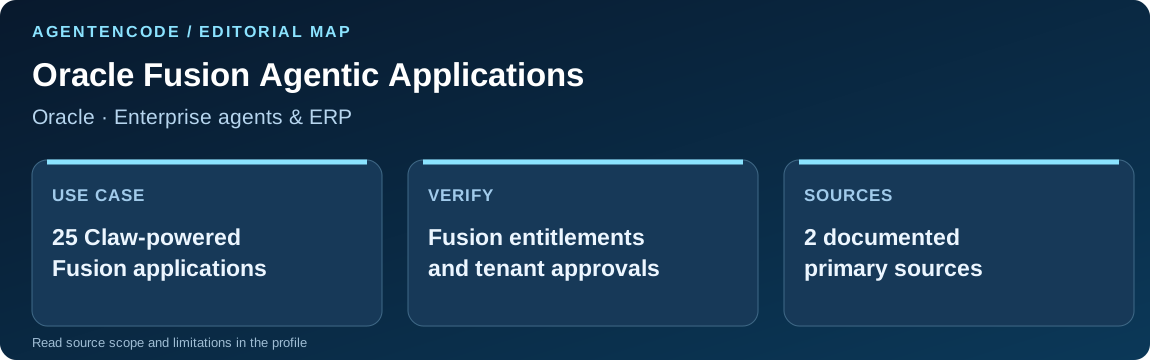
Oracle Fusion Agentic Applications — decision overview
Product context, adoption checks and primary references at a glance. The article below explains the evidence and limitations.
Overview and direct answer
What is Oracle Fusion Agentic Applications?
Direct answer: Oracle Fusion Agentic Applications are business-process applications built to analyze, plan and execute approved work inside Fusion Cloud Applications. Oracle reports 25 new Claw-powered applications available since September 2026, subject to customers' modules, entitlements and tenant configurations.
Enterprise agents & ERP
25 Claw-basierte Anwendungen laut Oracle seit 29. September 2026 für Fusion-Kunden verfügbar; Modul-, Vertrags- und Tenantfreigaben individuell prüfen.
Official vendor references, checked 28 October 2026. No independent product test.
Capabilities and execution
What Fusion Claw is meant to change
Oracle positions Fusion Claw as an execution runtime combining model reasoning, deterministic business calculations and iterative replanning. The applications run within the Fusion Cloud environment, rather than representing a standalone general-purpose chat assistant.
The announcement describes 25 new Claw-powered applications, not 25 independent consumer products. The broader agentic portfolio contains further applications. Counts and capability claims are vendor descriptions, not an AgentenCode performance test.
Documented functions
- Accounting and close exceptions
- Workforce and supply-chain planning
- Procurement spend analysis
- Approved customer-service and CPQ workflows
Practical use cases
Four realistic scenarios
- Ledger: investigate close exceptions and reconcile entries
- Workforce Orchestration: assess staffing and cost trade-offs
- Procurement Spend: analyze contract leakage and spending anomalies
- Supply Planning Allocation: evaluate constrained-material and capacity options
Each scenario reflects vendor-published capabilities. It is not a measured success rate, independent customer audit or proof that all capabilities are enabled in your account.
Access, pricing and limitations
Who can actually use this?
Oracle says the 25 new Claw-powered applications are available to Fusion customers. This does not establish the same entitlement across all modules, environments or regions.
Published announcements reviewed here do not establish a universal standalone price, independent task-success rate or customer-specific data-retention and processing guarantees.
Questions for procurement
- Fusion module access and commercial terms
- Availability in each approved tenant
- Scope of delegated transaction permissions
- Audit logs and possible licensing restrictions
Trust, permissions and evidence boundaries
Where are the operational boundaries?
Oracle describes delegated authority, governance controls and outcome receipts. These claims should not be extended to every connector, action or organization without assessing the actual workflow configuration.
A finance or HR rollout needs explicit mapping of roles, approved actions, logs, escalation steps and human ownership. Autonomous execution must remain inside defined transaction and identity boundaries.
Before sending sensitive information or delegating state-changing actions, independently confirm tenant-level identity, permissions, storage location, sub-processors, consent, retention and auditability. EU AI Act applicability depends on the actual use case, not the product label.
Compared with related agent systems
Not interchangeable
Versus Oracle AI Agent Studio: the Studio creates and extends agents; Agentic Applications perform predefined functional business workflows.
Versus Oracle Fusion Companion: Companion routes user goals to the right Fusion agents, transactions and approvals; Agentic Applications carry out specialist processes.
Related existing AgentenCode reference: Oracle AI Agent Studio.
Our evaluation and decision checklist
What to verify before deployment
- Verify that the specific business application is licensed and enabled in your Fusion environment.
- Map identity, transaction-level access and any required review gates.
- Evaluate traceability, reversibility, escalation and failure handling using approved test data.
- Expand to production only with documented business ownership and delegated authority.
Editorial view
The newsworthy development is a concrete product boundary, not a headline promise of complete autonomy. A specialist agent is useful when it can access approved source data and produce reviewable work. Its purchase decision depends on verified contract terms, explicit authorization and practical tests.
We have not benchmarked accuracy, performed a security audit or reviewed a customer tenant. Vendor promises remain attributed; missing details stay UNKNOWN.
Frequently asked questions
Can all 25 applications be used immediately?
Oracle reports 25 available Claw-powered applications, but access still depends on the relevant Fusion module, account and commercial agreement.
Are these 25 different AI models?
No. They are specialist business applications that may use agentic orchestration and supported models.
Do they operate without human approvals?
Oracle describes governed authority and approvals; the exact implementation must be assessed within each workflow.
Is a universal subscription price published?
No universal standalone price is confirmed by the product launch sources reviewed here.
Official sources and review log
Primary references
- Oracle – Fusion Applications launch (26 October 2026)
- Oracle – Fusion Claw runtime and 25 applications (29 September 2026)
Review date: 28.10.2026. A first source-scoped editorial review, not full product deployment certification. Changes will be updated when first-party access, contractual terms or independent tests become verifiable.
Stable profile ID: AI-0146. New entry on 28.10.2026.