
Agent reference · ERP orchestration & AI
Oracle Fusion Companion
Provider: Oracle
State a business outcome instead of navigating many ERP screens: Oracle wants Fusion Companion to route intent into approved Fusion transactions, agents and workflows. Launch scope and access remain key questions.
Source-backed decision graphic
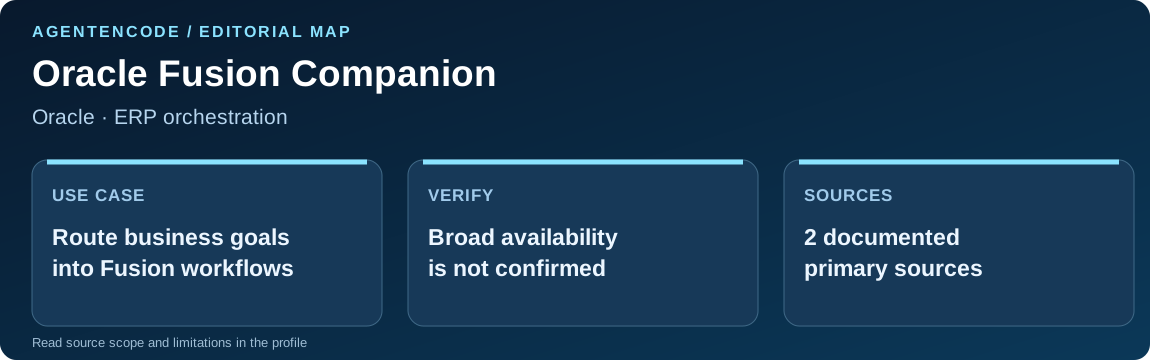
Oracle Fusion Companion — decision overview
Product context, adoption checks and primary references at a glance. The article below explains the evidence and limitations.
Overview and direct answer
What is Oracle Fusion Companion?
Direct answer: Oracle Fusion Companion is an orchestration layer announced on October 26, 2026. It is designed to translate requests from supported AI clients, including ChatGPT, into Fusion transactions, approvals and agent workflows. No clear broad GA date or universal price is confirmed in the announcement.
ERP orchestration & AI
Announced, broad GA unconfirmed
Official vendor references, checked 28 October 2026. No independent product test.
Capabilities and execution
From user intent to an authorized transaction
Oracle describes an intent-first experience: users specify the desired business result, and Companion selects applicable agents, transactions and workflow steps. This makes it an orchestration layer, not an independently proven all-purpose accounting or HR specialist.
Fusion Agentic Home is the vendor's proposed personal view of delegated work and progress. The announcement does not establish universal replacement of Oracle interfaces or instant availability across third-party clients.
Documented functions
- Route goals to Fusion workflows
- Coordinate approvals and specialist agents
- Track delegated work in Agentic Home
- Respect existing enterprise permissions as described by Oracle
Practical use cases
Four realistic scenarios
- Route requests from supported AI clients into Fusion workflows
- Coordinate transactions, approvals and specialist agents
- Track delegated work in Fusion Agentic Home
- Use authorized business context across connected enterprise systems
Each scenario reflects vendor-published capabilities. It is not a measured success rate, independent customer audit or proof that all capabilities are enabled in your account.
Access, pricing and limitations
Who can actually use this?
Oracle announced Fusion Companion and Agentic Home on October 26 but did not specify a firm general availability schedule or universal list price in the sources evaluated here.
We therefore classify the offering as announced; general availability unconfirmed. Product integration is not proof that a given customer account already has access.
Questions for procurement
- Actual rollout timeline and tenant access
- Supported AI clients, connectors and regions
- Commercial terms and consumption charges
- Identity mapping between client and ERP
Trust, permissions and evidence boundaries
Identity and delegated authority are the critical boundaries
Calling an ERP workflow from a ChatGPT-like interface is not the same as granting a model administrator permissions. Oracle says actions must remain within user identity, authorization policies and existing approvals.
Enterprise buyers still need to verify which clients are supported, what data leaves Fusion, how delegated identities are propagated, and which action and audit records are retained.
Before sending sensitive information or delegating state-changing actions, independently confirm tenant-level identity, permissions, storage location, sub-processors, consent, retention and auditability. EU AI Act applicability depends on the actual use case, not the product label.
Compared with related agent systems
Not interchangeable
Fusion Companion: intent and work coordination. Fusion Agentic Applications: specialist business processes. AI Agent Studio: build and manage the agents themselves.
These have different roles; counting them as interchangeable products would mislead enterprise procurement and safety planning.
Related existing AgentenCode reference: Oracle AI Agent Studio.
Our evaluation and decision checklist
What to verify before deployment
- Confirm product entitlement, region, Fusion module and supported AI client with Oracle.
- Document what business data may cross the AI-client boundary.
- Test a non-sensitive workflow including the approval and cancellation path.
- Approve production only after validating audit coverage, role scope and costs.
Editorial view
The newsworthy development is a concrete product boundary, not a headline promise of complete autonomy. A specialist agent is useful when it can access approved source data and produce reviewable work. Its purchase decision depends on verified contract terms, explicit authorization and practical tests.
We have not benchmarked accuracy, performed a security audit or reviewed a customer tenant. Vendor promises remain attributed; missing details stay UNKNOWN.
Frequently asked questions
Is Fusion Companion generally available now?
The Oracle source announces the feature but does not confirm a clear broad GA date.
Will it work with ChatGPT?
Oracle identifies ChatGPT among supported AI clients; actual tenant integration must be verified.
Is Fusion Companion the same as AI Agent Studio?
No. Companion routes work; Agent Studio is used to create, extend and manage agents.
What is the pricing?
No verified universal product-specific price is published in the announcement reviewed here.
Official sources and review log
Primary references
- Oracle – Fusion Companion & Agentic Home announcement (26 October 2026)
- Oracle – Outcome-driven AI overview (26 October 2026)
Review date: 28.10.2026. A first source-scoped editorial review, not full product deployment certification. Changes will be updated when first-party access, contractual terms or independent tests become verifiable.
Stable profile ID: AI-0147. New entry on 28.10.2026.