
For individuals, AI agents are most useful when they reduce repetitive research, planning or digital work without requiring broad access to sensitive accounts.
AGENTENCODE · ORIGINAL DATA / EDITORIAL ANALYSIS
What AgentenCode's own data adds
An expert reading of our source-linked registry — not an invented lab benchmark.
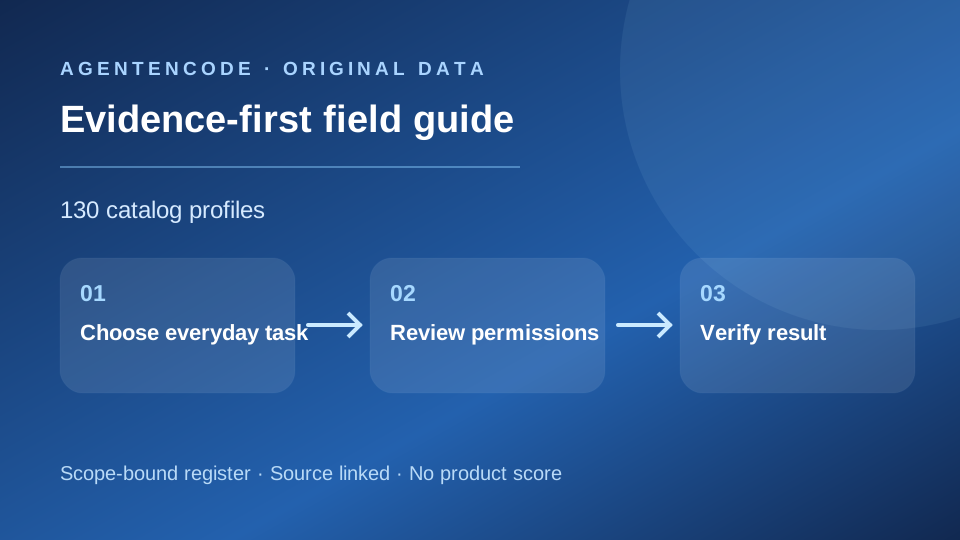
Our catalog currently contains 130 individual agent and platform profiles (registry snapshot: 2026-10-08). Those entries are documented products and frameworks, not independently scored performance tests.
Three documented agent examples
These deliberately different profiles illustrate how application scope changes what the concept means:
ChatGPT Deep Research OpenAI
AgentenCode records ChatGPT Deep Research (OpenAI) in the Research segment. Use the individual profile to check the exact product, plan and deployment limits rather than projecting another agent's abilities onto it.
Perplexity Comet Assistant Perplexity
AgentenCode records Perplexity Comet Assistant (Perplexity) in the Automation segment. Use the individual profile to check the exact product, plan and deployment limits rather than projecting another agent's abilities onto it.
ChatGPT Work OpenAI
AgentenCode records ChatGPT Work (OpenAI) in the Enterprise segment. Use the individual profile to check the exact product, plan and deployment limits rather than projecting another agent's abilities onto it.
Method: the named profiles come from the AgentenCode catalog (snapshot 2026-10-08). Protocol relations, where shown, come from the explicit AgentenGraph relation set (snapshot 2026-10-05). This is editorial interpretation of primary-source-backed records, not independent hands-on testing, formal certification, proof of production deployment or an exhaustive market census. Unknown does not mean false. Read methodology →.
Research and purchase decisions
Agents can compare products, collect sources, summarize trade-offs and track changing information. The best tasks have clear constraints: budget, region, must-have features and source requirements.
For important purchases, users should still inspect the cited sources because prices, availability and specifications can change quickly.
Travel and planning
Agents can help build itineraries, compare options and organize multi-step planning. They are especially useful when the task spans many sources and needs repeated refinement.
Booking or payment should be treated separately from research. A user may want the agent to prepare options while retaining final control over purchases.
Learning and knowledge work
An agent can create study plans, explain concepts, collect sources and organize notes. Persistent state can make long-term projects more coherent, but users should understand what information is stored and how to delete it.
For factual learning, source transparency matters more than fluency. A polished explanation can still be wrong if it is not grounded in reliable material.
Coding and personal projects
Coding agents can inspect repositories, generate changes and run tests. For hobby projects, they can reduce the barrier to automation and scripting.
Users should still keep backups and review changes, especially when an agent can run terminal commands, install packages or access cloud credentials.
Privacy and account access
Connecting email, cloud storage, calendars or financial accounts gives an agent broader context but also raises the cost of mistakes. Least privilege is useful even for personal workflows.
Before connecting an account, check what data the service stores, whether data can be used for training, how long it is retained and which integrations can write or delete information.
A safe adoption path
Stage 1: use the agent for reading and drafting. Stage 2: connect low-risk data with read-only access. Stage 3: enable selected actions with confirmations or approvals.
This progression lets users learn the agent’s behavior before granting it the ability to change important external state.
What not to delegate blindly
High-stakes medical, legal, financial or security decisions should not be handed over without appropriate professional or human review. The same applies to irreversible actions such as account deletion, large purchases or credential changes.
Frequently asked questions
Which agents are easiest for beginners?
Research and planning agents with limited external permissions are often easier to evaluate than agents that can act broadly across accounts.
Should I connect my email immediately?
Only if the use case needs it and you understand the permissions, retention and write capabilities involved.
Can an agent make purchases for me?
Some systems may support transaction-related actions, but users should keep explicit approval around consequential financial actions.