
There is no defensible single number for “good AI agents” in 2026 because the count depends on what qualifies as an agent, which products are active and what evidence standard is used.
AGENTENCODE · ORIGINAL DATA / EDITORIAL ANALYSIS
What AgentenCode's own data adds
An expert reading of our source-linked registry — not an invented lab benchmark.
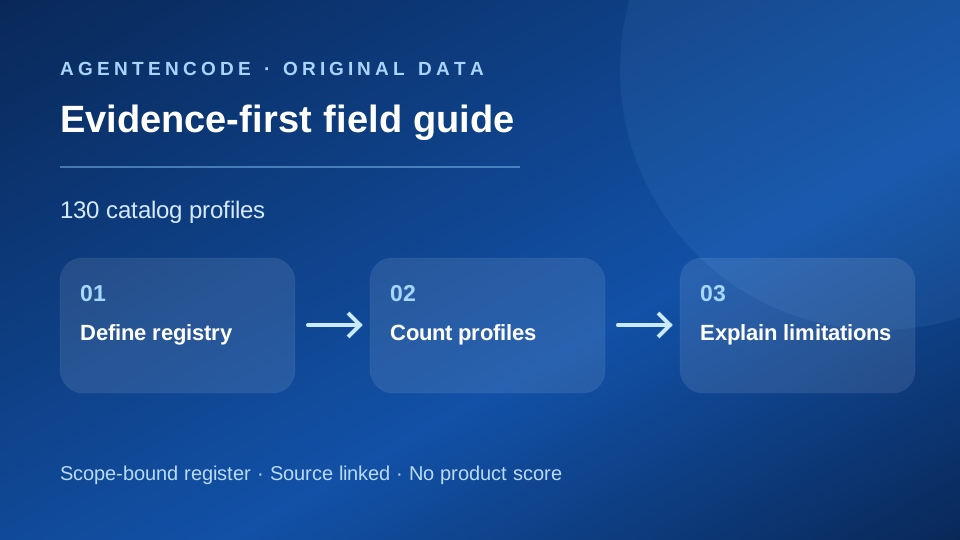
Our 2026-10-08 catalog contains 130 profiles. For example, it tags 25 as coding, 10 as research and 29 as automation. These categories describe a curated sample, not market share.
Three documented agent examples
These deliberately different profiles illustrate how application scope changes what the concept means:
Microsoft Agent Framework Microsoft
AgentenCode records Microsoft Agent Framework (Microsoft) in the Automation segment. Use the individual profile to check the exact product, plan and deployment limits rather than projecting another agent's abilities onto it.
ChatGPT Work OpenAI
AgentenCode records ChatGPT Work (OpenAI) in the Enterprise segment. Use the individual profile to check the exact product, plan and deployment limits rather than projecting another agent's abilities onto it.
Intercom Fin Intercom
AgentenCode records Intercom Fin (Intercom) in the Service & sales segment. Use the individual profile to check the exact product, plan and deployment limits rather than projecting another agent's abilities onto it.
Method: the named profiles come from the AgentenCode catalog (snapshot 2026-10-08). Protocol relations, where shown, come from the explicit AgentenGraph relation set (snapshot 2026-10-05). This is editorial interpretation of primary-source-backed records, not independent hands-on testing, formal certification, proof of production deployment or an exhaustive market census. Unknown does not mean false. Read methodology →.
Why a market count is difficult
Vendors use the word agent for very different products: research tools, coding assistants, workflow builders, customer-service bots, orchestration platforms and persistent personal agents. Counting every marketing label produces a large but misleading number.
Products also change lifecycle quickly. Some are previews, some are embedded features rather than standalone products, and some are discontinued.
Define counting rules first
A useful market count needs a stable unit: a distinct product or agent surface with an identifiable provider and current public documentation. Duplicates, renamed products and generic platform templates should not be counted as separate agents without a clear reason.
AgentenCode also separates products from frameworks, components and broader agent platforms where possible.
Coverage is not the market
AgentenCode currently documents 130 profiles. That number describes the verified reference set, not a claim that only 130 agents exist worldwide.
Coverage expands when a product is sufficiently relevant and can be supported with traceable sources. A larger number is not automatically better if the additional entries have weak evidence or duplicate one another.
Automated discovery versus editorial review
Automated monitoring can discover candidate products or changes, but publication requires editorial verification. This prevents a crawler from turning every landing page or “agent template” into a supposedly equal market entry.
The same principle applies to rankings: evidence quality and product relevance matter more than raw count.
What “good” means depends on the user
A strong coding agent may be irrelevant to a sales team, while an enterprise agent platform may be excessive for an individual. Quality is multidimensional: task performance, reliability, controls, integration, cost and fit all matter.
That is why AgentenCode favors structured comparison and user-selected requirements over one universal top-agents list.
Frequently asked questions
Does AgentenCode cover every AI agent?
No. The site documents a curated source-first set and expands coverage over time.
Why not publish a single market-size number?
Because definitions, lifecycle and product granularity make such a number highly sensitive to counting rules.
Does more coverage always mean better quality?
No. A smaller evidence-rich dataset can be more useful than a much larger list of weakly documented entries.