
Autonomy is not an on/off property. AI agents can range from read-only analysis to proposing actions, acting with approval, or executing bounded tasks automatically.
AGENTENCODE · ORIGINAL DATA / EDITORIAL ANALYSIS
What AgentenCode's own data adds
An expert reading of our source-linked registry — not an invented lab benchmark.
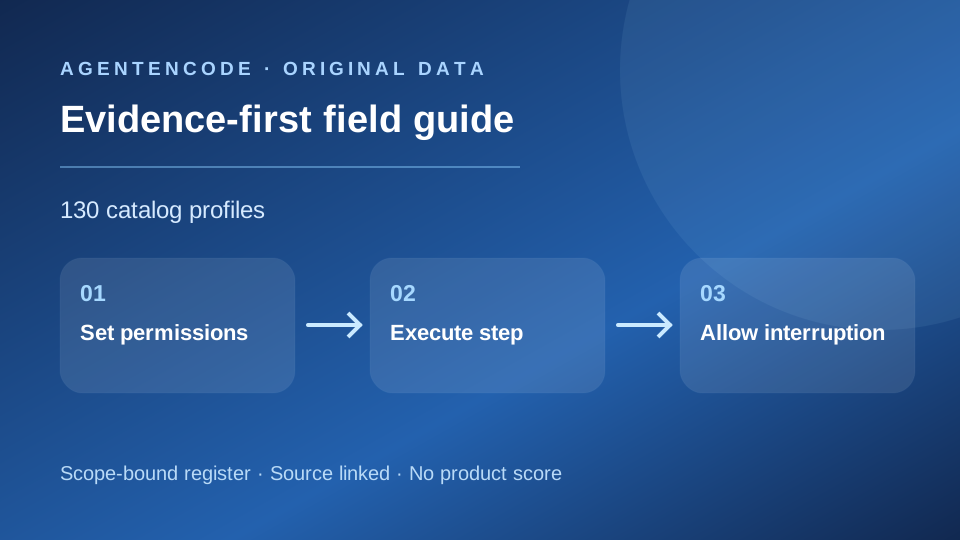
Our catalog currently contains 130 individual agent and platform profiles (registry snapshot: 2026-10-08). Those entries are documented products and frameworks, not independently scored performance tests.
Three documented agent examples
These deliberately different profiles illustrate how application scope changes what the concept means:
Manus Agent Manus
AgentenCode records Manus Agent (Manus) in the Automation segment. Use the individual profile to check the exact product, plan and deployment limits rather than projecting another agent's abilities onto it.
Browser Use Agent Browser Use
AgentenCode records Browser Use Agent (Browser Use) in the Automation segment. Use the individual profile to check the exact product, plan and deployment limits rather than projecting another agent's abilities onto it.
OpenAI Codex OpenAI
AgentenCode records OpenAI Codex (OpenAI) in the Coding segment. Use the individual profile to check the exact product, plan and deployment limits rather than projecting another agent's abilities onto it.
Method: the named profiles come from the AgentenCode catalog (snapshot 2026-10-08). Protocol relations, where shown, come from the explicit AgentenGraph relation set (snapshot 2026-10-05). This is editorial interpretation of primary-source-backed records, not independent hands-on testing, formal certification, proof of production deployment or an exhaustive market census. Unknown does not mean false. Read methodology →.
Read and analyze
At the lowest autonomy level, an agent can inspect information, summarize it and make recommendations without changing external state. This can still involve multiple steps and tool use.
Read-only operation is often a good starting point because it allows teams to evaluate quality and observability before adding write permissions.
Propose actions
An agent can prepare a draft action—such as an email, code change or ticket update—while a human remains responsible for execution. This separates planning capability from authority.
The review interface should show enough context for the person to understand what is being proposed and why.
Act with approval
The agent may execute tools, but selected actions require explicit human approval. This is common for money movement, permission changes, external communication or irreversible operations.
Approval should be technically enforced and recorded rather than represented only as a prompt instruction.
Act autonomously inside a bounded scope
For low-risk, repetitive work, an agent may be allowed to act without per-action approval. The boundary is then defined by permissions, policy, tool design, budgets, rate limits and monitoring.
Autonomous operation still needs ownership. Someone must be responsible for the policy, exceptions, incidents and ongoing evaluation.
How to choose an autonomy level
Start from the consequence of failure rather than from the maximum capability of the model. High-impact actions deserve more friction; low-impact reversible actions can often be automated more aggressively.
AgentenCode therefore treats human approval, permission controls, audit logs and rollback as separate evidence fields instead of using one broad “autonomous” badge.
Frequently asked questions
Does autonomous mean unsupervised?
Not necessarily. An autonomous agent can still be monitored, constrained and interrupted.
Is more autonomy always better?
No. The best autonomy level is the smallest one that delivers the required value with acceptable risk.
Can an agent be autonomous and still require approval?
Yes. It may act autonomously for routine steps while pausing on defined high-impact actions.