
A research agent searches, reads, compares and synthesizes information across multiple steps. Its quality depends on source selection, traceability and how well it separates evidence from interpretation.
AGENTENCODE · ORIGINAL DATA / EDITORIAL ANALYSIS
What AgentenCode's own data adds
An expert reading of our source-linked registry — not an invented lab benchmark.
Our 2026-10-08 catalog contains 130 profiles. For example, it tags 25 as coding, 10 as research and 29 as automation. These categories describe a curated sample, not market share.
Three documented agent examples
These deliberately different profiles illustrate how application scope changes what the concept means:
ChatGPT Deep Research OpenAI
AgentenCode records ChatGPT Deep Research (OpenAI) in the Research segment. Use the individual profile to check the exact product, plan and deployment limits rather than projecting another agent's abilities onto it.
Claude Research Anthropic
AgentenCode records Claude Research (Anthropic) in the Research segment. Use the individual profile to check the exact product, plan and deployment limits rather than projecting another agent's abilities onto it.
Perplexity Deep Research Perplexity
AgentenCode records Perplexity Deep Research (Perplexity) in the Research segment. Use the individual profile to check the exact product, plan and deployment limits rather than projecting another agent's abilities onto it.
Method: the named profiles come from the AgentenCode catalog (snapshot 2026-10-08). Protocol relations, where shown, come from the explicit AgentenGraph relation set (snapshot 2026-10-05). This is editorial interpretation of primary-source-backed records, not independent hands-on testing, formal certification, proof of production deployment or an exhaustive market census. Unknown does not mean false. Read methodology →.
A typical research workflow
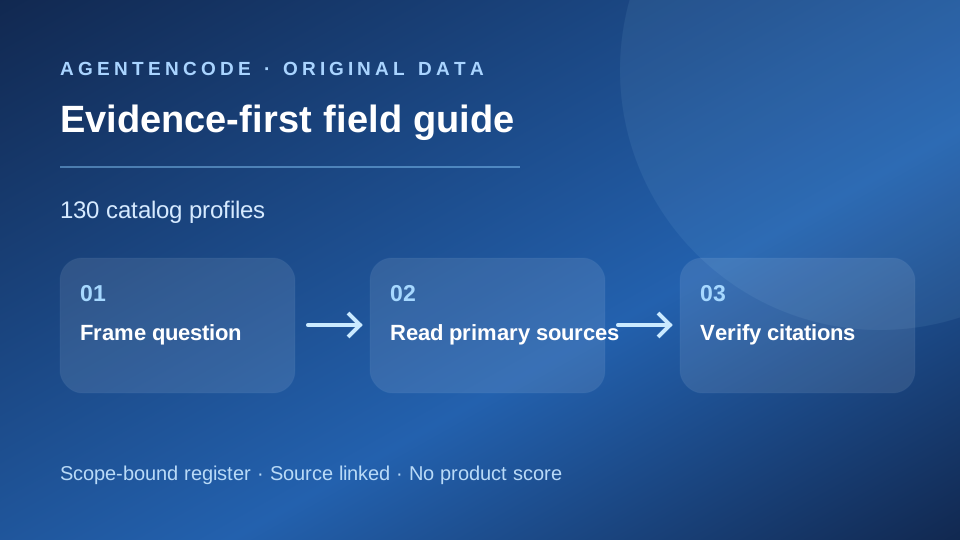
The agent interprets the question, breaks it into subtopics, searches or reads available sources, extracts relevant evidence and updates its plan as gaps become visible.
It then synthesizes findings into a report, ideally with citations that let the user inspect the underlying material.
Why research agents are useful
They can reduce the manual work of opening many sources, comparing claims and organizing notes. This is valuable for product comparisons, market research, travel planning, technical research and internal knowledge work.
The time saving is greatest when the user provides clear constraints and the agent can access reliable sources.
A good research brief
Specify the decision you are trying to make, relevant geography or time period, source preferences, exclusions and the required output format. Ask the agent to separate confirmed facts from uncertainty.
Broad prompts such as “research everything about X” make it harder to judge completeness and can encourage irrelevant source collection.
Source quality still matters
A research agent can cite a source that is outdated, circular or low quality. Citations are therefore necessary but not sufficient. Users should inspect important primary sources directly.
For current product facts, official documentation and provider changelogs usually deserve more weight than secondary summaries.
Research for individuals and enterprises
Individuals can use research agents for purchases, travel, learning and personal projects. Enterprises can use them for competitive intelligence, internal document review, vendor evaluation and technical investigation.
Enterprise use adds questions about confidential data, source permissions and whether results are stored or reused.
Common failure modes
Agents can miss sources, overgeneralize from one document, confuse old and current information, or produce a polished narrative that hides uncertainty. Long reports are not automatically better reports.
A robust workflow asks for dates, citations, conflicting evidence and explicit unknowns.
How to compare research agents
Compare browsing depth, file support, source transparency, citation quality, ability to revisit earlier work, context limits, cost and speed. If the agent can take actions beyond research, evaluate those permissions separately.
Frequently asked questions
Are research agents reliable?
They can be useful, but important claims should still be checked against the cited sources.
What makes a good research prompt?
A clear decision, scope, date range, source preferences and expected output format.
Is more research depth always better?
No. Depth is valuable only when it produces relevant, traceable evidence rather than more volume.