
GitHub brings license compliance into the coding-agent workflow
GitHub's open-source license compliance is generally available, with enterprise merge rules and an API agents can check before selecting dependencies.
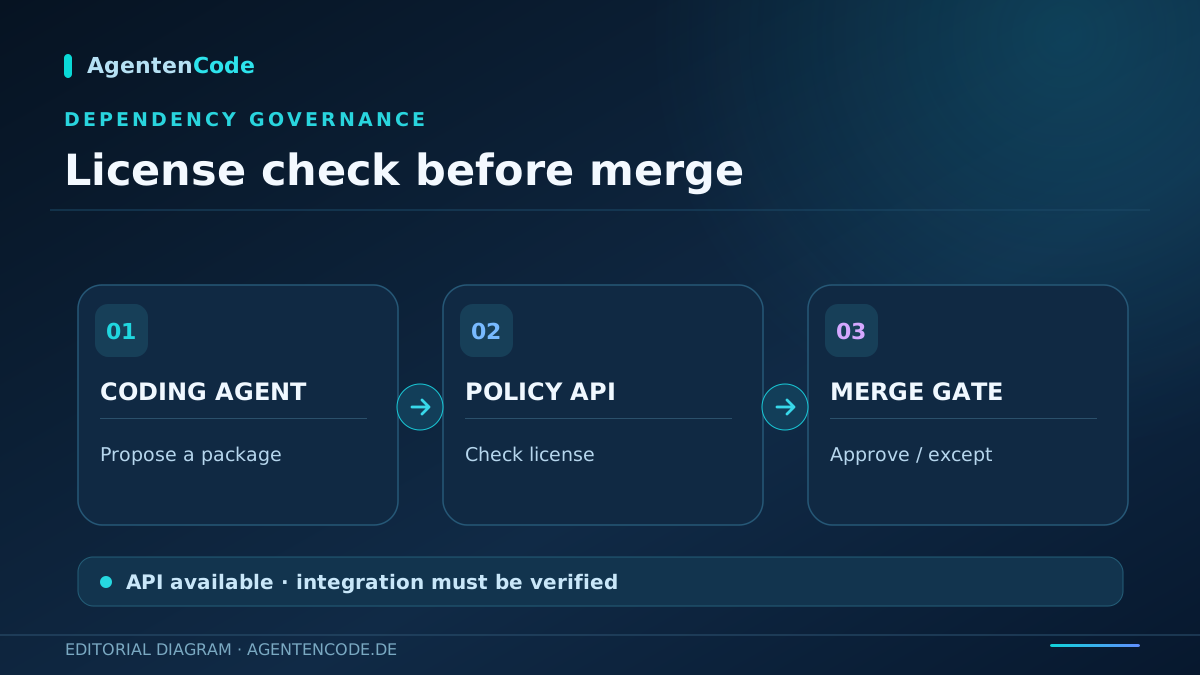
On October 16, 2026, GitHub made open-source license compliance generally available for eligible Enterprise Cloud repositories. New or changed dependencies can be checked against centralized license policies before merging. A new API also lets coding agents check whether a proposed package complies with enterprise policy.
Dependency review could already identify problematic packages, but enterprise-wide enforceable license policies with dedicated approval workflows were not generally available in this form.
Eligible GitHub Enterprise Cloud repositories can now enforce license results at merge time. A package-compliance API also creates an earlier decision point for coding agents.
From repository warning to enforceable policy
GitHub extends its dependency-review capabilities with a central enterprise license policy. Administrators can target repositories with a ruleset requiring successful license-compliance results before merging. When a pull request introduces or changes dependencies, license checks compare the packages with organizational rules and annotate any conflicts directly in the review.
GitHub describes several resolution paths: remove or replace the dependency, amend the license policy, or approve a package exception. That does not mean the platform has declared a particular open-source license universally unacceptable. Each organization defines which licenses fit its use. The meaningful change is that policy can now be enforced at a reviewable boundary before code joins the main branch.
Why an API matters for AI coding agents
One new endpoint checks package compliance with the enterprise policy. GitHub explicitly identifies coding agents as beneficiaries: an agent can consult the endpoint before recommending or adding a dependency. In principle, this moves a governance check from a late pull-request objection to an earlier tool-assisted step in the agent's decision process.
The existence of an API is not evidence that every coding agent already calls it. The integration must be implemented, the result interpreted, and the decision logged. The announcement does not certify any particular agent's reliability in honoring license policies. Organizations should distinguish a platform capability from an active control they can demonstrate in their own deployment.
Roles, auditability, and availability boundaries
GitHub introduces an Enterprise Open-Source License Manager role to review exceptions and closure requests. Changes to enterprise license policy produce audit events. License information is available to GitHub Enterprise Cloud data-residency customers through dependency graphs and software bill of materials exports. General availability covers Enterprise Cloud, including its data-resident offering, when Code Security is enabled for the repository.
A useful pilot combines an allowed package, a deliberately disallowed package, and an exception request. Test whether the expected merge rule fires, whether the right reviewer can approve an exception, and whether an agent's package lookup leaves an auditable trace. License compliance does not by itself establish that a dependency is secure or resolve every legal question about complex licenses.
AgentenCode assessment
AgentenCode assessment: This is a concrete governance checkpoint for agents, not merely another dashboard label. The strongest benefit comes when an agent checks policy before choosing a library and the merge gate independently enforces the result. Both steps need explicit configuration and testing; the available API alone is not an end-to-end guarantee.
Sources and verification
Checked October 19, 2026 against GitHub's October 16 primary changelog. The source specifies availability, eligibility, enforcement, and the new API. We did not independently test integration with a named coding agent.