

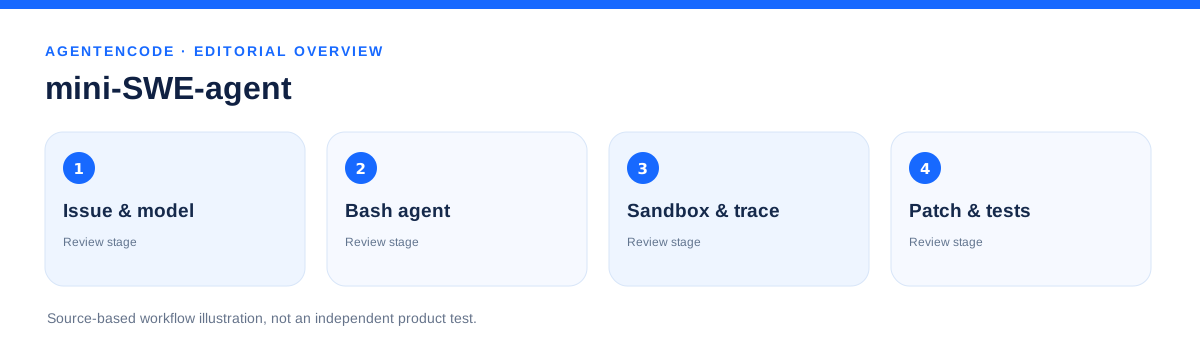
Quick answer: mini-SWE-agent
mini-SWE-agent is a lightweight open-source coding agent from the SWE-agent research ecosystem. It uses a linear language-model and shell loop to work on software tasks and offers an inspectable scaffold for evaluations.
The descriptions are derived from linked primary sources. There is no independent product test, no security certification and no measured performance benchmark in this dossier. Unverified claims remain unknown.
How it works
The project deliberately uses a single Bash-oriented tool and a linear progression of model messages and executed commands. Official docs describe local and sandboxed environments, including containers, and multiple model providers.
Use cases
When is it a fit?
Well suited to developers and research teams needing transparent agent trajectories, custom sandboxes and reproducible coding experiments.
Not a complete managed enterprise security platform. Shell commands and model API access must be explicitly isolated.
Comparison and alternatives
Unlike full-featured coding products, mini-SWE-agent intentionally minimizes orchestration complexity. Production suitability depends on tests, controls, model choices and execution isolation—not on code length.
Privacy and control
Models may receive source files and shell outputs. Data residency depends on provider, network policy and runtime configuration. Use sandboxing and credential isolation for sensitive projects.
Four checks before deployment
- Execute shell actions inside isolated containers or disposable environments.
- Keep secrets and production credentials away from the working tree.
- Treat project-reported benchmark results as attributed claims, not AgentenCode testing.
- Use v2 documentation and verify model/provider dependencies.
Trust: No individual controls were independently audited for this new profile; unknown is not a negative finding.
Pricing and total cost
The code is open source, but model inference, compute, isolation infrastructure and evaluations can incur costs. This is not a universal free end-to-end service.
Practical evaluation checklist
- Pin a documented repository version.
- Select a small isolated project and reproducible issue.
- Restrict shell commands, network access and secrets.
- Review the trajectory and final patch independently.
- Run the same tasks against alternatives under comparable model conditions.
TECHNICAL REFERENCE
Architecture, versions and practical boundaries
The following topics separate documented capabilities from untested installation conditions. A feature list does not certify deployment safety.
A deliberately small agent scaffold
mini-SWE-agent intentionally reduces its core to a language model, shell execution and a linear message history. The official project emphasizes Bash as its sole tool rather than adding a dedicated tool-call API for every operation.
That minimal structure makes the loop easier to study, but it does not make shell execution safe by default. Fewer lines of code are not a substitute for least-privilege operating-system permissions.
Linear agent loop
The agent emits a shell action, receives the result and appends it to the next model message. Official docs describe independent subprocess executions rather than a persistent stateful shell session. This makes individual actions inspectable.
Reviewers should retain commands and outputs. Context limits, error handling and follow-up decisions depend on model and configuration; an incorrect shell command can still modify files.
Sandboxing and secrets
A test repository can run inside an isolated container. Filesystem privileges, network access, temporary files, dependencies and model endpoints still need explicit control. Environment variables and credentials checked into source trees are particularly sensitive.
An open-source scaffold does not automatically provide local-only inference or enterprise-grade security. External model APIs may receive source code and shell output.
Research comparisons
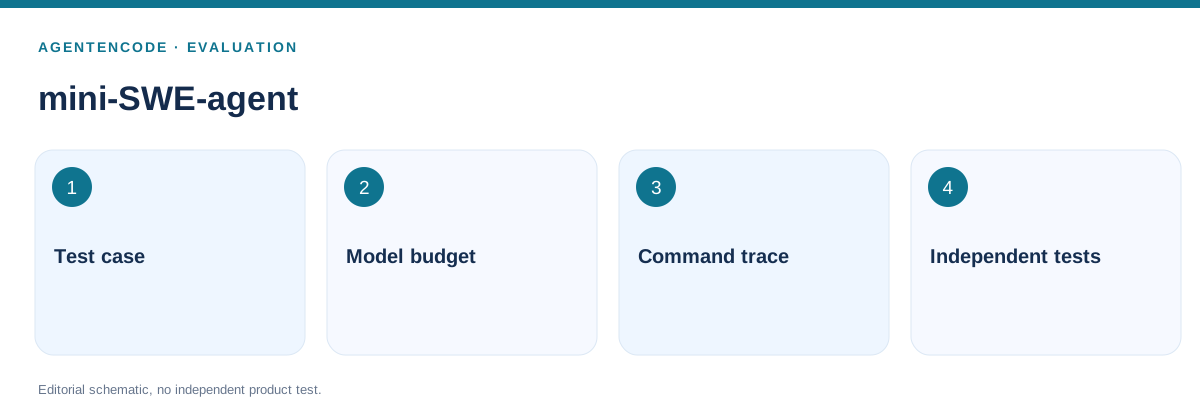
Reproducible evaluations pin the SWE-bench case or custom issue, model settings and budget. The project publishes research context, but those claims have not been independently remeasured by AgentenCode.
Comparisons with Codex or Claude Code should separate scaffold simplicity from underlying model capability and preserve unsuccessful runs in the record.
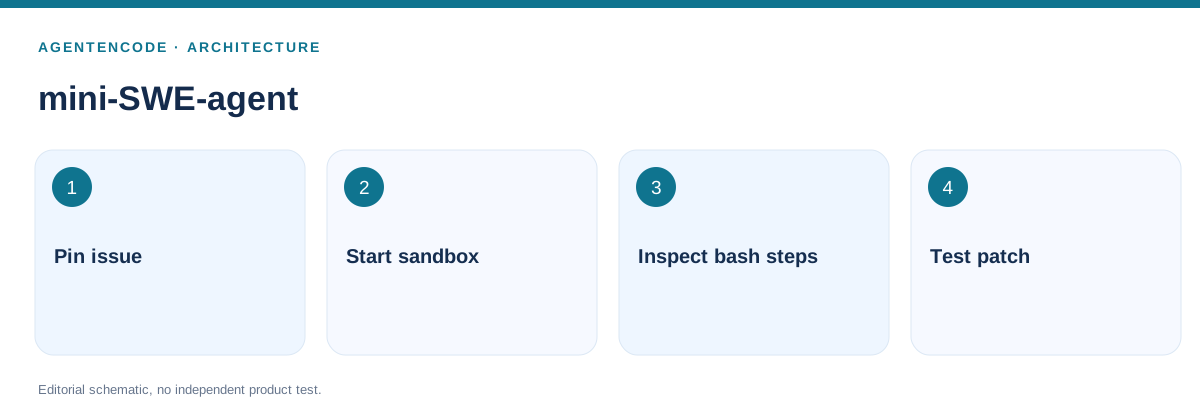
Step-by-step evaluation workflow
A controlled experiment needs fixed inputs, restricted permissions, acceptance criteria and independent checking. This is an evaluation plan, not a performed test.
- Pin issue
Pin initial conditions, record actions and independently check the output.
- Start sandbox
Pin initial conditions, record actions and independently check the output.
- Inspect bash steps
Pin initial conditions, record actions and independently check the output.
- Test patch
Pin initial conditions, record actions and independently check the output.
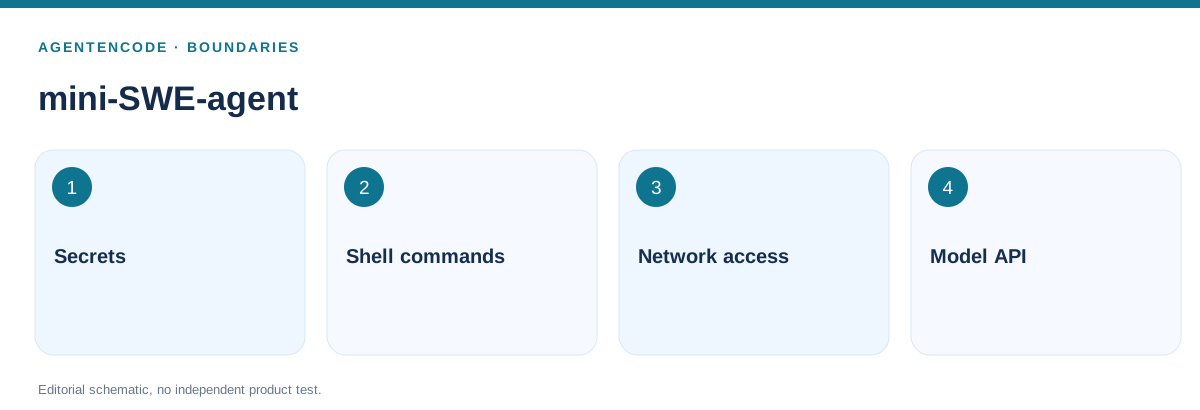
Permissions, data flows and risks
The checklist identifies controls to validate before production. It does not assign fictional Trust points or replace a security audit.
Use a disposable container or sandbox with narrow filesystem rights.
Remove production credentials from the workspace before execution.
Restrict network and package-installation access as needed.
Record the model endpoint and potential data transfer.
Store the execution trace, patch diff and test results separately.
Comparison criteria and evidence boundaries
Official project and developer documentation on features and versions.
No independent benchmarks, complete permission audits or legal assessments.
Record versions, models, tasks, runtime and token budgets, including failures.
Without independent checks all 36 Trust areas remain unknown.
Frequently asked questions
What is mini-SWE-agent?
A deliberately minimal open-source software engineering agent with shell execution and a linear message history.
Is version 2 current?
The official documentation identifies v2 and links migration guidance for earlier versions.
Which models work?
The project documents flexible model integrations. Reliability, data processing and fees depend on the provider.
Is it production-safe by default?
No. Shell operations require isolation, least privilege, independent testing and approvals.
Did AgentenCode benchmark it?
No. Project-reported benchmarks must not be mistaken for independent AgentenCode measurements.
Does mini-SWE-agent use only one tool?
The project documents Bash as its only core tool.
Does it keep a persistent shell session?
The documentation describes independent subprocess actions instead of a constantly open shell.
Does minimal design ensure security?
No. Sandboxing, secrets, network permissions and independent tests remain necessary.
Official sources and limitations
The descriptions are derived from linked primary sources. There is no independent product test, no security certification and no measured performance benchmark in this dossier. Unverified claims remain unknown.
- mini-SWE-agent – offizielles GitHub-Projekt ↗
- mini-SWE-agent – technische Dokumentation ↗
- mini-SWE-agent – Quickstart ↗
- mini-SWE-agent architecture ↗
Editorial source check: 30 October 2026. Full end-to-end verification, paid feature access, performance claims, external tool permissions and legal compliance were not independently tested.