

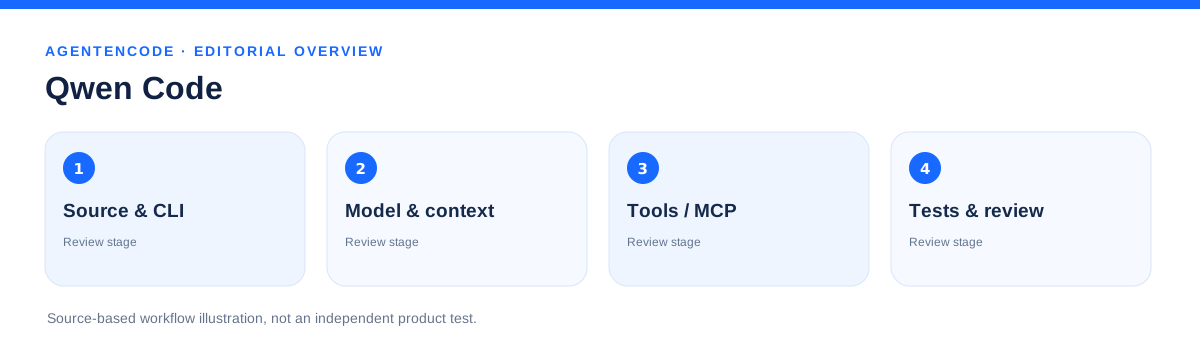
Quick answer: Qwen Code
Qwen Code is an open-source coding agent for terminal and development workflows. With an authorized model and tools, it can inspect a repository, modify files, execute commands and connect additional systems through MCP.
The descriptions are derived from linked primary sources. There is no independent product test, no security certification and no measured performance benchmark in this dossier. Unverified claims remain unknown.
How it works
Qwen Code uses project context with the configured model and tool permissions. Official documentation covers the terminal, editors, headless mode, subagents and MCP. Exact features vary by installed version and configuration.
Use cases
When is it a fit?
A fit for developers who want a customizable, source-visible coding workflow rather than only a managed proprietary IDE.
Less suitable where a managed enterprise service with independently proven security guarantees, fixed SLA or data residency is mandatory.
Comparison and alternatives
Claude Code, Codex and Gemini CLI are useful comparators. Compare reproducible tasks under equal model, budget, permission and review conditions rather than making untested winner claims.
Privacy and control
Open source does not guarantee local-only processing. Cloud models and external MCP servers may receive code or task context. Data flow, permissions, credentials and logs require deployment-specific checks.
Four checks before deployment
- Version-control the project and limit the directory scope before allowing edits.
- Review effective permissions for shell commands, dependencies and Git operations.
- Record which code and metadata leave the machine when using external models or MCP servers.
- Independently review patches and run tests and security checks.
Trust: No individual controls were independently audited for this new profile; unknown is not a negative finding.
Pricing and total cost
Open-source code does not mean zero total cost. Model APIs, local compute, hosting and integrations may incur costs; no universally applicable provider pricing is asserted here.
Practical evaluation checklist
- Choose a small nonproduction repository with tests.
- Define one issue, acceptance criteria and a resource budget.
- Initially restrict filesystem, network and MCP privileges.
- Review the patch and run tests separately.
- Record errors, API usage and data boundaries before wider adoption.
TECHNICAL REFERENCE
System and operational boundaries
Official documentation describes features but is not independent verification of operational quality. These architecture points identify what responsible users need to examine.
Runtime and client interfaces
The developer architecture describes direct terminal and headless execution alongside an ACP mode through which a client controls the agent runtime. The core package owns context, model providers, sessions and permissions, while presentation and transport stay separate. An HTTP/SSE daemon can expose longer-running workspace sessions.
For production, the relevant question is not only which model is selected but whether the agent runs inside a local CLI, an editor host or a persistent service. Network exposure and workspace ownership are not interchangeable across those modes.
Tools, MCP and permissions
Qwen Code can inspect project files, prepare edits, execute terminal commands and iterate on tool results. MCP adds extra tool and resource servers. Such a connection may expose information outside a repository or enable state-changing operations.
Review every extension separately. Allowed shell commands, filesystem roots, provider credentials and possible external data transfers should be documented before execution.
Subagents without uncontrolled delegation
The project's subagent documentation describes specialized assistants with separate contexts and configurable tools. That can separate repository analysis, implementation and review, but separate conversations do not create an operating-system sandbox or isolate credentials.
A bounded pilot could define a read-only analyst, a narrowly writable implementer and an independent tester. The environment must enforce those boundaries rather than relying on a prompt to do so.
Evidence of quality
A useful coding outcome is not just a persuasive explanation. It is a reviewable patch against a pinned repository, backed by independently passing tests and recorded correction effort. Unauthorized commands and failed approaches should remain visible.
Project-published benchmark results are attributed project claims. AgentenCode did not rerun those benchmarks and makes no independent performance ranking or security-audit claim.
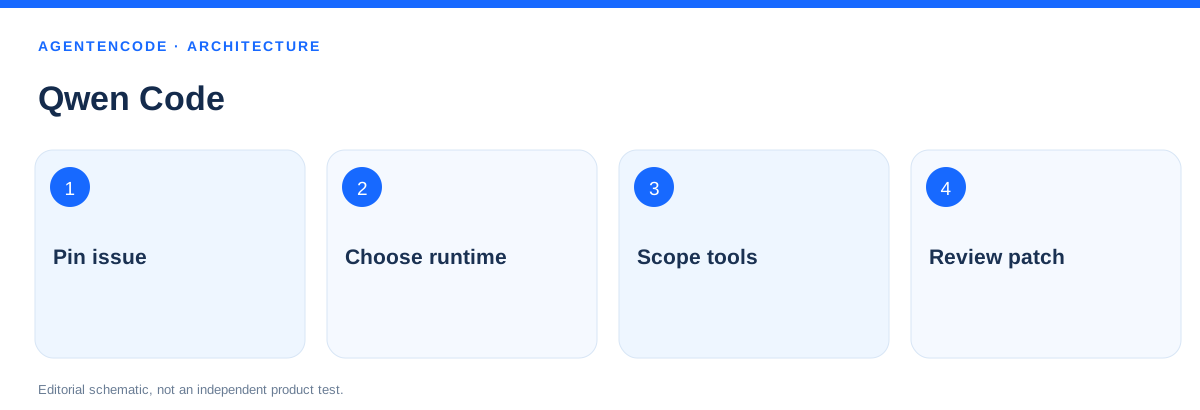
Step-by-step reference workflow
These four steps are an editorial evaluation proposal, not an experiment performed by AgentenCode.
- Pin issue
Define in advance, record and verify separately from the agent output.
- Choose runtime
Define in advance, record and verify separately from the agent output.
- Scope tools
Define in advance, record and verify separately from the agent output.
- Review patch
Define in advance, record and verify separately from the agent output.
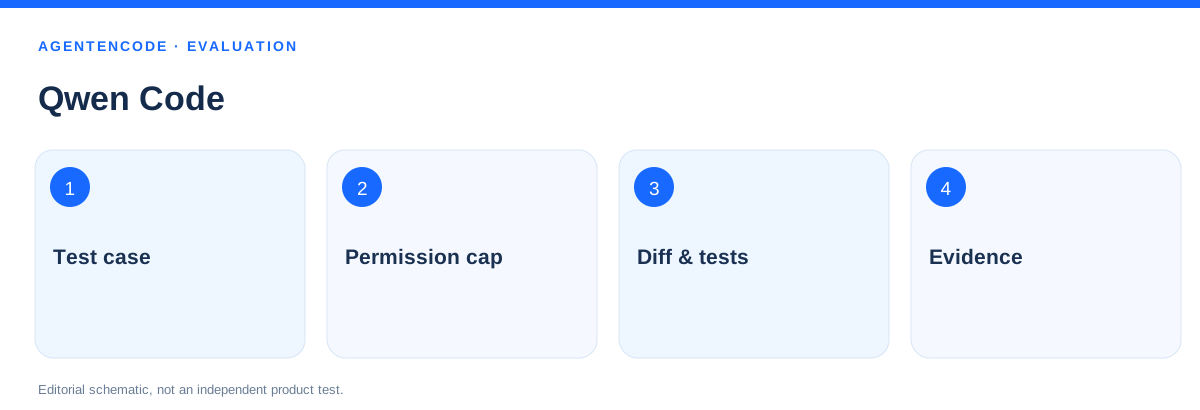
Privacy, permissions and risk boundaries
These are suggested checks, not certified controls or independently reviewed security evidence. Unknown remains unknown.
Limit repository and sensitive path access to the task.
Control shell and Git operations before state-changing commands.
Treat MCP servers and subagents as independent trust boundaries.
Record model providers, data flows and token-based costs.
Require independent tests, review and rollback before merge.
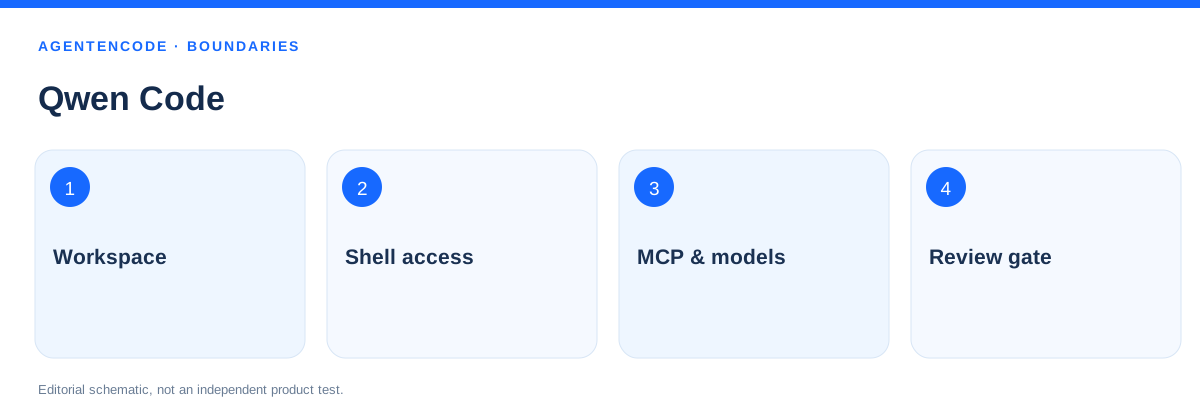
Selection criteria and evidence
Before selecting a tool, use equivalent inputs, a capped budget and explicit failure scenarios. Features are documented only to the extent supported by their sources.
Source-backed product features and access boundaries.
Operational safety, performance, costs and individual account settings.
Proposed protocol with approvals, evidence and failure cases.
All 36 control areas remain UNKNOWN without independent auditing.
Frequently asked questions
Is Qwen Code an AI agent?
Yes. The official project documents an agentic coding workflow with tools and project context; autonomy is configuration-dependent.
Can it run locally?
The client can run locally. Local-only inference and tool execution depend on which models and integrations are used.
Is it free?
Its source code is available, but provider APIs, infrastructure and connected services may cost money.
Does it support MCP?
MCP is documented by the project. Individual server trust and permission requirements still need evaluation.
Did AgentenCode test Qwen Code?
No. This is an editorial review of official sources, not a hands-on product test or security audit.
Are ACP and MCP equivalent?
No. ACP connects agents to clients while MCP expands tool and resource access.
Do subagents automatically isolate secrets?
No. Filesystem permissions, runtime isolation and credential separation remain necessary.
Is the daemon automatically secure?
No. Remote access and workspace isolation need deployment-specific verification.
Official sources and limitations
The descriptions are derived from linked primary sources. There is no independent product test, no security certification and no measured performance benchmark in this dossier. Unverified claims remain unknown.
- Qwen Code – offizielles GitHub-Repository ↗
- Qwen Code – Nutzerdokumentation ↗
- Qwen Code Architecture ↗
- Qwen Code Subagents ↗
Editorial source check: 30 October 2026. Full end-to-end verification, paid feature access, performance claims, external tool permissions and legal compliance were not independently tested.