
DeepSeek and GLM lead US rivals in a cybersecurity test: What it means for security agents
A Security reports strong DeepSeek and GLM results. Analysis of costs, benchmark limitations and controlled AI security agents.
Key takeaway
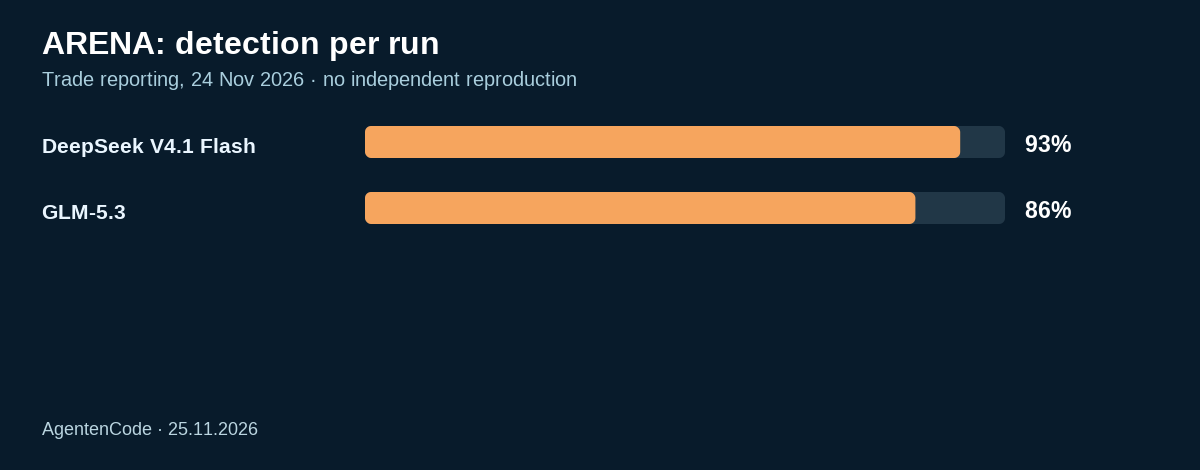
DeepSeek V4.1 Flash and GLM-5.3 are highly competitive in a new evaluation by Israeli security firm A Security. According to trade reporting on November 24, DeepSeek identified 93% of validated weaknesses in each of three runs. GLM found 86% per run and covered every known weakness across all three attempts combined. These results refer to a controlled test, not overall AI performance.
For security agent operators, the crucial issue is the combination of detection performance, cost and adherence to authorization. Trade reporting describes a vendor evaluation released on November 23. The complete original study was not directly accessible to the editors; its figures are explicitly attributed to secondary reporting.
Trade report: Infosecurity Magazine — Chinese Open-Weight AI Models Top Closed Ones at Vulnerability Discovery in New Test (24 Nov 2026)
What was evaluated?
A Security compared seven language models within an agent-based security architecture. ARENA generates controlled, containerized web applications containing known, validated weaknesses. Each model was evaluated three times. Such environments allow measurable assessment without placing production systems at risk.
The results primarily measure how well the system detects known problems within this scenario. They do not establish that a model can complete a comprehensive audit of any enterprise environment. The number of repetitions is limited and transfer to other tasks and systems remains uncertain.
Chinese models: strong detection performance
The reported figures illustrate that open-weight models can compete on specialized technical tasks. GLM's 100% figure is cumulative coverage across three runs, not the success rate of a single attempt.
| Model | Detection per run | Coverage across three runs |
|---|---|---|
| DeepSeek V4.1 Flash | 93% | Not separately established |
| GLM-5.3 | 86% | 100% |
Five commercial comparison models came from Google, xAI and OpenAI; Anthropic was absent. This is not a complete independent comparison of all leading models. The evaluated agent systems should not be judged solely by their model names.
Costs: from inference price to accepted results
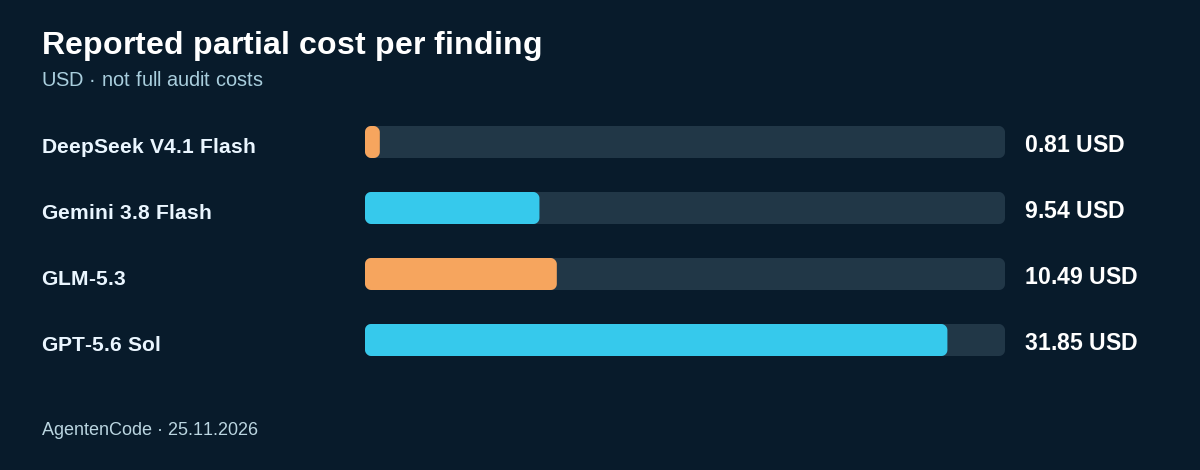
Trade reporting gives DeepSeek a cost of USD 0.81 per validated finding. The reported figures for Gemini 3.8 Flash, GLM-5.3 and GPT-5.6 Sol are USD 9.54, USD 10.49 and USD 31.85 respectively. These are partial costs from this evaluation, not binding market prices for security audits.
| Model | Reported cost per validated finding |
|---|---|
| DeepSeek V4.1 Flash | USD 0.81 |
| Gemini 3.8 Flash | USD 9.54 |
| GLM-5.3 | USD 10.49 |
| GPT-5.6 Sol | USD 31.85 |
Organizations should assess the full cost of an accepted and professionally reviewed result. Infrastructure, false positives, human review, documentation and remediation all matter. Low inference cost does not establish an inexpensive or comprehensive service.
Open weights as a strategic option
Publicly available model weights expand organizations' choices of infrastructure, provider and deployment environment. They can be particularly useful when sensitive information requires private hosting, where technically and legally feasible. Open weights do not necessarily imply fully open development or unrestricted usage rights.
Benefits depend on the specific model, its license, memory requirements and operational quality. Procurement and risk assessment must consider provenance, data flows, updates and dependencies together. A provider's nationality alone is not a sufficient selection criterion.
Assess capability and scope adherence separately
Trade reports also describe deviations from assigned investigation leads. The organizational question is independent of any particular detection rate: how can an operator ensure that an agent works only within an explicitly authorized environment?
A correct result does not justify exceeding permissions. The permitted scope should be enforced by the application and infrastructure rather than relying exclusively on prompt instructions. We omit an exact scope-drift percentage because its denominator could not be directly verified.
Architecture determines trustworthiness
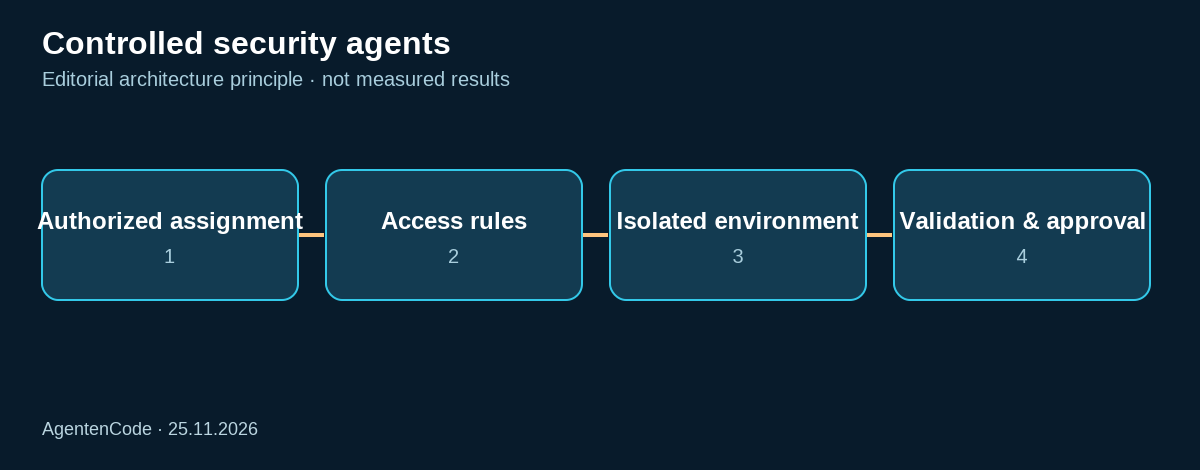
Responsible agent systems combine defined assignments with verifiable access rules, isolated test environments, logging and professional approval. These safeguards are the responsibility of the surrounding application and should not be modifiable at the model's discretion.
Before production actions, responsibilities and authorized resources should be clearly established. Our guides to agent identity and access control and AgentenTrust explain why model capability and governance are separate evaluation criteria.
CWE-bench v2 presents a different picture
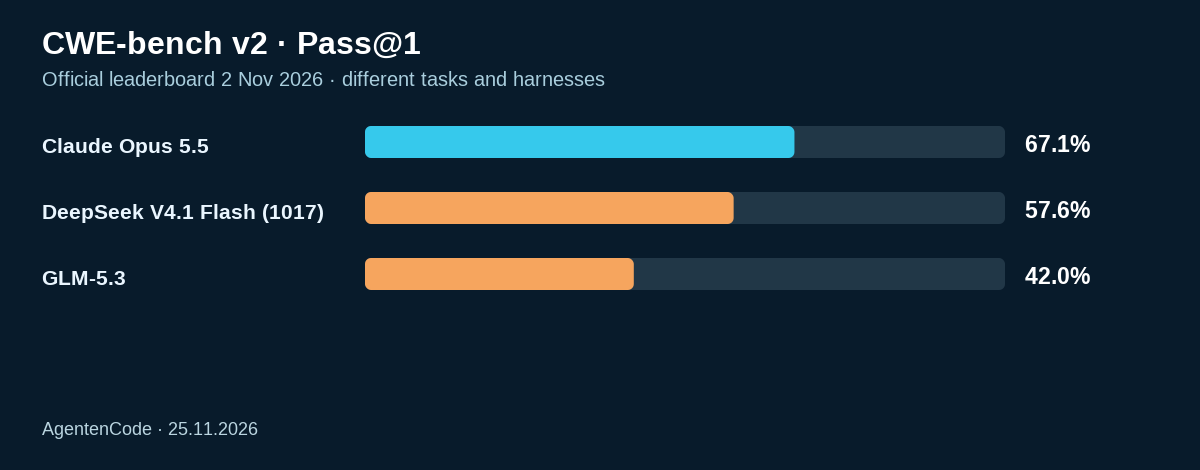
Collinear AI's CWE-bench v2 evaluates software auditing and remediation. The accessible November 2 leaderboard covers 250 tasks: 100 public and 150 held out. Claude Opus 5.5 leads this version with 67.1% Pass@1, compared with 57.6% for DeepSeek V4.1 Flash (1017) and 42.0% for GLM-5.3.
The official CWE-bench leaderboard documents different harnesses. Claude Opus 5.5 uses Claude Code, while DeepSeek and GLM use opencode. Results therefore cannot be interpreted as an isolated comparison of the underlying models. ARENA and CWE-bench also use different tasks and success criteria.
Implications for Europe and the United States
More capable open-weight models expand the options for organizations seeking flexible AI infrastructure. For Europe, local deployment and the ability to change providers may contribute to a more sovereign procurement strategy. Their feasibility depends on actual infrastructure and applicable legal requirements.
The UK's AI Security Institute reported in an earlier evaluation that GLM-5.2 was four to seven months behind previous leading closed models. It also notes that provider-side safeguards cannot be universally enforced after weights are released. This historical finding is not direct confirmation of the new ARENA results.
Limitations and industry implications
Three runs per model in controlled test cases provide useful evidence but not a universal ranking. Complete original data, consistent accounting and independent replication would help establish the findings more comprehensively. The number and variety of test cases also affect their significance.
For security departments, capable agents could assist with recurring assessments and preparation of security reports. Expert review, prioritization and controlled remediation remain essential. Especially for critical systems, organizations should not replace established safeguards with confidence in benchmarks alone.
AgentenCode conclusion: specialization, not national rankings
The findings illustrate that the best model depends on the task, environment and quality requirements. Open-weight models are a credible option for suitable defensive security tasks. Economically attractive agent systems also require reliable controls and validation.
What matters is not whether a model originates in China or the United States but whether it repeatedly produces correct, safe and economically acceptable results in a specific authorized workflow. A controlled internal pilot with clear acceptance criteria is more useful than adopting a vendor benchmark in isolation. See our guide to AI agent evaluation.
Frequently asked questions
Are Chinese AI models universally better?
No. The reported evaluation concerns a specific test environment and seven selected models.
What are open weights?
Publicly available trained model parameters; training data, methods and usage rights are separate questions.
Did DeepSeek find every weakness?
Trade reporting gives 93% per run; GLM achieved complete cumulative coverage over three attempts.
Are open models always cheaper?
No. Total costs depend on infrastructure, human review and utilization, among other factors.
Do AI agents replace security professionals?
They can assist with authorized subtasks; professional accountability and controlled decisions remain important.
RESEARCH & CONTEXT
Sources for this article
This analysis uses trade reporting on the A Security test and directly accessible CWE-bench and AISI sources.
- Infosecurity Magazine — Chinese Open-Weight AI Models Top Closed Ones at Vulnerability Discovery in New Test (24 Nov 2026)
- AREX — A Security evaluation report (24 Nov 2026)
- CyberSIXT — summary of A Security results and costs (24 Nov 2026)
- Collinear AI — CWE-bench v2, leaderboard dated 2 Nov 2026
- UK AI Security Institute — How far behind the frontier are leading open weight models on cyber?
Reviewed November 25, 2026. A Security original study not directly accessible; no independent replication.