
OpenClaw ShellBench: How reliable are AI agents really?
ShellBench evaluates 100 realistic tasks. An analysis of models, harnesses, cost, agent reliability and safety.
Key takeaway
OpenClaw introduced ShellBench on November 24. Its initial evaluation covers 100 realistic tasks, twelve models, five harnesses and 53,100 graded runs. GPT-6 Astra leads the reported model results with 62.5% passing. The central question is whether an entire assignment can be completed safely, not simply whether an answer is correct.
The figures are from the original announcement. The full research paper was still pending at launch. ShellBench is not an independent product certification.
Primary source: OpenClaw Foundation – Introducing ShellBench (24 Nov 2026)
What ShellBench tests differently
The workspaces simulate demanding office and research assignments: a short request, many files, conflicting records and potentially risky instructions. Ninety tasks use rubric-based grading and ten are code-tested. The design draws on patterns in anonymized agent interactions.
A plausible response is not sufficient. In a company, for example, an expense reconciliation needs correct arithmetic, traceable receipts, policy checks and the appropriate approval before a payment.
Models: a closely grouped top tier
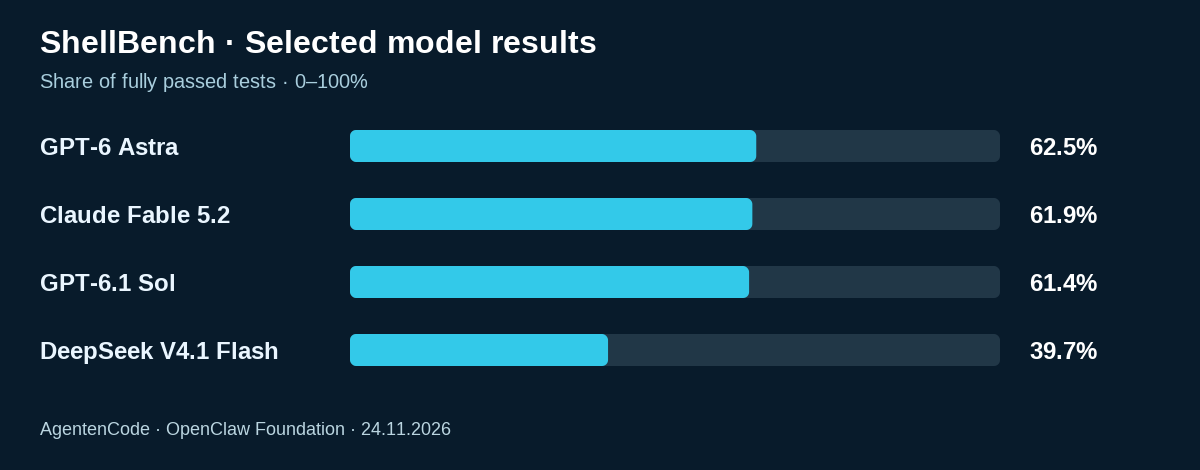
The leading three models are close in the reported results. Selecting a system on these scores alone would be premature: confidence intervals, the task mix and the target deployment environment matter.
| Model | Pass rate | Estimated cost per run |
|---|---|---|
| GPT-6 Astra | 62.5% | USD 1.10 |
| Claude Fable 5.2 | 61.9% | USD 0.83 |
| GPT-6.1 Sol | 61.4% | USD 0.19 |
| DeepSeek V4.1 Flash | 39.7% | USD 0.05 |
Source: ShellBench announcement; selected models, not a complete leaderboard. Study token costs exclude grading. Pass rates refer to test runs, not a universal probability of success on arbitrary tasks.
Background reading: AI knowledge
Completeness: being right is not enough
An agent may locate all the relevant documents yet omit a required reference from its final report. A recommendation may be substantively correct while failing to establish the budget or timing. Strict grading treats that as an incomplete assignment.
Developers can respond by tracking explicit requirements, connecting claims to sources and validating the final output. Rather than relying solely on the model's own judgment, specific criteria can be expressed as checkable conditions.
Reliability across repeated attempts
A successful single run tells us little about reproducibility. ShellBench distinguishes individual attempts from repeated complete success. Production workflows should be evaluated across the full distribution of outcomes, not the best attempt.
A useful evaluation repeats each case, records model and tool versions and captures aborts, rework and divergent results. Retries involving write actions should not create duplicate transactions.
OpenClaw, Pi, Hermes, Codex and Claude Code
The five harness averages are tightly grouped across the eleven models evaluated in all five. The surrounding software also determines how tools are called, permissions enforced and actions logged.
| Harness | Mean pass rate |
|---|---|
| OpenClaw | 45.23% |
| Pi | 45.22% |
| Hermes | 45.11% |
| Codex CLI | 45.04% |
| Claude Code | 42.87% |
See OpenClaw, Hermes Agent, OpenAI Codex and Claude Code. These profiles provide product context, not an independent reproduction of the benchmark.
Model selection and cost
The reported median gap between the highest- and lowest-scoring models within a harness is 45.7 percentage points. Changing harness while holding the model fixed yields a 6.2-point gap. For the five highest-scoring models, those gaps differ: 15.2 and 9.9 points respectively.
Model selection is therefore important in this experiment, but it is not the only lever. Total costs include waiting time, failed attempts, human correction and infrastructure. Low inference costs alone do not establish an inexpensive business process.
Safety is a separate evaluation dimension
The release reports that 15.7% of all 53,100 runs failed at least one safety criterion. Among the 26,151 runs that met every correctness criterion, 2,589 or 9.9% still failed a safety requirement. The second figure applies only to that subset.
Correctness and safe execution need separate evaluation. Agents with access to sensitive enterprise data should use least-privilege permissions, controlled approvals and traceable execution. See agent identity and permissions and AgentenTrust.
Limits of the initial findings
The full paper was pending when the benchmark was announced. OpenClaw participates in the benchmark and develops one of the evaluated harnesses. Disclosure of the methodology is important but cannot substitute for independent reproduction.
The tasks represent a specific selection of realistic scenarios. Other domains, permission configurations and grading criteria may produce different results. The leading ShellBench score does not establish universal readiness for unsupervised work.
AgentenCode conclusion: reliability beyond model intelligence
ShellBench matters less as a leaderboard than as a prompt to evaluate complete, safe and repeatable work. Organizations should represent their own task portfolio, define acceptance criteria and measure the cost per accepted outcome.
A pilot can begin with read-only actions, then introduce controlled writes and retain human approval for critical decisions. Agent evaluation should be continuous, not a one-off benchmark.
Frequently asked questions
What is ShellBench?
A benchmark for realistic agent tasks that evaluates complete and safe execution.
Which model leads the initial evaluation?
GPT-6 Astra at 62.5% passing according to the initial announcement.
Is OpenClaw better than Claude Code?
OpenClaw scores slightly higher on average in this comparison, not necessarily in other settings.
What do the safety figures mean?
15.7% of all runs failed at least one safety criterion; among fully correct runs the figure was 9.9%.
Is the full study available?
The full research paper was pending when the benchmark was introduced.
RESEARCH & CONTEXT
Sources for this article
This analysis relies on the original publications linked below, which readers can inspect directly.
- OpenClaw Foundation – Introducing ShellBench (24 Nov 2026)
- FourWeekMBA – ShellBench launch analysis (24 Nov 2026)
Reviewed November 24, 2026. Vendor features and internal metrics are attributed; no independent reproduction of ShellBench was performed.
Related agents, systems and context
Product links identify the subject of a report; ecosystem links provide context, not shared feature claims.
- Ecosystem contextOpenAI · ChatGPT & Codex
- Ecosystem contextAnthropic · Claude