
AgentenCode Intelligence Report · AC-IR-2026-11-02
State of MCP 2026: How AI agents document Model Context Protocol integration
MCP connects AI applications to external tools and context. But saying a product supports MCP reveals little about its role, transport or permissions. Our second original study examines these distinctions in the AgentenCode registry.
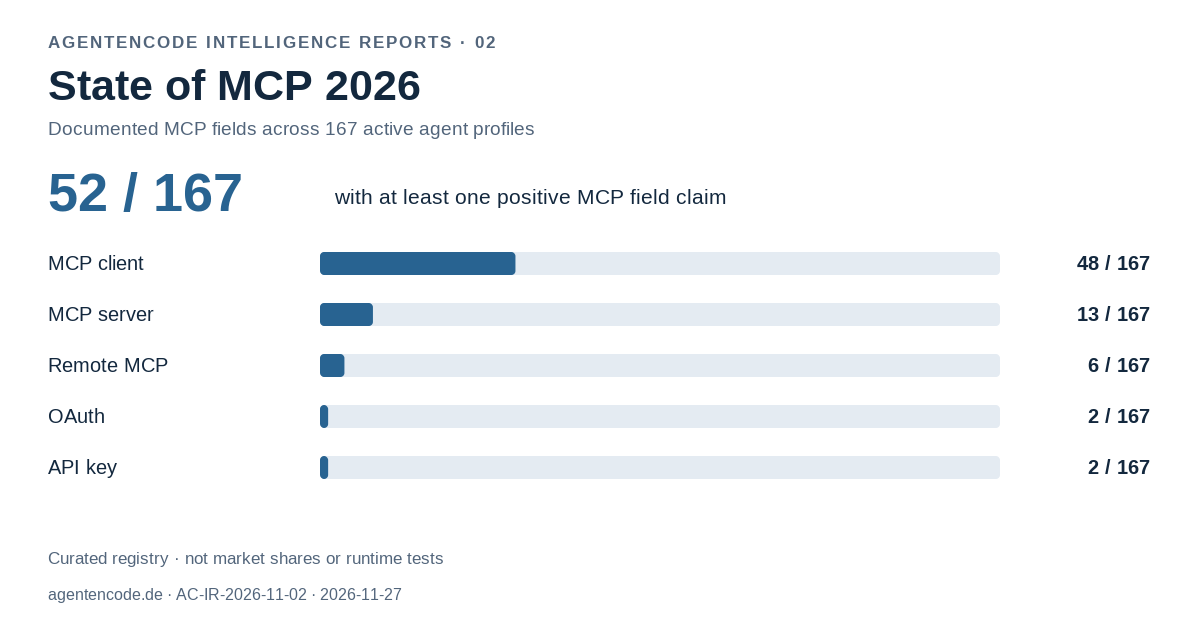
Key finding: Positive client evidence is much more common than server evidence. 9 profiles have both roles documented. 115 profiles have no positive MCP field claim in the snapshot. This does not mean these products lack MCP, nor that documented integrations are interoperable or secure.
1. The documented MCP landscape
An MCP client connects to a server that may expose tools, resources or prompts. Client and server are therefore not interchangeable claims. A product can serve both roles, and the role may depend on its specific interface.
Of the 52 MCP-evidenced profiles, 39 have client but no server claim, 4 server but no client claim, 9 both roles and 0 only other MCP fields. 4 profiles have at least one positive MCP authentication claim. A2A is counted separately: 14 profiles have at least one positive A2A claim. The protocols should not be treated as equivalent.
2. MCP evidence by use category
Denominators below are the sizes of the primary categories in the curated registry. Small categories are sensitive to individual profiles; the figures are neither market shares nor category rankings.
3. Coding agents and platforms compared
This selection illustrates different product forms, not the best products. Expand evidence to see the exact scope. Missing claims in the snapshot remain unknown.
OpenAI Codex
Claude Code
OpenCode
Pydantic Pax
Amazon Bedrock AgentCore
4. What to verify before deploying MCP
MCP compatibility is not a security certification. Verify the role, supported transports and versions, authentication and authorization, permitted tools and their side effects. In particular, document which identity is used and how permissions are scoped.
The official specification announcement of July 28, 2026 describes further authorization hardening. It provides context for technical review, not product evidence for our counts. Model Context Protocol · 2026-07-28
5. Data and methods
Cutoff November 27, 2026. agents.json is joined to evidence.json on profile_id / agent_id. Profiles with lifecycle_status are excluded. Only field keys prefixed protocols.mcp. or protocols.a2a. are used. Positive evidence is strictly boolean true. Each profile is counted once per field. Any MCP evidence is the union of profiles across MCP keys. Missing fields are unknown. The CSV lists all active profiles per observed field, including unknowns; JSON contains existing claims and their sources.
Non-random curated sample; heterogeneous product and plan scope, review dates and documentation depth. No independent interoperability, security or runtime testing. No claim about worldwide MCP adoption. The snapshot is frozen; upstream data changes continuously.
6. Citation, data and press information
AgentenCode (2026). State of MCP 2026: How AI agents document Model Context Protocol integration. AgentenCode Intelligence Report AC-IR-2026-11-02, v1.0, 2026-11-27. https://agentencode.de/en/research/state-of-mcp-2026-11/.
SHA-256 (JSON): c6fdbb713aacd4d75f1da78c689d4e7e8b4095a32a4d6e635c5ffa78a3a2576f
When citing, include sample, cutoff and the distinction between documented evidence and actual capability. Primary sources remain with their respective rights holders.