
AgentenCode Intelligence Report · AC-IR-2026-11-01
Trust evidence in AI agents: What 167 profiles reveal about governance documentation
Many AI agents are described with governance and security features. But how often are specific controls backed by public evidence? Our first registry study reveals the differences without converting documentation gaps into product judgments.
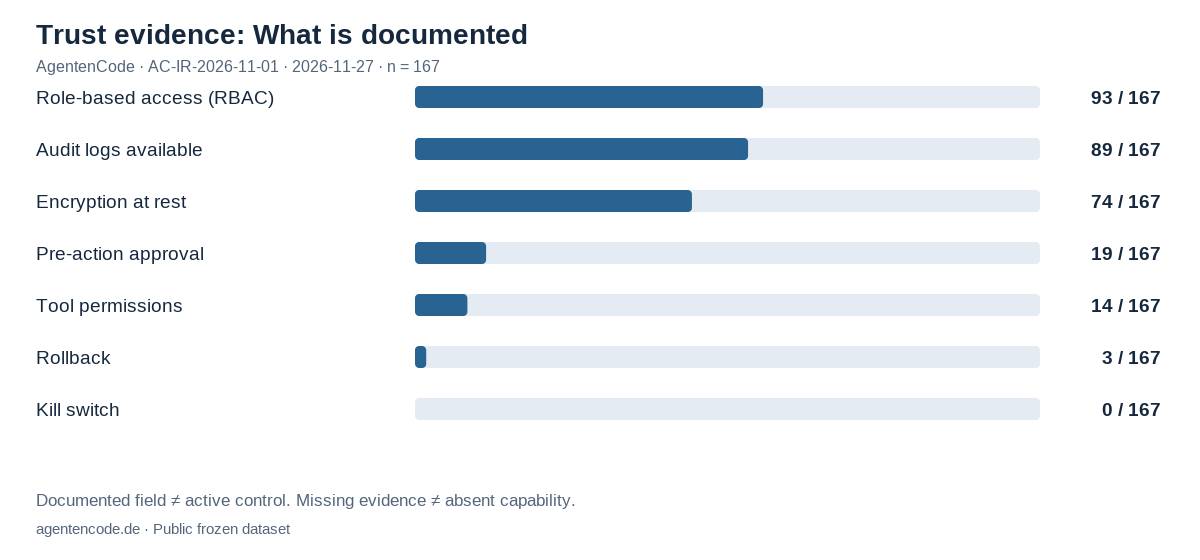
Key finding: Role-based access and audit logs are documented considerably more often in the registry than pre-action approvals or rollback. This describes public evidence, not implementation or market prevalence.
1. What the registry covers
The study population comprises 167 active products and platforms. Two archived profiles are excluded. Automation, enterprise and coding are the largest primary categories, accounting for 111 of 167 profiles together. This distribution describes our editorial selection, not the worldwide market.
Provider counts use the exact labels in the registry; subsidiaries or brands have not been consolidated into corporate groups.
2. The trust-control documentation gap
Of 6,012 possible profile-field pairs, 852 are documented; 5,160 have no field signal in the governance dataset. 150 profiles have at least one signal and 17 have none. Documentation is distributed across many profiles but varies considerably in depth.
The median is five documented fields per profile (maximum: 13 of 36). 27 of the 36 field types have at least one signal; nine have no signal anywhere in the active sample. This does not mean no product offers these capabilities.
| Field | Yes | No | Value | Documented | Unknown |
|---|---|---|---|---|---|
| Role-based access (RBAC) | 93 | 0 | 0 | 93 | 74 |
| Audit logs available | 89 | 0 | 0 | 89 | 78 |
| Encryption at rest | 30 | 0 | 44 | 74 | 93 |
| Pre-action approval | 17 | 2 | 0 | 19 | 148 |
| Tool permissions | 14 | 0 | 0 | 14 | 153 |
| Rollback | 3 | 0 | 0 | 3 | 164 |
| Kill switch | 0 | 0 | 0 | 0 | 167 |
Across all 36 fields: 729 documented yes states, 7 no states and 116 concrete values. A field without a signal is counted as unknown; a documented no is not an evidence gap.
Audit logs (traceability) and pre-action approval (prevention) are not interchangeable. A source may also apply only to a particular product variant, plan or configuration.
3. Four coding agents compared on source-backed fields
This deliberately selected case group includes two commercial and two open-source coding agents. It is neither representative nor a performance ranking. All four have a positive MCP client claim in the evidence dataset. Trust fields below come from governance, not independent product testing.
OpenAI Codex
Claude Code
OpenCode
Scope and source
OpenCode v2 configurable permissions for agent tools/actions (allow, deny, ask); concrete runtime behavior depends on policy, not independently tested
2026-10-31 · Source 1
Pydantic Pax
Scope and source
pax_configurable_permissions_not_default_approval_or_independent_enforcement
2026-11-27 · Source 1
Different evidence densities are not directly comparable as quality. Enterprise sources for Codex and Claude Code partly concern plan-specific controls. OpenCode and Pax have documented configurable tool permissions; that does not imply default approval or sandboxing. Local agent execution does not necessarily mean local inference.
4. Practical implications for organizations
A broad security promise is not enough for production deployment. What matters is which action is actually permitted, under which identities, plan and deployment. A documented permission option replaces neither an isolated test environment nor an acceptance test.
- Define mandatory requirements before selecting tools: write access, approvals, identities, data flows and auditing.
- Check product, plan and deployment scope for each relevant source.
- Track unknowns as open verification tasks; do not treat them as no or yes.
- Run acceptance tests with representative tasks, allowed actions and negative tests in an isolated environment.
5. Methods, reproducibility and limits
Cutoff: November 27, 2026. The analysis joins public agents, evidence and governance datasets on profile_id and agent_id. Archived profiles (lifecycle_status present) are excluded. The frozen JSON extract contains all 167 profile IDs, primary categories, provider labels, evidence claim counts, 36 control keys and the corresponding documented governance signals, including scope, review date and source URL. MCP client claims for the coding comparison are also included.
Trust coverage is the number of distinct documented (profile ID, control key) pairs divided by 167 × 36. Multiple sources for a field do not increase the numerator. Profiles without governance records contribute zero documented fields. Evidence claims and trust signals are different measures and are not added together.
Limits: curated non-random sample, unequal documentation and review density, varying scope, no independent runtime, security or compliance testing. Results do not establish global market shares, actual availability of all features or overall product safety. The CSV contains one row per profile and control; unknown means only that the frozen governance dataset has no signal for that pair.
Public upstream datasets (continuously updated)
6. Citation, data and chart
AgentenCode (2026). Trust evidence in AI agents: What 167 profiles reveal about governance documentation. AgentenCode Intelligence Report AC-IR-2026-11-01, v1.0, 2026-11-27. https://agentencode.de/en/research/ai-agent-trust-evidence-2026-11/.
For analysis and citation, reference this fixed edition and its data cutoff. The extract and chart are tied to this snapshot; later changes to the live registry do not change the results reported here.
SHA-256 (JSON): c23ad69fb23fcc3d009c346041f0e44f940affed628f93624516eeb3123c5b1f