
From conversation to transaction
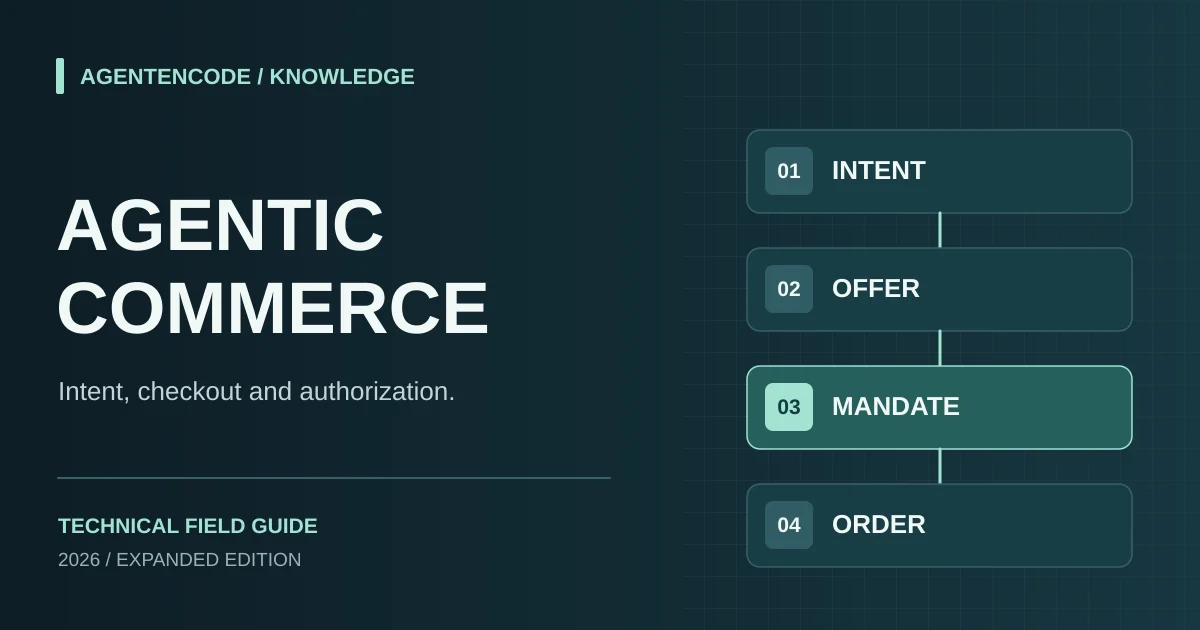
A product recommendation is not a purchase. The agent needs concrete offer data for variants, availability, shipping, taxes, returns and total price. It can then prepare checkout. A valid authorization is required for a binding action. Record the steps separately so that a useful recommendation cannot quietly turn into an unwanted order.
Who participates in an agentic order?
A typical architecture includes at least four business roles: buyer, agent platform, merchant and payment service. The platform translates user intent into searches and a basket. The merchant supplies binding product, price and delivery data and remains responsible for the order. The payment provider processes authorized payments and exposes payment status. Multiple organizations may implement one role, but responsibilities must remain distinguishable.
The agent must distinguish product information from a binding offer. A search result may contain a stale price. Checkout needs a current offer identifier with variants, quantities, currency, price components and expiry. The merchant does not need to transfer all recommendation logic to the agent. Its existing offer and order logic can remain behind a standardized interface.

Conceptual role model, not a normative protocol sequence.
Three protocols with distinct roles
ACP describes programmatic commerce and checkout between agents and businesses. UCP targets broader interoperable commerce from discovery through and beyond checkout. AP2 focuses on authorizing and evidencing agent-assisted payments through defined mandates. Their scopes overlap but are not identical. Implementations need to check the actual versions, merchant support and available payment paths.
ACP, UCP and AP2: their boundaries in detail
ACP describes itself as an open standard for programmatic commerce. Merchants retain customer relationships and the merchant-of-record role. UCP defines several commerce capabilities and interfaces, including a checkout contract. Its published checkout specification addresses uncertain completion and subsequent status retrieval. AP2 documents an agent-payment authorization framework including checkout and payment mandates.
These should not be presented as three competing payment methods. Their architectural scopes differ and overlap. An integration may prepare checkout through a commerce interface and use separate payment evidence. Supported combinations depend on versions, merchant, platform and payment service. Neither a specification nor a demo checkout establishes availability for all users, regions, payment methods or goods.
Documentation: UCP – Checkout capability specification · AP2 – Agent Payments Protocol · ACP – Agentic Commerce Protocol
Mandates rather than blanket permission
Purchase intent should constrain product, merchant, quantity, total price, currency and expiry. If a basket changes, the application must check whether approval still applies. An agent must not infer missing consent from a plausible message. Recurring purchases need a revocation mechanism and limits across multiple transactions.
Worked example: where binding prices matter
A fictional task permits two cartridges up to €150 total with delivery by Friday. Offer A costs 2 × €59 plus €8 delivery, including tax already in the price, totaling €126. Offer B costs 2 × €64 with free delivery, totaling €128. A is initially cheaper. At checkout, A's shipping increases to €15 and its total becomes €133. Both remain under budget, but B is now cheaper.
If the customer specifically approved offer A at €126, the agent cannot infer general authority to spend €150. If a valid dynamic mandate permits the cheapest matching offer up to €150, policy may decide differently. This example shows why the price limit and authorization scope are separate fields. Unclear authorization requires renewed confirmation.

Fictional offers including shipping and taxes; a spending cap is not specific consent.
Example: office supplies under €150
A user requests two specific toner cartridges with delivery by Friday. The agent retrieves offers and checks compatibility, total price and delivery. An approved order receives a unique identifier. A change above the price cap triggers a stop and renewed approval. Following a network error after checkout, the agent queries order status before considering a retry.
Mandates, baskets and machine-checkable consent
An implementation-neutral approval object could contain task_id, merchant_id, offer_id, items, max_total_minor_units, currency, expires_at, approved_by and approval_scope. Represent prices as integer minor currency units where appropriate to minimize rounding errors. This is an original architecture example, not a claimed ACP, UCP or AP2 schema. The selected protocol version defines binding fields and verification rules.
Before placing an order the executor validates approval against the actual basket. A changed merchant, different variant or expired approval triggers another decision. Audit should connect the approved version, actual offer and merchant acknowledgment. Authorization must not exist solely as a natural-language model statement that may be interpreted differently during recovery.
Merchant responsibilities and trust
Merchants need reliable product information and explicit responsibility for the offer, payment processing, fulfillment and returns. Hidden fees or ambiguous variants cause incorrect purchases. Structured current data and clear order states are therefore more useful than an agent-ready badge alone. Protocol compatibility proves neither broad availability nor legal compliance.
Security and outcome measurement
Product pages are untrusted data and may contain manipulative instructions. Checkout and payment tools should enforce independent policy decisions. Track incorrect orders, duplicate transactions, cancellations, price deviations, refunds and correctly recorded approvals. Conversion alone is insufficient if increased sales come from unintended purchases.
What happens after a payment timeout
Suppose an agent submits an authorized checkout and receives no response after fifteen seconds. That does not establish payment failure: the merchant may already have accepted the order. The application marks the result unconfirmed, retains checkout ID and stable order reference and queries status. UCP describes bounded status retrieval until expiry when checkout completion does not return a response.
Only after the destination state is established can the next action be chosen. A second checkout with a new identifier risks duplicate orders. Cancellation or refund is a separate operation requiring authorization and confirmation. During uncertainty the customer should see a clear unresolved status. An agent that guesses success or failure introduces financial and trust risks.
Documentation: UCP – Checkout capability specification

For uncertain completion, query status using the original reference first.
Five pieces of transaction evidence
A reliable purchase flow should distinguish original intent, the concrete offer, authorization, merchant acknowledgment and payment or refund status. Do not store all payment data in agent logs. Use a transaction reference that can be reconciled with the merchant and payment provider. A changed seller, delivery option or item may require renewed consent.
The agent should be able to give the customer a summary of the actual purchase: item, quantity, merchant, total, delivery, order reference and return information. If merchant acknowledgment is absent, do not report the order as complete merely because the model considers checkout successful.
What merchants can prepare
Begin with a consistent product feed and clearly defined endpoints for offers, baskets, order status and cancellation. Identify variants unambiguously. Calculate tax and shipping server-side instead of asking the agent to estimate amounts. Basket changes should generate a refreshed, time-limited offer. Protocol integration can build on this foundation but cannot replace it.
Test important failure paths: unavailable items, unsupported delivery addresses, price changes, declined payments and duplicate requests. A failed purchase should not leave lost data or ambiguous charges. Responsibilities for consumer information and payment operations must be reviewed in the specific legal and contractual context.
Merchant checklist: data, integration and support
Merchants should make variant identifiers, pricing, tax and delivery calculations, availability and return terms machine-readable. Checkout creation and updates need clear states. Error codes should distinguish business rejection from temporary service failure. After ordering, status queries, cancellation and refund information matter. Product descriptions and order states should not need to be inferred solely from unstructured website text.
Determine which information the platform actually needs and what stays with merchant or payment service. Agent logs should not contain full payment details. Authorization, retention, fraud prevention, consumer information and dispute handling remain separate responsibilities. Legal obligations depend on the specific contract and jurisdiction; technical protocol integration is not proof of legal compliance.
A cautious rollout plan
In phase one the agent only searches and compares. In phase two it prepares a basket that the customer completes. In phase three a tightly scoped authorized request can enter checkout. Recurring autonomous purchases should follow only after reliable status queries, revocation tests and spending limits. Each phase needs a fallback.
A team might simulate fifty fictional orders in a test environment. The important outcome is not revenue but traceable price binding, approval and refund handling across the defined cases. Real purchases then need a separate release decision and a clear support owner.
Meaningful agentic commerce metrics
Compare more than revenue and conversion: accepted orders per hundred checkout attempts, price deviations, unconfirmed states, duplicate transactions, support contacts and correction time. One useful safety measure is the share of binding actions supported by a valid traceable approval record. A test environment should deliberately produce price changes, expired mandates, delivery problems and network failures.
We would first test one low-risk product class with transparent total price and straightforward cancellation. Start with read-only discovery, then basket preparation and finally authorized checkout. A successful pilot establishes only suitability of the tested path. For new regions, merchants or payment methods, reassess pricing, authorization, support and failure scenarios.
AgentenCode assessment
We see the strongest near-term value in better purchase preparation and transparent controlled checkout. Autonomous purchases are plausible for tightly scoped recurring tasks, not as a universal substitute for consent. Merchants should first implement one low-risk purchase path with status queries, revocation and clear price binding before adding more agent channels.
Decision matrix
| Layer | ACP | UCP | AP2 |
|---|---|---|---|
| Discovery / offer | Commerce flow; verify integration | Commerce capabilities; verify version | Not primary purpose |
| Checkout | Programmatic checkout | Checkout capability and status | Checkout mandate |
| Payment | Verify payment integration | Verify payment handlers / integration | Payment mandate and authorization |
| Evidence | Merchant acknowledgment | Resource and status contract | Verifiable authorization |
| Limit | No universal merchant coverage | No universal implementation coverage | No automatic payment approval |
Additional practical decision guide
| Stage | Risk | Control |
|---|---|---|
| Discover | Wrong item | Variant check |
| Checkout | Price change | Bind total |
| Pay | Missing consent | Mandate |
| Order | Duplicate | Status and key |
Frequently asked questions
Is agentic commerce a chatbot shop?
Not necessarily. The key is executing commerce actions through verified interfaces.
How do UCP and AP2 differ?
UCP addresses commerce flows; AP2 focuses on payment authorization and evidence.
Is ACP universally available?
No. Support depends on the specific integration.
Can an agent pay without asking?
Only within valid authorization and applicable rules.
What if the price changes?
The policy must check the new total and require approval if needed.
How do we prevent duplicate orders?
Unique order IDs, status queries and idempotent ordering operations.
Did AgentenCode lab-test the named products?
No. Our assessment combines public vendor documentation with original conceptual examples and calculations. Suitability must be tested in the specific environment.
Primary sources and methodology
Claims are grounded in the linked primary sources and original editorial analysis. Examples are illustrative; AgentenCode has not independently tested products, certified security or measured keyword volume. Sources reviewed November 25, 2026.