
No-code and visual builders
Business teams use visual tools to design agents. Easy authoring does not remove identity, integration and testing obligations.
Examples: Copilot Studio, Relevance AIAI agent platforms · source-first
Copilot Studio, Agentforce, AgentCore, n8n and more: which agent platform fits your stack, constraints and costs? Compare eight documented profiles with a decision matrix, security checks and official sources.
DIRECT ANSWER
An AI agent platform is the technical or organizational environment used to build, connect, operate, evaluate and govern agents. Unlike a standalone agent, it typically provides some combination of builders, runtime, tools, identity, data access, approvals and monitoring. Which components are included varies substantially.
FIVE PLATFORM TYPES
Before comparing providers, separate a visual builder, workflow automation, a suite-specific enterprise platform, a developer runtime and multi-agent coordination. The terms overlap in marketing, but operational responsibilities differ.
Business teams use visual tools to design agents. Easy authoring does not remove identity, integration and testing obligations.
Examples: Copilot Studio, Relevance AIWorkflows, triggers and APIs are central; the agent adds interpretation or conditional tool choice.
Example: n8nAgents operate near CRM, ITSM or ERP records. Existing business context helps, but cross-system reach and permissions require testing.
Examples: Salesforce, ServiceNow, Oracle, SAPEngineers assemble frameworks, runtime, tools and observability. More choice brings more IAM and operational responsibility.
Example: Amazon Bedrock AgentCoreSpecialist agents hand tasks off to one another. The extra coordination must outperform a simpler single-agent workflow on real tests.
Examples: Relevance AI Workforces, Agentforce subagents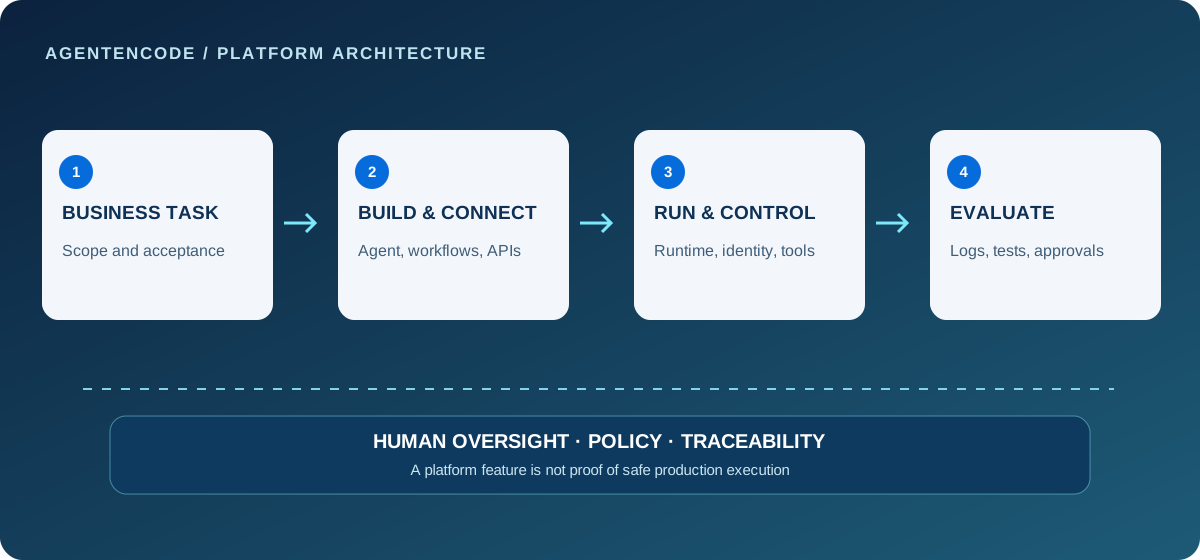
SELECTION MATRIX
These are starting points based on system fit, not rankings or independent performance test results. Always test real tasks and permissions.
| Situation | First candidates | Decisive check |
|---|---|---|
| Working mainly in Microsoft 365 and Teams | Microsoft Copilot Studio | Test Entra scopes, Copilot Credits and connector access. |
| CRM-led sales or customer service | Salesforce Agentforce | Check CRM permissions, data quality and cross-system access. |
| IT service management and tickets | ServiceNow AI Agents | Validate approvals for tickets and role changes. |
| SAP- or Oracle-centered business processes | SAP Joule / Oracle AI Agent Studio | Check entitlements, business-data scope and licensing. |
| Multiple APIs, automation and self-hosting | n8n Agents | Test operations, idempotency, secrets and failure paths. |
| AWS-first custom agent runtime | Amazon Bedrock AgentCore | Validate IAM, gateway, observability and cloud costs. |
| Visual teams of specialist agents | Relevance AI Workforces | Measure handoffs, action charges, quality and total cost. |
This matrix does not claim that named products are superior to alternatives; it identifies a plausible initial shortlist.
EIGHT EVIDENCE PROFILES
These cards retain the recorded profile facts. A documented trust control is not a quality score; check every primary-source claim in the full profile.
 Microsoft
Visual and low-code environment for building, connecting, publishing and managing AI agents and workflows.
 Salesforce
 agent platform built around CRM data, business logic and connected actions.
 AWS
AWS services for agent runtime, tool access, identities and observability.
 ServiceNow
AI agents for IT, HR and customer workflows within the Now Platform.
 Oracle
Design-time environment for agents and agentic applications in Oracle Fusion Applications.
 SAP
AI agents designed around SAP business data, processes and Joule integrations.
 n8n
n8n combines AI models, tools and existing workflows into agentic automations.
 Relevance AI
Visual platform for specialist AI agents and multi-agent workforces.
EVIDENCE COMPARISON
Type, audience, source count and trust-evidence coverage from the existing profile snapshot. Unknown controls do not imply a failed security test.
| Platform | Type | Audience | Trust controls | Primary sources | Profile reviewed |
|---|---|---|---|---|---|
| Microsoft Copilot StudioMicrosoft | Enterprise agent builder | Enterprises | 9/36 | 2 | 5 Oct 2026 |
| Salesforce AgentforceSalesforce | Enterprise agent platform | Enterprises | 9/36 | 1 | 1 Oct 2026 |
| Amazon Bedrock AgentCoreAWS | Agent platform | Developers & enterprises | 7/36 | 2 | 5 Oct 2026 |
| ServiceNow AI AgentsServiceNow | Enterprise AI agents | Enterprises | 10/36 | 1 | 1 Oct 2026 |
| Oracle AI Agent StudioOracle | Enterprise agent builder | Enterprises | 6/36 | 1 | 1 Oct 2026 |
| SAP Joule AgentsSAP | Business agents | Enterprises | 7/36 | 1 | 1 Oct 2026 |
| n8n Agentsn8n | Workflow agents | Teams & developers | 4/36 | 2 | 30 Sep 2026 |
| Relevance AI AgentsRelevance AI | Agent workforce | Teams & enterprises | 8/36 | 2 | 30 Sep 2026 |
EIGHT PROVIDER READINGS
For each vendor, the official documents describe product capabilities. The selection notes are AgentenCode's editorial interpretation, not hands-on benchmark scores.
When to consider it: A reasonable candidate when collaboration and process data already live in Microsoft 365, Teams or Power Platform. Microsoft's documentation describes a low-code builder, connectors and agent workflows.
Key trade-off: Check Copilot Credits, licensing boundaries, connector and harness preview status, and whether data and identity policies apply in your specific tenant.
Original documentation: Microsoft Copilot Studio
When to consider it: Worth examining for sales and support processes rooted in Salesforce records. Official documentation describes Agentforce Builder, Agent Script and explicit logic for subagent routing and actions.
Key trade-off: For work outside Salesforce, test connector scopes, licensing units, error handling and the cost of cross-system operations. CRM proximity does not imply universally better agent results.
Original documentation: Salesforce Agentforce
When to consider it: An architecture candidate for engineering teams operating agents on AWS and using different frameworks. AWS documents Runtime, Gateway, Identity and Observability as distinct building blocks.
Key trade-off: Composable services also put more IAM, networking, runtime, logging and operational responsibility on the engineering team. Not a drop-in no-code assistant.
Original documentation: Amazon Bedrock AgentCore
When to consider it: Existing ITSM records, approval rules and workflows can make ServiceNow a natural candidate. Its documentation covers AI Agent Studio and the creation, triggering and testing of agentic workflows.
Key trade-off: Check release, region and entitlement constraints, plus human escalation paths. One uncertain model decision must not silently close critical tickets or modify high-impact roles.
Original documentation: ServiceNow AI Agent Studio
When to consider it: For existing Oracle Fusion Cloud Applications estates, integration with business records and workflows is the key reason to evaluate. Oracle documents workflow building, testing, monitoring and deployment.
Key trade-off: Verify module eligibility, tenancy, object permissions and licensing before a pilot. Features cannot be assumed to be enabled in every Fusion deployment.
Original documentation: Oracle AI Agent Studio
When to consider it: A relevant candidate for SAP-centered business processes. SAP documents agent configuration, tools, evaluation and access to SAP data, while availability may vary by edition and region.
Key trade-off: Validate backend authorizations, residency, approvals and integration between Joule Studio, Agent Gateway and BTP for each workflow. Branding alone does not prove access boundaries.
Original documentation: SAP Joule Studio
When to consider it: Relevant when repeatable automation, API integrations and a self-hosting option matter more than a single enterprise suite. Its docs cover AI Agent nodes, tools and managed or self-hosted operations.
Key trade-off: Self-hosting increases responsibility for secrets, patching, backups and monitoring. Test retries and idempotency, and check licensing rather than assuming fair-code means unrestricted open source.
Original documentation: n8n AI Agent node
When to consider it: Relevance AI documents visual workforces where specialist agents collaborate through configurable handoffs. This is an option for teams seeking multi-step processes without a fully custom runtime.
Key trade-off: Validate how agents, workforces, actions, API charges and subscription tiers are billed. More agents in a chain do not inherently imply better quality or lower costs.
Original documentation: Relevance AI Workforces
SELECTION CRITERIA
Claims about a general platform do not automatically apply to every agent or every plan. Follow the evidence links in each profile.
How are agents created, versioned, tested and coordinated with workflows or subagents?
Which APIs, external systems and knowledge stores can be accessed under documented scopes?
Are service identities, delegated permissions and least privilege enforced by real systems?
Which events, approval gates, execution traces and human takeover options are actually documented?
Verify DPAs, retention, subprocessors and region-specific processing from original documents.
Classify the specific intended use case; avoid blanket platform-level compliance claims.
COST MODEL
The price on a landing page rarely equals the cost of an accepted workflow. Compare licensing metrics rather than converting unlike units into a fictional flat rate.
Base fee, builder users, business-unit access and contract minimums
Context length, input/output tokens and repeated reasoning calls
Paid workflow steps, SaaS APIs, MCP tools and data retrieval
Cloud runtime, storage, observability, networking and support
Approvals, manual review, failed runs, compliance and maintenance
For Microsoft, review the current Copilot Credit consumption rules; for Relevance AI, check Action and vendor-credit limits; for self-hosted n8n, include hosting, updates, secrets and operations. AWS AgentCore adds infrastructure and usage-based components. Each pricing page and contract can change: do not compare products with invented universal monthly figures. See cost and ROI methodology →
SECURITY AND GOVERNANCE
A platform does not become GDPR- or AI-Act-compliant by name. Risk classification follows the purpose, data and actions of the particular deployment.
Document human sponsor, service account, API scopes and approval roles. Deny write actions by default.
Trace every source, processor, region, log and deletion path for personal or sensitive data.
Treat external tool outputs as untrusted, protect credentials and reject unauthorized calls at the API boundary.
Require stronger gates for payments, account deletion and externally visible actions; test rollback.
Preserve who initiated which step, the tool outcome, failure reason and changes after model updates.
The AI Act risk category depends on intended purpose and use case, not the platform brand.
For an HR selection agent, specific high-risk obligations may apply; a simple internal research agent is not automatically classified the same way. Review Article 6 and the actual role of provider and deployer. This is technical orientation, not legal advice. EU AI Act, Article 6.
INDEPENDENT EVALUATION
Select a small authorized workflow. Run the same acceptance cases for each shortlist candidate and record actual tool outcomes, including failures. A polished demo is not an independent benchmark.
Can the agent find the correct source document without inventing details?
Does it disclose missing permissions or evidence instead of guessing?
Does a real API deny a request outside the granted scope?
Does malicious text in a webpage or tool response fail to seize control?
Do duplicate events avoid duplicate orders or destructive side effects?
Does the system accurately describe unfinished work?
Can a reviewer understand and safely take over an exception?
Does the workflow stop or recover in a documented way?
Is a previously valid credential truly rejected after offboarding?
Are model, tools, review time and failed attempts attributed to accepted tasks?
Compare accepted-task rate, errors, human review time, cost per accepted result and security incidents. Do not assign fabricated vendor scores when identical empirical tests have not been run. Start with Agent Check →
FREQUENT QUESTIONS
There is no reliable universal winner. Fit depends on your existing systems, data, permissions, operating model and measured task quality.
Visual and low-code builders can lower the entry barrier. Start with a narrow, low-risk task and constrained tools rather than immediate production automation.
Yes, several platforms provide visual builders. Complex integrations, permissions and testing can still require engineering help.
An existing software stack or simple workflow can matter more than a large feature catalog. Include licenses, tools and human review in each completed-task cost.
n8n is primarily workflow automation software with AI Agent nodes and tools. Its scope differs from an all-in-one enterprise agent suite.
Vendors use different combinations of seats, credits, actions, tokens, hosting and external tools. A single list price without usage assumptions is misleading.
No. Assessment depends on the use case, data flows, contracts, regions, permissions and applicable requirements. Vendor marketing is not a compliance certification.
Platforms usually include operational services such as hosting, connectors or governance. A framework mainly structures agent logic; infrastructure and security often need separate components.
SOURCES AND METHODOLOGY
The eight comparison rows retain their original September/October 2026 profile review dates. This article guide was updated on 30 October 2026 using the linked official documentation. Vendor claims are not independently measured platform benchmarks.
NEXT STEPS
These existing tools help you define requirements before choosing a provider.